Peace for the World World ! Your War Our Lives

The Dalai Lama
A Brief Colonial History Of Ceylon(SriLanka)
Sri Lanka: One Island Two Nations
A Brief Colonial History Of Ceylon(SriLanka)
Sri Lanka: One Island Two Nations
(Full Story)
Back to 500BC.

Wednesday, June 8, 2016
To Israel, being “from Gaza” is a crime
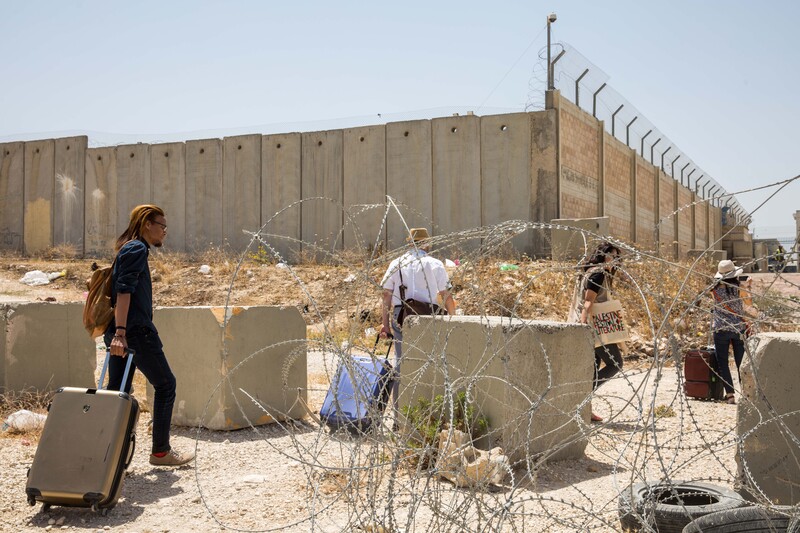
PalFest participants travel through the Qalandiya checkpoint between Jerusalem and Ramallah. (Rob Stothard)
Ahmed Masoud-6 June 2016

I was invited to take part in this year’s PalFest literary festival as a Palestinian writer talking about my novelVanished and
my theater work. I traveled to Palestine as a British citizen with my
red passport. Everyone in my group was waved through at the
Israeli-controlled Allenby crossing between Jordan and the occupied West Bank. Except me.
Far worse than not being allowed to enter Palestine was the fact that Israel denied me entry because I am from Gaza.
Not only did Israeli soldiers deny me entry but they were shocked to see
someone like me trying to visit the rest of Palestine. Imagine that you
are from Manchester or somewhere else up north and tried to fly into London and were told that you were “a northerner, you can’t come here.”
They were surprised that I even thought about it. “You are from Gaza,” they kept saying.
When I was sent back and the Jordanian authorities realized that I had
been denied entry, the guards at the border were furious, and said, “You
are from Gaza, what were you thinking?”
As if trying to go back home is a crime, as if the idea itself is a
crime, as if I had to accept my oppressed status and not even dare to
think that I could be a normal human being traveling to my own country.
Panic
I could almost feel the Israelis’ panic, their fear and confusion the
moment they realized that I was from Gaza. I could almost see sweat
drops on their foreheads as they were turning me away.
A man came and shouted at me to hand him my Palestinian passport and ID. Another man told me that they needed those documents.
A soldier with a big gun took me to a room and showed me my details on a screen followed by details of my family in Gaza.
“Go back to Gaza!” he shouted.
But how? Why don’t you bloody let me go there to see my family whom I
haven’t seen for more than three years now, who haven’t met my daughter
yet? Let me through to see my ill mother, let me through to see my aging
father, let me through to hug my niece, to be at my brother’s wedding.
“You are from Gaza,” he continued.
“I am not,” I said.
I really am not from Gaza. My family live in Jabaliya refugee camp, they have blue United Nations refugee cards, they are considered homeless and it is all thanks to you and your fascist state.
You will probably finish your shift today and go back to your house. For all I know, you may live in my family’s village of Deir Suneid. You may even live in the same house my grandfather built and was expelled from.
“You have a Gaza citizenship,” he continued shouting at me.
What does that even mean? I really didn’t know; it was the first time I
had never heard this term, “Gaza citizenship,” being used.
It pained me to see everyone go into my country except me.
I was happy the rest of the group got through, of course.
But all I could think of was that it was a dream for me to see the cities I heard about while growing up in Gaza. To go to Ramallah, Jenin, Nablus, Jerusalem and all the others.
Second class citizen
I heard so much about them, was told stories at bedtime, many of my
people in Gaza died for them. Yet I have never ever been able to see
them simply because I am from Gaza.
I said to the Israeli soldier that I was traveling as a British person, not as a Palestinian. But he looked at me and said “khabebi, you are from Gaza. I can’t do anything for you.”
I got my phone out and wanted to call the British consulate in Jerusalem. But I stopped halfway.
Something told me that it was going to be a wasted call. Something told
me that if he could say it to me like that, surely a British consulate
wouldn’t really do anything, surely I wasn’t the first person this had
happened to, surely I was just a second class citizen to them.
Maybe if I was white and was called Michael, it might be different.
I had written to the consulate many times previously, asking for their
help to allow me access to visit my family when my mum was in hospital
and then again when my brother got married. But the response was: “We
are sorry, we can’t help you because you are from Gaza.”
Lucky?
So here I am writing these words and thinking that I am the lucky one
because I have a British passport and I am based in London at the
moment.
But I am thinking of the 1.8 million people trapped in Gaza. I am
thinking of all the mothers who haven’t seen their children, the
elderly, the children who urgently need medication, the students, the
business people, the nation.
I am thinking of that awful ghetto. Where else would such conditions be allowed?
I am thinking: what if an Israeli writer was denied entry on their British passport? Would the BBC cover it?
The PalFest group were amazing: a talented collective of writers, poets,
journalists, bookshop owners and filmmakers. They kept in touch with me
all the way through.
They took pictures of my novel Vanished in all the cities they went to. It was very touching.
The poet Ricky Laurentiis read passages from the book at the closing
evening in Ramallah. I felt like I had been martyred, as if I was dead,
watching people from above reading my words.
I wondered if I would be remembered afterwards or if the agony will
pass. I wondered whether my fellow group members would see what happened
to me as another symptom of the occupation.
I wondered whether, like every single Israeli assault, it would become
an expedition, a funeral that people come together for, then leave the
bereaved to their pain.
I cried as they ejected me from the Israeli-controlled side of the
boundary between the West Bank and Jordan. I cried because it hurt,
because that was the only thing I could do.
The tears scratched my throat before coming up. I was powerless, I was angry.
Confused, frustrated and lost, but mostly hopeless that anything or anyone could change this.
And now all I want to do is write, and write that I am a Palestinian
from Gaza. Write it down: I am a Palestinian from Gaza, I am a
Palestinian from Gaza.
Live with it.
Ahmed Masoud is a writer and theater director who grew up in Palestine and moved to the UK in 2002. His debut novel is Vanished - The Mysterious Disappearance of Mustafa Ouda.
