Peace for the World World ! Your War Our Lives

The Dalai Lama
A Brief Colonial History Of Ceylon(SriLanka)
Sri Lanka: One Island Two Nations
A Brief Colonial History Of Ceylon(SriLanka)
Sri Lanka: One Island Two Nations
(Full Story)
Back to 500BC.

Tuesday, May 1, 2012
The
tea sector:-There
are none so blind as those who will not see

 As a sector of indisputable importance to
the nation, the tea industry draws periodic comments and now seems such a time.
The various assessments and comments are naturally, not wholly acceptable. In
fact, my long held view is that the assumed profitability of the industry is
spurious. There is the peculiar phenomenon that while most of the estate
operations report losses, the industry as a whole is said to be profitable. This
is either bad arithmetic or superficial - for how can the whole exceed the sum
of the parts? I believe that part of this puzzle derives from the fact that the
production and marketing arms display contrasting profitabilities. No plans or
projections are valid unless this fundamental feature is recognised and
accommodated. Read
More...
As a sector of indisputable importance to
the nation, the tea industry draws periodic comments and now seems such a time.
The various assessments and comments are naturally, not wholly acceptable. In
fact, my long held view is that the assumed profitability of the industry is
spurious. There is the peculiar phenomenon that while most of the estate
operations report losses, the industry as a whole is said to be profitable. This
is either bad arithmetic or superficial - for how can the whole exceed the sum
of the parts? I believe that part of this puzzle derives from the fact that the
production and marketing arms display contrasting profitabilities. No plans or
projections are valid unless this fundamental feature is recognised and
accommodated. Read
More...
By Elmo Leonard
Sri Lanka’s 2011 tea exports of $1.491 billion was the highest for a tea producing country while global exports of this commodity was $10 billion, Minister of Plantation Industries Mahinda Samarasinghe said last week. Colombo tea auction prices for 2011 was higher by half a US dollar per kilogram over that in other auction centres the world over, Minister Samarasinghe told delegates at the 20th session of the Food and Agricultural Organization’s (FAO) IGG – Inter Government Group, which met in Colombo, last week.
Colombo hosted the FAO sessions marking 145 years of commercial tea production in Sri Lanka. In attendance were over 100 delegates from 25 nations. Deliberations were intended to cover issues over the next ten years, from current market activity, the progress of selected tea markets, factors affecting supply and demand, analysis of risk management and short to medium term factors.
Also marking the milestone of the 145th year, chairperson, Sri Lanka Tea Board (SLTB) Janaki Kuruppu took over the chairmanship of the FAO-IGG body on tea. Kuruppu will hold the post for the next two years having succeeded Ashok Mangotra, India’s additional secretary to the Ministry of Commerce and Industry.
Minister Samarasinghe called on FAO to hold a producer forum of tea producing countries, to ensure mutual benefit for all.
Minister Samarasinghe drew attention to external factors which affect tea prices. During the past year unrest in the Middle East reduced demand from some of Sri Lanka’s main buyers; the Euro Zone countries saw a weakening currency and Japan was hit by a series of natural disasters. Thus, there is a possibility in the future of external factors affecting global prices. Necessi-tating a win-win outcome, Minister Samarasinghe called for a producer conference, with Sri Lanka willing “without hesitation” to host such a conference on tea during the coming year.
Two million or 20 per cent of Sri Lanka’s workforce is directly and indirectly involved in the island’s tea industry. Around 1.5 to 2 per cent of Sri Lanka’s GDP comes from tea. Yet, there is a need to bring down Sri Lanka’s extremely high cost of producing tea, Samarasinghe said.
The Tea Board head said that while Sri Lanka had a name change from Ceylon, in 1972, the word Ceylon Tea, a branded name, stood firm and continued to grow.
April
30, 2012
As a sector of indisputable importance to
the nation, the tea industry draws periodic comments and now seems such a time.
The various assessments and comments are naturally, not wholly acceptable. In
fact, my long held view is that the assumed profitability of the industry is
spurious. There is the peculiar phenomenon that while most of the estate
operations report losses, the industry as a whole is said to be profitable. This
is either bad arithmetic or superficial - for how can the whole exceed the sum
of the parts? I believe that part of this puzzle derives from the fact that the
production and marketing arms display contrasting profitabilities. No plans or
projections are valid unless this fundamental feature is recognised and
accommodated. Read
More...
 2011: Lanka $1.491 billion tea exports of $10
billion worldwide
2011: Lanka $1.491 billion tea exports of $10
billion worldwide
SRI LANKA: Tea rich but nutrient poor

 Sunday 05 February 2012Children from the estate sector
By Elmo Leonard
Sri Lanka’s 2011 tea exports of $1.491 billion was the highest for a tea producing country while global exports of this commodity was $10 billion, Minister of Plantation Industries Mahinda Samarasinghe said last week. Colombo tea auction prices for 2011 was higher by half a US dollar per kilogram over that in other auction centres the world over, Minister Samarasinghe told delegates at the 20th session of the Food and Agricultural Organization’s (FAO) IGG – Inter Government Group, which met in Colombo, last week.
Colombo hosted the FAO sessions marking 145 years of commercial tea production in Sri Lanka. In attendance were over 100 delegates from 25 nations. Deliberations were intended to cover issues over the next ten years, from current market activity, the progress of selected tea markets, factors affecting supply and demand, analysis of risk management and short to medium term factors.
Also marking the milestone of the 145th year, chairperson, Sri Lanka Tea Board (SLTB) Janaki Kuruppu took over the chairmanship of the FAO-IGG body on tea. Kuruppu will hold the post for the next two years having succeeded Ashok Mangotra, India’s additional secretary to the Ministry of Commerce and Industry.
Minister Samarasinghe called on FAO to hold a producer forum of tea producing countries, to ensure mutual benefit for all.
Minister Samarasinghe drew attention to external factors which affect tea prices. During the past year unrest in the Middle East reduced demand from some of Sri Lanka’s main buyers; the Euro Zone countries saw a weakening currency and Japan was hit by a series of natural disasters. Thus, there is a possibility in the future of external factors affecting global prices. Necessi-tating a win-win outcome, Minister Samarasinghe called for a producer conference, with Sri Lanka willing “without hesitation” to host such a conference on tea during the coming year.
Two million or 20 per cent of Sri Lanka’s workforce is directly and indirectly involved in the island’s tea industry. Around 1.5 to 2 per cent of Sri Lanka’s GDP comes from tea. Yet, there is a need to bring down Sri Lanka’s extremely high cost of producing tea, Samarasinghe said.
The Tea Board head said that while Sri Lanka had a name change from Ceylon, in 1972, the word Ceylon Tea, a branded name, stood firm and continued to grow.

Sri Lanka's Killing Fields gains support in Radio Times Bafta poll
Radio Times
Votes in our poll top 150,000 as campaigners for justice in Sri Lanka support Channel 4 film
- Jack Seale

 |
| “You can bend it and twist it... You can misuse and abuse it... But even God cannot change the Truth.” |
The Mad Men of Dambulla
“Ordered
disorder, planned caprice, And dehumanised humanity…”
Brecht (The Exception and the Rule)
Brecht (The Exception and the Rule)
By
Tisaranee Gunasekara

 That the ancient-city of
Dambulla is not sundered by religious violence is thanks to the sense and
sensibility of its ordinary inhabitants (of all faiths) and the security
personnel on duty.
That the ancient-city of
Dambulla is not sundered by religious violence is thanks to the sense and
sensibility of its ordinary inhabitants (of all faiths) and the security
personnel on duty.Had the people of Dambulla been as virulent as the anti-Mosque/anti-Kovil demonstrators, had the STF and police personnel been as supine as the government, a religious conflagration would have engulfed the area and beyond.
Mobs have no sense; religious-frenzy is unconcerned about consequences. But governments need to count the cost of fanaticism, especially in a pluralist country which is yet to recover from the wounds of a 30 year war. The manner in which the Rajapaksa administration responded to the Mad Men of Dambulla indicates that the self-destructively myopic mindset, which created a linguistic issue and facilitated its evolution into an ethnic war, flourishes still, in the highest echelons of the Lankan state.


Monks destroy Muslim shrine as police stand idle
Bishop's House appeals to Vatican to urge Colombo to renovate Vanni churches
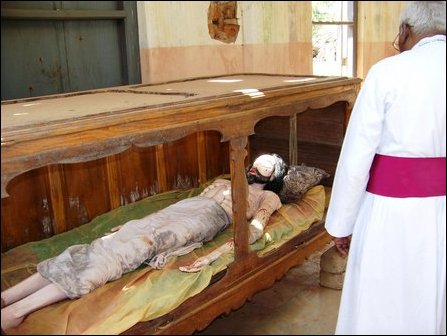
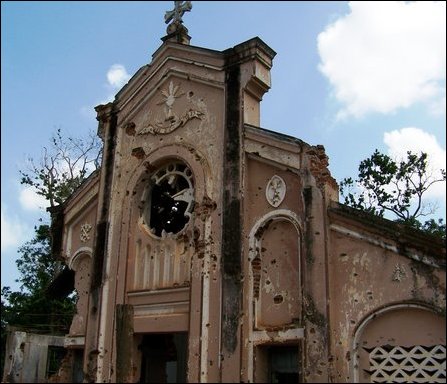

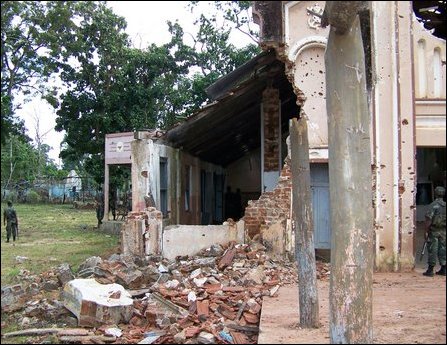
Defunct
Muslim Information Centre (MIC) Head espousing anti-Tamil hatred
by Our London Correspondent
by Our London Correspondent
 |
| S M Bazeer |
 At the meeting held (30/4) at the
House of Commons organised by the newly formed Tamil National Congress (TNC) S M
Bazeer lambasted the Tamil groups involved in the TNC as unrepresentative
terrorist groups.
At the meeting held (30/4) at the
House of Commons organised by the newly formed Tamil National Congress (TNC) S M
Bazeer lambasted the Tamil groups involved in the TNC as unrepresentative
terrorist groups.
The
well attended meeting Chaired by Dr A Nicholaspillai and hosted by the Secretary
of the All Party Parliamentary Group for Sri Lanka Andy Love MP, touched on wide
ranging issues affecting the Tamil people in Sri Lanka.
Seated
in the back row next to K Pathmanathan, Minister Councillor of the Sri Lanka
High Commission, S M Bazeer was seen agitated and conspiring with the Councillor
by the attendees. Towards the end of the meeting, he went on the rage accusing
the groups present at the meeting as unrepresentative organisations and praised
the paramilitary outfit leader and the government Minister Douglas Devananda as
a saviour and his group as a registered party and a representative organisation
in Sri Lanka.
Publicity
seeking S M Bazeer is given prominent role in the Douglas Devananda’s
paramilitary group run Dan TV and a Paris based Jaljalpu website and is a known
vociferous critic of Tamils, Hindus and Christians of Sri Lanka.
His
pro-government--anti-Tamil campaign has caused considerable embarrassment for
the expatriate Muslim community who have expressed their resentments in various
forums and personally sympathising with the Tamils.
Following
his angry charge at the parliament meeting, he is said have exited from the
Westminster premises without facing any questions.
S
M Bazeer is from the village of Earavur in the Eastern Provice and is said to be
a very close relative of the Sri Lanka’s Justice Minister Raul Hakeem. According
to information, S M Bazeer’s stand has caused major embarrassment for the
Minister and both are said to be not in talking terms.
A
close friend of S M Bazeer based in Oslo said Bazeer is aiming for a diplomatic
post and is hell bent on convincing the President Mahinda Rajapakse that he his
anti-Tamil. His comments on the Dambulla Mosque attack by the Buddhist monks is
said to be very mild and favouring the government.
S
M Bazeer is a practising lawyer in immigration and conveyancing work and is
based in Wimbledon. Following the defeat of the LTTE in 2009, he is said to be
acting as a campaigner for the Sri Lanka government and has severed his
connections with several Tamil groups and is said to be a frequent visitor to
the High Commission of Sri Lanka.
His
Paris based website has taken over the role of the former LTTE’s Nitharsanam.com
and is publishing doctored images and false and discrediting news of individuals
whom were his colleagues before the defeat of the LTTE.
Sri Lanka And Its Broken Promises: Time For India To Re-Examine The Issue
 May
1, 2012By Usha
S Sri-Skanda-Rajah -
May
1, 2012By Usha
S Sri-Skanda-Rajah -
Usha S Sri-Skanda-Rajah
It
is hard for a man to keep a straight face and tell a lie but President Rajapakse
manages to do it every time he has to face the Indians and the International
community about devolving power to the Tamil NorthEast. He just did it again
when he had breakfast with Sushma Swaraj on the last day of the Indian
delegation’s visit to Sri Lanka.
There
is now a huge confusion as to who said what. Sushma says Rajapakse talked about
devolution and mentioned 13th +Amendment and Rajapakse through the Island denies
he said that: “The Sri Lankan government on Monday strongly denied a statement
attributed to Indian Opposition Leader Sushma Swaraj, that her delegation had
received an assurance from Mr. Rajapaksa on his commitment to the 13th
Amendment, and his readiness to go even beyond it.”
Raising
the matter of the continuing saga of Rajapakse saying one thing to Indian
officials and then totally denying the statement when they have gone, under the
headline “No assurance from Rajapaksa, says Sri Lankan daily,” R. K
Radhakrishnan of the The Hindu, opines on Rajapakse’s promises “This is an exact
replay of what happened with External Affairs Minister S.M. Krishna in January
2012. Soon after Mr. Krishna met the President, the Indian side released to the
press, a statement, which said the President had agreed to the implementation of
the 13th Amendment (which grants some powers to the provinces) as a means to
cater to the hopes and aspirations of Tamils in the Northern Province. Then,
too, there was no briefing from the government side. A day later, the
government’s preferred newspaper, The Island, quoting the President, said he had
not discussed 13-plus with Mr. Krishna.”
This
clearly illustrates the sad spectacle, the tale of “Broken Promises” that Tamils
have experienced under successive Sri Lankan governments and in this case under
the Rajapakse regime.
When Is India Going To Re-Assess? Read More
TNA
demands release of arrested Tamil
youth In a letter to President Rajapaksa:
April
30, 2012

TNA Leader and parliamentarian R.
Sampanthan has sought President Mahinda Rajapaksa’s intervention to secure the
release of several youth taken into custody during the recent search operations
in the Eastern Province, particularly in the Trincomalee District.
youth In a letter to President Rajapaksa:
By
Franklin R. Satyapalan
TNA Leader and parliamentarian R.
Sampanthan has sought President Mahinda Rajapaksa’s intervention to secure the
release of several youth taken into custody during the recent search operations
in the Eastern Province, particularly in the Trincomalee District.
Sampanthan
has in a letter, brought to the President’s notice that the arrested youth have
been taken to Colombo and some undisclosed locations.
The
TNAleader has said in his letter: "Many of those arrested have been leading
normal civilian lives being bread winners of the young families. Some have had
no connection to any illegal activities at all, certainly not recently. The
action of the Police and the Security Forces, in addition to being arbitrary and
illegal, has caused great consternation and unrest among the Tamil people of the
Eastern Province. Some next of kin have been informed that they had been taken
for "rehabilitation". I wish to bring to your notice that there is no legal
provision under which this can be done".
Sampanthan
has also requested President Rajapaksa to effect changes to the Pillayan Temple
situated at the entrance to the General Hospital in Trincomalee.
"Renovations
of this temple commenced in July 2011 and the structure had to be adjusted
slightly to comply with the prescribed AHGAMAM rules. Consequently, some pillars
of the temple seem to have been placed alongside the road. However, this section
of the hospital road is no longer used as a public road since it is within the
Hospital premises.
"The
Urban Development Authority has directed that the front portion of the building,
said to be on the road reservation area, be removed, on the basis that this is
still a public road.
"I
appeal to you to kindly intervene in this matter and direct the UDA to withdraw
the said letter and permit the renovation work to be completed within one year
as required by the AHGAMAM rules so that the Kumbabisheham scheduled for the 5th
of June, 2012 can take place."
Responding
to the TNA leader’s demand, the Defence Ministry told The Island last night that
the security forces had been directed to conduct search operations in the former
war zone and arrest the ex-LTTEcadres who had not undergone rehabilitation. The
arrested youth would be rehabilitated and released, the government
said.
Implications And Ramifications Of The Attack On The Masjidul Khaira Mosque
May
1, 2012

Ajit Rupasinghe
On 20th April 2012- Friday, a mob of some
2,000 led by Buddhist priests occupied and ransacked the Masjidul Khaira Mosque,
obstructing those engaged in prayer. Even the police and the Special Task Force
could not prevent the mayhem. The attack was carried out on the grounds that the
mosque had been constructed on a site designated as a sacred Buddhist area. A
firebomb had been blasted the day before, without, however , causing any
casualties. This attack follows another attack against a Moslem mosque in
Anuradhapura, last September, by a mob led by Buddhist priests, and by the
series of attacks against Christian, Hindu and Islamic religious institutions
elsewhere in the country- all with impunity. By Monday, the Minister for
Religious Affairs had given the order for the Mosque and a Hindu Kovil in the
vicinity to be demolished and asked that they be relocated elsewhere. As of now,
the President has not stated anything in this regard, attesting to his
complicity in this decision. This has been decided in spite of the fact that the
Mosque had been in existence since 1964,where Islamic devotees had regularly
practiced their religion. Read More
Sri
Lanka: Australia Should Raise Torture Concerns
APRIL 30, 2012 Cooperation on People-Smuggling Risks Further Abuses
 (Melbourne) –
Australia’s immigration minister should raise concerns with Sri Lankan officials
about alleged arbitrary arrest and torture of people who were refused asylum and
sent back to Sri Lanka when he visits this week, the Human Rights Law Centre and
Human Rights Watch said today.
(Melbourne) –
Australia’s immigration minister should raise concerns with Sri Lankan officials
about alleged arbitrary arrest and torture of people who were refused asylum and
sent back to Sri Lanka when he visits this week, the Human Rights Law Centre and
Human Rights Watch said today.
Immigration Minister Chris Bowen is scheduled to visit Sri Lanka from May 2 to 4, 2012, to discuss migration issues, including preventing people smuggling from Sri Lanka to Australia. Bowen has said, “Australia will continue working closely with Sri Lanka on issues relating to people smuggling, including preventing and disrupting people smuggling ventures by air and sea.” The Human Rights Law Centre and Human Rights Watch called on Bowen and all senior Australian officials to ensure that respect for human rights and accountability for human rights violations are central to all discussions with their Sri Lankan counterparts. Full Story>>>
APRIL 30, 2012 Cooperation on People-Smuggling Risks Further Abuses
Rejected asylum seekers returned to Sri Lanka have
been subject to arbitrary detention, torture, and other serious human rights
abuses. Efforts to counter and prevent people-smuggling should seek to protect
asylum seekers, and shouldn’t interfere with their right to seek
asylum.
(Melbourne) –
Australia’s immigration minister should raise concerns with Sri Lankan officials
about alleged arbitrary arrest and torture of people who were refused asylum and
sent back to Sri Lanka when he visits this week, the Human Rights Law Centre and
Human Rights Watch said today.Immigration Minister Chris Bowen is scheduled to visit Sri Lanka from May 2 to 4, 2012, to discuss migration issues, including preventing people smuggling from Sri Lanka to Australia. Bowen has said, “Australia will continue working closely with Sri Lanka on issues relating to people smuggling, including preventing and disrupting people smuggling ventures by air and sea.” The Human Rights Law Centre and Human Rights Watch called on Bowen and all senior Australian officials to ensure that respect for human rights and accountability for human rights violations are central to all discussions with their Sri Lankan counterparts. Full Story>>>

.jpg)
TUESDAY,
01 MAY 2012
The
Sri Lankan government on Tuesday slammed a British human rights report which
listed the island among countries of concern over human rights issues.Deputy External Affairs Minister Neomal Perera said that Britain had no right to accuse Sri Lanka of not doing enough to address accountability of the war just three years after the conflict ended.
The Human Rights Report for 2011 released by the UK Foreign and Commonwealth Office on Monday said that significant progress was still needed in Sri Lanka to address the institutional weaknesses that allow for frequent human rights violations.
The report also called on the Sri Lankan government to implement recommendations of a local war commission and address outstanding questions regarding accountability for alleged war crimes.
"How can they say we have not done enough? On what basis are they saying that? The Lessons Learned and Reconciliation Commission (LLRC) handed over its final report only in December last year so how can the UK report say we did not do enough to address the issues mentioned. We have started addressing them now and some of the recommendations of the LLRC are also being implemented," Neomal Perera told Xinhua.
The British report also said UK will contribute to Sri Lanka's Universal Periodic Review under the UN human rights system in Geneva but Perera said Sri Lanka would have done a lot by then to address most of the human rights concerns.
"We are still in May and October is a long way ahead. They cannot prejudge us when we still have time in our hands and are already working on most of the issues," said Perera.
He also said that a visiting European Union Parliamentary delegation which met him on Monday expressed satisfaction on the progress achieved by Sri Lanka in addressing most issues.
"They did say there were still some issues but overall they were happy with the progress," he said.
The British government has an international legal obligation not to deport people who have a credible fear of torture upon return. Convincing reports of arbitrary arrests and torture demand that the UK government suspend returns of rejected Tamil asylum seekers to Sri Lanka until it can fairly and thoroughly assess their individual claims based on up-to-date human rights information on Sri Lanka.
(New York) – The United Kingdom should suspend
deportations of ethnic Tamil asylum seekers to Sri Lanka and immediately review
its policies and information about the country’s rights situation used to assess
their claims, Human Rights Watch said today. Research by Human Rights Watch has
found that some returned Tamil asylum seekers from the United Kingdom have been
subjected to arbitrary arrest and torture upon their return
to Sri Lanka.
In recent
months the British government has sent Tamil asylum seekers back to Sri Lanka on charter flights. Human Rights Watch expressed
particular concern about the next scheduled deportation from the United Kingdom
of about 100 Tamil asylum seekers, scheduled for February 28, 2012.
Full
Story>>>
Subscribe to:
Posts (Atom)