



Peace for the World World ! Your War Our Lives

The Dalai Lama
A Brief Colonial History Of Ceylon(SriLanka)
Sri Lanka: One Island Two Nations
A Brief Colonial History Of Ceylon(SriLanka)
Sri Lanka: One Island Two Nations
(Full Story)
Back to 500BC.
Monday, February 1, 2016
Will Rajitha undermine the account details which Anura demanded?
 Jan 31, 2016
 Health
minister Rajitha Senarathna avoided answering the question raised by
the chief opposition whip Anura Dissanayake last 27th when announcing
cabinet decisions, about the country’s elite group of people’s account
details containing billions of rupees supposedly alleged to be deposited
in a bank in Dubai.
Health
minister Rajitha Senarathna avoided answering the question raised by
the chief opposition whip Anura Dissanayake last 27th when announcing
cabinet decisions, about the country’s elite group of people’s account
details containing billions of rupees supposedly alleged to be deposited
in a bank in Dubai.
Anura Kumara Dissanayake questioned the Prime Minister to inform the
factual current situation to the parliament, about Rajitha Senarathna’s
the continuous statements about these accounts. Leader of the house
Lakshman Kiriella on the following day said that the Prime Minister
would answer the question, but he did not. During the cabinet decision
media communiqué when a journalist raised a questioned Rajitha
Senarathna said the investigations have been handed over to the central
bank of America and the required information reaching is getting late.
However in many occasions minister Rajitha has spoken publicly about
these illegal bank accounts. During the cabinet decision announcement on
February 14th minister exposed that more than one billion US dollars
deposited in a private bank in Dubai by a member of an elite political
family and another three people related to this family.
One members bank account had US dollars 1.086 billion, a businessmen cum
a MP have US dollars 500 and a former secretary and a chairman of an
institute have US dollars 1.8 billion deposited in a joint account.
Meantime Rajitha Senarathna’s son Chathura Senarathna said that he saw
from his eyes the 420,656 million rupees illegally hidden by the
Rajapaksa son’s in the foreign banks.
Foreign Minister Mangala Samaraweera too once told that illegal money is
being deposited in bank in Dubai but expressed his displeasure how
these information’s were revealed to the media before investigations.
However nobody able to reveal about these with credible evidence so far.
Therefore JVP leader Anura Kumara questioned about this in the
parliament last 27th.
Reports reaching us conform that Sri Lanka lost the opportunity of
fetching information about these illegal pelf deposited in a bank in
Dubai. In spite of revealing information’s to the media, taking
irregular actions and failing to lead stealthy investigations, the Sri
Lankan government lost opportunity to get information’s to retrieve the
money back.
Police inside information emphasized, minister Rajitha, in spite of
revealing stealthy information’s before formal investigations, about
these Dubai bank accounts and other criminal charges, the investigation
team have suffered serious setbacks. Before disclosing about the CCTV
footage of the murder of the rugby player Wasim Thajudeen, Rajitha
Senarathna said that he saw the murder recorded in the CCTV cameras.
However so far no such visuals have been located and if there was such a
doubt is created with the investigation team, was an opportunity given
for the those criminals to destroy the evidences.
Political analysts say serious doubts have been erupted about this.
Meantime so far no investigations have started against Rajitha
Senarathna about the allegation leveled against him about the ownership
of eight ships belong to the latter from the Rajapaksa era. Although a
complaint has been made currently to the Commission to Investigate
Bribery & Corruption but so far no credible steps have been taken.
Political analysts say that it would be problematic that the President
and the Prime Minister continue to keep Minister Rajitha Senarathna as
the cabinet spokesperson for the amount of allegations leveled against
him and for presenting false information’s.

Funds given to extremists during Rajapaksa regime

SUNDAY, 31 JANUARY 2016
 Funds
were released to an extremist organization for its activities from a
secret account in the Ministry of Defense during the period Mahinda
Rajapaksa regime ruled the country. This has been revealed by state
intelligence services.
Funds
were released to an extremist organization for its activities from a
secret account in the Ministry of Defense during the period Mahinda
Rajapaksa regime ruled the country. This has been revealed by state
intelligence services.
It was discussed at a meeting held between government authorities and
officers of the state intelligence services regarding dangerous and
instigating campaigns that have emerged in the country at present.
A senior officer in charge of intelligence services has told media
questioning about or getting information regarding the account has been
prohibited.
The officer said the CID that investigated the murders and mayhem
committed by an extremist organization in Beruwala area in 2014 has sent
the files including their observations to the Attorney General for
future action.
It is reported that information regarding powerful people of the
previous regime who were behind the extremist organization has been
revealed to intelligence services. Meanwhile, weekend newspapers had
reported that persons in a motorcade held by the extremist organization
were entertained at UPFA Parliamentarian Pavithra Wanniarachchi’s
residence at Pelmadulla.
Academic boycott of Israel takes off in Italy
31 January 2016
There have been major breakthroughs in Italy for the campaign to boycott Israeli academic institutions.
More than 200 academics from 50 Italian universities have signed a call for the boycott of Israeli academic institutions until Israel complies with international law.
This is the first time a significant number of Italian academics have
taken a public stand in support of the Palestinian-led campaign of
boycott, divestment and sanctions (BDS).
The move comes just months after Italian Prime Minister Matteo Renzi lashed out at the BDS movement as “stupid and futile” in a speech to the Israeli parliament.
The Italian scholars join more than 1,500 of their colleagues in the United Kingdom, Belgium, South Africa,Ireland and Brazil who have endorsed similar pledges in recent months.
The scholars endorsing the Italian call, which echoes the pledge signed
by UK academics last October, are committing to refuse invitations from
Israeli academic institutions and not to act as referees or participate
in conferences funded, organized or sponsored by Israeli institutions.
Consistent with the guidelines set out by the Palestinian Campaign for the Academic and Cultural Boycott of Israel (PACBI),
which targets institutions not individuals, the academics clarify that
they will “continue to work and cooperate with [their] Israeli
colleagues individually.”
They also reiterate the anti-racist nature of the boycott campaign.
Read More
The United States Should Admit It No Longer Has a Middle East Policy
If the
current — and future — U.S. administration wants to battle the Islamic
State, save Syria, and keep ties with Israel, it’s got to ditch the Cold
War playbook.

 BY JANUARY 29, 2016
Do you know what the United States should do in the Middle East? The answer to that question used to be pretty obvious, but not anymore. For most of the past half-century, U.S. leaders knew who their friends and enemies were and had a fairly clear sense of what they were trying to accomplish. No longer. Today, there is greater uncertainty about U.S. interests in the region, more reason to question the support it gives its traditional partners, and no consensus on how to deal with the dizzying array of actors and forces that are now buffeting the region.
One thing is clear: The playbook we’ve been using since the 1940s isn’t going to cut it anymore. We still seem to think the Middle East can be managed if we curry favor with local autocrats, back Israel to the hilt, constantly reiterate the need for U.S. “leadership,” and when all else fails, blow some stuff up. But this approach is manifestly not working, and principles that informed U.S. policy in the past are no longer helpful.
Things used to be so simple — and no, that’s not just nostalgia talking. During the Cold War, for example, the central elements of U.S. Middle East policy were reasonably well understood. First and foremost, the United States sought to contain and, if possible, reduce Soviet influence in the region. It also wanted to make sure Middle East oil and gas continued to flow to world markets and that Israel survived, although the dysfunctional “special relationship” that now exists did not begin to emerge until the late 1960s.
To achieve these goals, from 1945 to 1990 the United States generally acted as an “offshore balancer.” In sharp contrast to its military deployments in Europe or Asia, Washington didn’t station large ground forces in the Middle East and kept its overall military footprint low, relying instead on a variety of local allies and clients. In particular, the United States backed conservative Arab monarchies in Saudi Arabia, Jordan, and the Persian Gulf; had a close relationship with Iran until the 1979 revolution; and saw Israel as a strategic asset mostly because it kept defeating the Soviet Union’s various Arab clients. Indeed, a string of defeats and rising economic problems eventually convinced Egyptian President Anwar Sadat to abandon his Soviet patron and realign with Washington. The United States also played a balance-of-power game in the Gulf: Ronald Reagan and Bush 41 tilted toward Iraq during its war with Iran, and then Bush turned against Iraq when it invaded Kuwait in 1990.
More Story>>>
Aerial of C.I.A. headquarters in Virginia. (Carol M. Highsmith/Getty Images)
Senior CIA officials have for years intentionally deceived parts of the
agency workforce by transmitting internal memos that contain false
information about operations and sources overseas, according to current
and former U.S. officials who said the practice is known by the term
“eyewash.”
Agency veterans described the tactic as an infrequent but important
security measure, a means of protecting vital secrets by inserting fake
communications into routine cable traffic while using separate channels
to convey accurate information to cleared recipients.

But others cited a significant potential for abuse. Beyond the internal
distrust implied by the practice, officials said there is no clear
mechanism for labeling eyewash cables or distinguishing them from
legitimate records being examined by the CIA’s inspector general, turned
over to Congress or declassified for historians.
Senate investigators uncovered apparent cases of eyewashing as part of a
multi-year probe of the CIA’s interrogation program, according to
officials who said that the Senate Intelligence Committee found glaring
inconsistencies in CIA communications about classified operations,
including drone strikes.
At least two eyewashing cases are cited in the classified version of the
committee’s final report, according to officials who have reviewed the
document. In one instance, leaders at CIA headquarters sent a cable to
the agency’s station in Pakistan saying operators there were not
authorized to pursue a potentially lethal operation against alleged
al-Qaeda operative Abu Zubaydah.
But a second set of instructions sent to a smaller circle of recipients
told them to disregard the other message and that the mission could
proceed.
“The people in the outer levels who didn’t have insider access were
being lied to,” said a U.S. official familiar with the report. “They
were being intentionally deceived.”
The CIA’s mission regularly involves carrying out operations that are
designed to deceive foreign governments and other adversaries. But
officials said that eyewashing is fundamentally different in that it is
aimed at an internal audience — sowing misinformation among the agency’s
rank and file.
India to build satellite tracking station in Vietnam that offers eye on China
People watch as India's
Geosynchronous Satellite Launch Vehicle (GSLV-D6) blasts off carrying a
2117 kg GSAT-6 communication satellite from the Satish Dhawan space
centre at Sriharikota, India, August 27, 2015.REUTERS/STRINGER/FILES
Mon Jan 25, 2016
 India
will set up a satellite tracking and imaging centre in southern Vietnam
that will give Hanoi access to pictures from Indian earth observation
satellites that cover the region, including China and the South China
Sea, Indian officials said.
India
will set up a satellite tracking and imaging centre in southern Vietnam
that will give Hanoi access to pictures from Indian earth observation
satellites that cover the region, including China and the South China
Sea, Indian officials said.
The move, which could irritate Beijing, deepens ties between India and
Vietnam, who both have long-running territorial disputes with China.
While billed as a civilian facility - earth observation satellites have
agricultural, scientific and environmental applications - security
experts said improved imaging technology meant the pictures could also
be used for military purposes.
Hanoi especially has been looking for advanced intelligence,
surveillance and reconnaissance technologies as tensions rise with China
over the disputed South China Sea, they said.
"In military terms, this move could be quite significant," said Collin
Koh, a marine security expert at Singapore's S. Rajaratnam School of
International Studies. "It looks like a win-win for both sides, filling
significant holes for the Vietnamese and expanding the range for the
Indians."
The state-run Indian Space Research Organisation (ISRO) will fund and
set up the satellite tracking and data reception centre in Ho Chi Minh
City to monitor Indian satellite launches, the Indian officials said.
Indian media put the cost at around $23 million.
India, whose 54-year-old space programme is accelerating, with one
satellite launch scheduled every month, has ground stations in the
Andaman and Nicobar islands, Brunei, Biak in eastern Indonesia and
Mauritius that track its satellites in the initial stages of flight.
The Vietnam facility will bolster those capabilities, said Deviprasad Karnik, an ISRO spokesman.
QUID PRO QUO
But unlike the other overseas stations, the facility will also be
equipped to receive images from India's earth observation satellites
that Vietnam can use in return for granting India the tracking site,
said an Indian government official connected with the space programme.
"This is a sort of quid pro quo which will enable Vietnam to receive IRS
(Indian remote sensing) pictures directly, that is, without asking
India," said the official, who declined to be identified because he was
not authorised to speak to the media.
"Obviously it will include parts of China of interest to Vietnam."
Chinese coastal naval bases, the operations of its coastguard and navy
and its new man-made islands in the disputed Spratly archipelago of the
South China Sea would be targets of Vietnamese interest, security
experts said.
Another Indian official said New Delhi would also have access to the imagery.
India has 11 earth observation satellites in orbit, offering pictures with differing resolutions and areas, the ISRO said.
Indian officials had no timeframe for when the centre would be operational.
"This is at the beginning stages, we are still in dialogue with Vietnamese authorities," said Karnik.
Vietnam's Foreign Ministry confirmed the project, but provided few other details.
Chinese Foreign Ministry spokeswoman Hua Chunying told a regular
briefing that Beijing hoped the facility "will be able to make a
positive contribution to pushing forward relevant cooperation in the
region". China's Defence Ministry said the proposed tracking station
wasn't a military issue.
Vietnam launched its first earth observation satellite in 2013, but Koh
said it was not thought to produce particularly high resolution images.
BLURRED LINES
Security experts said Vietnam would likely seek real-time access to
images from the Indian satellites as well as training in imagery
analysis, a specialised intelligence field.
"The advance of technology means the lines are blurring between civilian
and military satellites," said Trevor Hollingsbee, a retired naval
intelligence analyst with Britain's Defence Ministry. "In some cases,
the imagery from a modern civilian satellite is good enough for military
use."
Sophisticated military reconnaissance satellites can be used to capture
military signals and communications, as well as detailed photographs of
objects on land, capturing detail to less than a metre, Koh and other
experts said.
The tracking station will be the first such foreign facility in Vietnam
and follows other agreements between Hanoi and New Delhi that have
cemented security ties.
India has extended a $100 million credit line for Hanoi to buy patrol
boats and is training Vietnamese submariners in India while Hanoi has
granted oil exploration blocks to India in waters off Vietnam that are
disputed with China.
Under Prime Minister Narendra Modi, India has shown a greater
willingness to step up security ties with countries such as Vietnam,
overriding concerns this would upset China, military officials said.
"You want to engage Vietnam in every sphere. The reason is obvious -
China," said retired Indian Air Force group captain Ajay Lele at the New
Delhi-based Institute for Defence Studies and Analyses.
Both India and Vietnam are also modernising their militaries in the face
of Beijing's growing assertiveness, having separately fought wars with
China in past decades.
Australian-based scholar Carl Thayer, who has studied Vietnam's military
since the late 1960s, said the satellite tracking facility showed both
nations wanted to enhance security ties.
"Their interests are converging over China and the South China Sea," he said.
(Additional reporting by Megha Rajagopalan in Beijing and Ho Binh Minh in Hanoi; Editing by Dean Yates)
Beijing takes a gamble on Vietnamese leadership struggle
Nguyen
Phu Trong, left, General Secretary of the Communist Party of Vietnam,
and Vietnamese Prime Minister Nguyen Tan Dung. Pic: AP

 by 31st January 2016
The current General Secretary of the Communist Party, Nguyen Phu Trong, successfully secured a second term this
week, after a fiercely contested leadership campaign. His main rival in
the contest for party leadership was the incumbent Prime Minister,
Nguyen Tan Dung, but far from being a typical run-of-the-mill leadership
challenge, this was a battle which would provide the vision for
Vietnam’s future direction: whether as a socialist-cum-capitalist nation
firmly ensconced within the heart of Southeast Asia’s efforts to branch
out onto the world stage; or as a continuing hard line communist state
and vassal of Beijing.
Vietnamese politics are complex, maintaining an uneasy alliance at times
between party and state. Sitting at the head of a National Assembly,
the highest government institution, the position of Prime Minster is
ostensibly the nation’s foremost – ahead even of the State President and National Assembly Chair.
In truth, however, it is the General Secretary of the party who calls
the big shots. The PM might lead the nation in its day-to-day running
but if the General Secretary decides a course of governmental action
does not coincide with party policy, then he can ensure that it hits a
fairly hefty brick wall. And with radical plans afoot to bring Vietnam
into the international fold, at least in terms of part liberalizing its
economy, this explains why Dung was so eager to contest a position
which, to general appearances, seems the inferior.
Political pundits had invested much faith and optimism in Dung’s
accession to the post of General Secretary. Although Trong had the full
backing of the Communist old guard, there was a definite feeling that
change might be in the air, with the support of the nation’s youth and
business community firmly behind Dung. Partly this was due to Dung’s
efforts to liberalize the economy, but equally so what that
liberalization meant for Vietnam’s relationship with China. Dung’s
pursuit of membership in the Trans Pacific Partnership, (TPP) for
instance, which it is predicted will increase Vietnam’s GDP by $36 billion, changes the direction of the nation’s economic loyalties. With the TPPvery much a part of US policy,
Hanoi has shown, under Dung’s leadership, that it is not wholly averse
to following Washington’s lead rather than following in the traditional
policy of extending its loyalty to Beijing.
In recent years, the relationship between China and Vietnam has been
rather bumpy, and Dung’s courtship of China’s rival is a reflection of
this. Tensions over territorial disputes stretch
back decades, but have most recently have arisen over what Vietnam
considers illegal drilling operations in nearby waters. Beijing made
some attempt to pacify the consequent ire, but then, right in the middle
of the congress, towed another massive exploration rig right
into the middle of disputed territories. No coincidence, many observers
claim, in what is an obvious attempt to rattle a few sabers and
influence the outcome of the 12th National Congress in favor of Trong’s pro-Chinese faction.
This is not the first time that China has been accused of exerting influence upon the proceedings. On the 23rd December,
members of the party Central Committee landed in Beijing for five days
of meetings with senior Chinese leaders, purportedly to discuss
bilateral ties. The official reports, however, vary considerably from
unofficial sources, as well as those of independent observers, who claim
the meeting’s true purpose was to discuss Chinese dissatisfaction with a
pro-US Dung government and alternative leadership that Beijing might be
happy to deal with in future. Beijing, it seems, has never quite
forgiven Dung for his heroic verbal assault on
the unequal relationship that China expected from its southern “ally”.
And its gamble on attempting to influence the future leadership of
Vietnam could have seriously backfired, much as it has in the Taiwan
elections, where the electorate has shown with its ballot slips that it refuses to be influenced by
its cross-straits neighbor. Not only might it have been left bereft of a
significant ideological ally in the region, but a clear signal would
have been sent to the rest of the world that Beijing’s influence in the
region, as a friend, mentor and sometime aggressor to the Southeast
Asian nations, was waning.
Despite the optimism of those observers who expected Vietnam to follow
through with its early promise, it became swiftly apparent that Dung,
and those whom he represented, was not to have it his own way. Before
the congress had even begun, events unfolded in a way that left the
Prime Minster out in the cold, sidelined by the communist old guard
through exclusion from the list of candidates.
A last minute challenge was mounted by Dung, but it was, alas, to prove
futile. Long standing party regulations on the matter forced him to retire from the contest,
leaving Trong home and dry in pursuit of the party’s crown jewel.
Furthermore, Dung is now officially off the scene, having reached the
compulsory age of retirement; even though Trong, several years his
senior, has somehow managed to extend his position of authority for
another term.
Beijing may believe it has got precisely what it wanted from the
congress, but would do well to reassess its relationship with Hanoi.
Dung has indeed been forced off the scene, but the current zeitgeist is
very much a legacy of what the former PM brought to the nation’s door;
the TPP is still going ahead, as is the newly formed ASEAN Economic Community.
Consequently, certain liberalizations are being necessarily introduced
as part of those agreements – liberalizations which are more likely to
evolve than simply be maintained. Most importantly, however, with the
majority of Vietnam’s youth firmly in favor of a less servile
relationship with China, it may simply be a matter of waiting for the
old guard’s numbers to thin to the extent that a new Vietnam is able to
take shape. China’s influence may still be intact for the moment, but it
has far steeper challenges ahead.
Europol says 10,000 migrant children are missing
Europol sees evidence of a criminal infrastructure established over the last 18 months to exploit the migrant flow
 Migrants fleeing warring regions often cross to the Greek islands from Turkey before trying to make their way to Europe
 AFP-Sunday 31 January 2016
Europol sees evidence of a criminal infrastructure established over the last 18 months to exploit the migrant flow
 Migrants fleeing warring regions often cross to the Greek islands from Turkey before trying to make their way to Europe AFP-Sunday 31 January 2016
More than 10,000 unaccompanied migrant children have disappeared in
Europe, the EU police agency Europol said on Sunday, fearing many have
been whisked into sex trafficking rings or the slave trade.
Europol's news office confirmed the figures published first in British
newspaper the Observer, adding that they covered the last 18-24 months.
The agency's chief of staff Brian Donald said vulnerable children had
disappeared from the system after registering with state authorities
following their arrival in Europe.
"It's not unreasonable to say that we're looking at 10,000-plus
children," Donald said, adding that 5,000 had disappeared in Italy
alone.
"Not all of them will be criminally exploited; some might have been
passed on to family members. We just don't know where they are, what
they're doing or whom they are with."
Donald said there was evidence of a "criminal infrastructure" established over the last 18 months to exploit the migrant flow.
The Observer reported that Europol found evidence of links between
smuggling rings bringing people into the EU and human trafficking gangs
exploiting migrants for sex and slavery.
"There are prisons in Germany and Hungary where the vast majority of
people arrested and placed there are in relation to criminal activity
surrounding the migrant crisis," Donald said.
More than 1 million migrants and refugees, many fleeing the Syria conflict, crossed into Europe last year.
"Whether they are registered or not, we’re talking about 270,000 children," Donald told the paper.
"Not all of those are unaccompanied, but we also have evidence that a
large proportion might be," he said, adding that 10,000 is likely to be a
conservative estimate.
He said many of the children are "visible", and not "spirited away and held in the middle of forests".
Raffaela Milano, Save the Children's Italy-Europe programme director,
said that "unaccompanied minors who travel without adults are the most
vulnerable group of the migratory flow".
"Many minors, in fact, make themselves 'invisible' to the authorities to
enable them to continue their journey in Europe, for fear of being sent
back," she said.
The UN children's agency UNICEF also voiced alarm and urged European
countries to do more to protect migrant children who are on their own.
"We urgently call for a plan within Europe for unaccompanied and
separated children covering family reunification, relocation and other
alternatives so that children do not end up being abused and exploited
by smugglers and traffickers," it said in a statement.
Many children arrive first on the Greek islands before making the journey to relatives across Europe.
Laura Pappa, president of the Greek charity Meta-Action, a group
accompanying children who travel without relatives, said they "face a
destiny that is worse than that of the rest of migrants waiting to be
relocated".
She said they often have to wait for about seven months to be reunited
with relatives, and that procedures can be slow and complicated.
"There are some people that present themselves as uncles and take the
children. It's not easy in this mess to cross check the identity of the
'uncle'."
Pappa said the group has helped 3,000 children reach family, but that it "is not enough".
The UK has said it will take in migrant or refugee children who have been separated from their parents.
Despite the constant risk of death and deportation, migrants continue to
stream into Europe, risking their lives to escape poverty, repression
and conflict.
Guatemalan soldiers face civil war sexual slavery charges in historic trial
For
the first time ever, sex slavery will be prosecuted where the war crime
took place, 30 years after 11 Mayan women from Sepur Zarco were raped
and enslaved
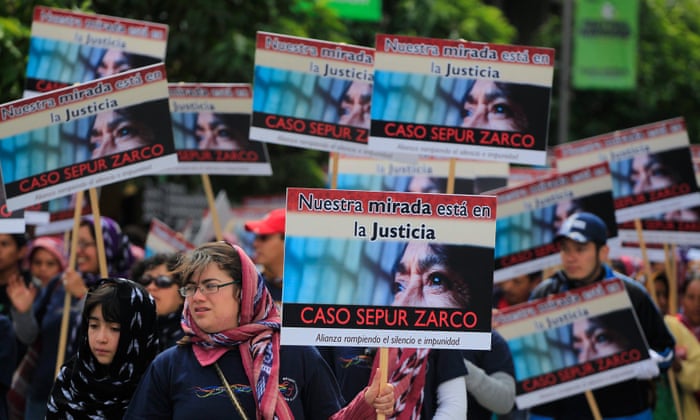 Women
hold up signs that read ‘We look to justice, Sepur Zarco case’ in 2012
to commemorate the International Day for the Elimination of Violence
Against Women in Guatemala City. Photograph: Jorge López/Reuters
Women
hold up signs that read ‘We look to justice, Sepur Zarco case’ in 2012
to commemorate the International Day for the Elimination of Violence
Against Women in Guatemala City. Photograph: Jorge López/Reuters
First the army came for the men. Fifteen Mayan peasant leaders in the tiny hamlet of Sepur Zarco in eastern Guatemala were seized and killed or forcibly disappeared.
A few weeks later, they came back for the women. Soldiers raped them in
front of their children, burned down their houses and crops, stole their
meagre belongings and made them move into shacks outside the nearby
military base.
Every two or three days, each woman was made to report for 12-hour
“shifts” at the base where they were forced to cook, clean and submit to
systematic rape, often by several soldiers.
It was 1982, one of the bloodiest years of the country’s civil war as
counter-insurgency operations against ethnic Mayans intensified under
the rule of the military dictator and evangelical Christian, Efraín Ríos
Montt.
First the army came for the men. Fifteen Mayan peasant leaders in the tiny hamlet of Sepur Zarco in eastern Guatemala were seized and killed or forcibly disappeared.
A few weeks later, they came back for the women. Soldiers raped them in
front of their children, burned down their houses and crops, stole their
meagre belongings and made them move into shacks outside the nearby
military base.
Every two or three days, each woman was made to report for 12-hour
“shifts” at the base where they were forced to cook, clean and submit to
systematic rape, often by several soldiers.
It was 1982, one of the bloodiest years of the country’s civil war as
counter-insurgency operations against ethnic Mayans intensified under
the rule of the military dictator and evangelical Christian, Efraín Ríos
Montt.
More than 30 years later, two former military officers will finally face
charges of sexual and domestic slavery and forced disappearance in a
landmark trial which opens on Monday.
The trial marks the first in the world that sexual slavery perpetrated
during an armed conflict has been prosecuted in the country where the
crimes took place.
The two defendants, former base commander Esteelmer Reyes Girón and
former regional military commissioner Heriberto Valdez Asij, are accused
of crimes against humanity, which are exempt from the country’s
post-war amnesty law.
Throughout Guatemala’s 36-year conflict, state security forces used rape
as a weapon of terror, according to the 1999 report of a UN-backed
Truth Commission, but no officers have ever faced charges of sexual
violence.
And while the plight of Korean and Filipino “comfort women” forced into
sexual slavery by Japanese troops during the second world war remains the subject of high-level diplomatic disputes, victims of similar crimes in Guatemala have had little or no official support.
Read More
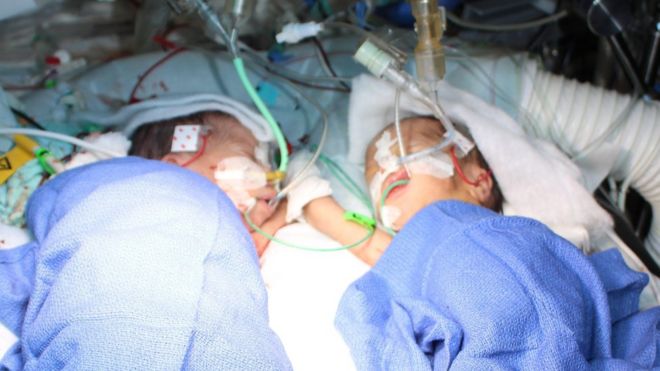
The twins underwent an operation to separate them in December
 31 January 2016
Doctors in Switzerland say they have separated eight-day-old conjoined
sisters, believed to be the youngest babies to be successfully parted.
The twins, born in December, were fused at the liver and chest.
Swiss media say doctors had originally planned to separate them when
they were several months old but brought the operation forward when they
each suffered a life-threatening condition.
The operation reportedly carried a 1% chance of success.
The twins, named Lydia and Maya, were born eight weeks premature at the
Inselspital hospital in Bern, along with a triplet who was fully
separate and healthy.
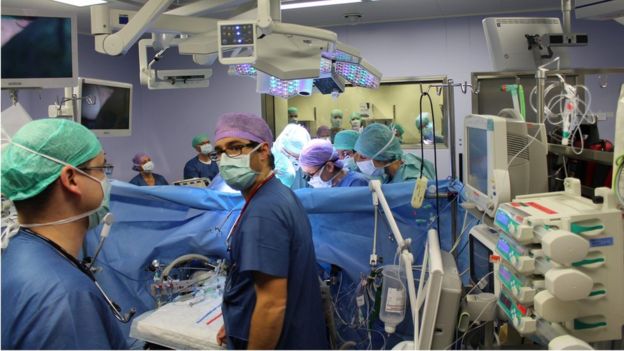
Doctors were forced to operate after the girls developed life-threatening conditions
The hospital said the twins were "extensively conjoined on the liver, but had all vital organs".
They weighed just 2.2kg (4lb 14oz) together. One of the twins had too
much blood, and very high blood pressure, while the other one did not
have enough.
A 13-strong medical team took five hours to separate the girls on 10 December.
"Such small conjoined siblings had never been successfully separated before," the hospital said.
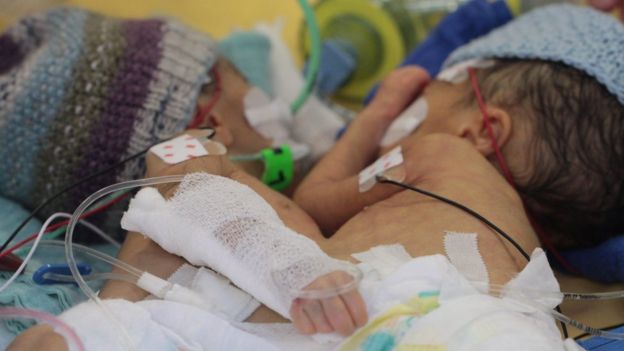
The twins, seen here before their operation, only weighed 2.2kg when they were born
The head of paediatric surgery, Steffen Berger, paid tribute to the
medical staff, saying: "The perfect teamwork of physicians and nursing
personnel from various disciplines were the key to success here. We are
very happy that the children and parents are faring so well now."
The girls underwent further surgery to close their abdominal walls and are now recovering in a paediatric intensive care ward.
The hospital says the children are "still very small" but developing well.
Le Matin Dimanche newspaper said they had put on weight and begun breastfeeding.

Not all the operating team could be present for the photo afterwards because some were still caring for the girls
Subscribe to:
Posts (Atom)