A child and a man are seen in hospital in the besieged town of Douma,
Eastern Ghouta, Damascus, Syria February 25, 2018. Picture taken
February 25,2018. Source: Reuters/Bassam Khabieh
NORTH KOREA has been shipping materials to the Syrian government for use
in what is suspected to be an industrial-scale chemical weapons
factory, according to intelligence information cited in a confidential
United Nations report.
US media reported a Chinese trading firm working on behalf of Pyongyang
made five shipments in late 2016 and early 2017 of high-heat,
acid-resistant tiles, stainless-steel pipes and valves to Damascus. The
UN report cited this as evidence that Syrian President Bashar al-Assad
is paying North Korea to help his country produce chemical arms.
According to The Wall Street Journal, the shipments were part of a steady stream of weapons-related sales by Pyongyang to Syria.
The allegations come after fresh reports of chlorine gas attacks by
Syrian forces in Eastern Ghouta. A statement from besieged Eastern
Ghouta’s interim health ministry said victims in the town of
al-Shifoniyeh had been admitted to hospital with convulsions, difficulty
breathing and irritation of the eyes and mouth following an air strike
on Sunday night. The Syrian regime has denied carrying out the attack.
Man with a child are seen in hospital in the besieged town of Douma,
Eastern Ghouta, Damascus, Syria February 25, 2018. Picture taken
February 25, 2018. Source: Reuters/Bassam Khabieh
The report, which was written by a panel of experts who looked at North
Korea’s compliance with UN sanctions, said North Korean missile
technicians have also been spotted working at known chemical weapons and
missile facilities inside Syria, as reported by The New York Times.
The Syrian government is reported to have denied this, claiming the only North Koreans in Syria are sports coaches and athletes.
North Korea is currently under strict international sanctions that
include restrictions on international trade in an effort to curb its
nuclear weapons programme.
Syria’s Scientific Studies and Research Center (SSRC), the Assad-backed
group responsible for developing chemical and other weapons of mass
destruction, used a series of front companies to pay for the illicit
materials.
According to the Times, the
report details how Pyongyang consistently uses a complex web of shell
companies and sympathetic foreign citizens to gain access to
international financing. The regime also uses its own diplomats in
smuggling operations and employs sophisticated cyber operations to steal
military secrets.
North Korean leader Kim Jong Un meets scientists and technicians in the
field of researches into nuclear weapons in this undated photo released
by North Korea’s Korean Central News Agency (KCNA) in Pyongyang March 9,
2016. Source: Reuters/KCNA
The successful delivery of these shipments between two heavily monitored
and isolated nations has highlighted the shortcomings in international
efforts to restrict both countries. The shipments would have eluded
detection despite both nations being under intense scrutiny from
American and international spy agencies.
Last week, US President Donald Trump said Washington was imposing a
fresh set of sanctions on North Korea, targeting more than 50 ships and
maritime transport companies in several countries.
The US says the new sanctions are designed to put a further squeeze on
North Korea, cutting off sources of revenue and fuel for its nuclear
programme and clamping down on evasion of already existing restrictions.
Officials in four countries discussed ways to manipulate Jared Kushner, President Trump’s senior adviser and son-in-law.(Video: Bastien Inzaurralde/Photo: Jabin Botsford/The Washington Post)
Officials in at least four countries have privately discussed ways they
can manipulate Jared Kushner, the president’s son-in-law and senior
adviser, by taking advantage of his complex business
arrangements, financial difficulties and lack of foreign policy
experience, according to current and former U.S. officials familiar with
intelligence reports on the matter.
Among those nations discussing ways to influence Kushner to their
advantage were the United Arab Emirates, China, Israel and Mexico, the
current and former officials said.
It is unclear if any of those countries acted on the discussions, but
Kushner’s contacts with certain foreign government officials have raised
concerns inside the White House and are a reason he has been unable to
obtain a permanent security clearance, the officials said.
Kushner’s interim security clearance was downgraded last week from the
top-secret to the secret level, which should restrict the regular access
he has had to highly classified information, according to
administration officials.
Senior
adviser Jared Kushner’s lack of foreign policy experience has been a
concern within the White House, current and former officials say. (Jabin
Botsford/The Washington Post)
H.R. McMaster, President Trump’s national security adviser, learned that
Kushner had contacts with foreign officials that he did not coordinate
through the National Security Council or officially report. The issue of
foreign officials talking about their meetings with Kushner and their
perceptions of his vulnerabilities was a subject raised in McMaster’s
daily intelligence briefings, according to the current and former
officials, who spoke on the condition of anonymity to discuss sensitive
matters.
Within the White House, Kushner’s lack of government experience and his
business debt were seen from the beginning of his tenure as potential
points of leverage that foreign governments could use to influence him,
the current and former officials said.
They could also have legal implications. Special counsel Robert S.
Mueller III has asked people about the protocols Kushner used when he
set up conversations with foreign leaders, according to a former U.S.
official.
Officials in the White House were concerned that Kushner was “naive and
being tricked” in conversations with foreign officials, some of whom
said they wanted to deal only with Kushner directly and not more
experienced personnel, said one former White House official.
Kushner has an unusually complex set of business arrangements and
foreign entanglements for a senior White House aide, experts have said.
But his behavior while in office has drawn more scrutiny and raised
concerns that he would be unable to obtain a final security clearance,
which he needs to perform the many jobs Trump has entrusted to him, from
negotiating foreign trade deals to overseeing a Middle East peace
process.
“We will not respond substantively to unnamed sources peddling
second-hand hearsay with rank speculation that continue to leak
inaccurate information,” said Peter Mirijanian, a spokesman for
Kushner’s lawyer.
(Thomas Johnson/The Washington Post)
White House officials said McMaster was taken aback by some of Kushner’s foreign contacts.
“When he learned about it, it surprised him,” one official said. “He
thought that was weird. . . . It was an unusual thing. I don’t know that
any White House has done it this way before.”
The official said that McMaster was “not concerned but wanted an explanation. It seemed unusual to him.”
In the months since, McMaster and Kushner have worked to coordinate so
that the National Security Council is aware of Kushner’s contacts with
foreign officials and so Kushner has access to the council’s country
experts to prepare for meetings.
“General McMaster has the highest regard for Mr. Kushner, and the two
work well together,” said council spokesman Michael Anton. “Everything
they do is integrated . . . it’s seamless.”
Foreign governments routinely discuss ways they can influence senior officials in all administrations.
“Every country will seek to find their point of leverage,” said one
person familiar with intelligence intercepts of foreign officials
discussing Kushner.
But Kushner came to his position with an unusually complex set of
business holdings and a family company facing significant debt issues.
A Mexican diplomatic source said that Kushner “has remained strictly
professional” in his dealings with the country, “with both sides looking
after their interests but trying to find common ground.”
Officials from the UAE identified Kushner as early as the spring of 2017
as particularly manipulable because of his family’s search for
investors in their real estate company, current and former officials
said.
Officials at the embassies of China, Israel and the UAE did not respond to requests for comment.
Kushner’s lack of a final security clearance has drawn scrutiny in
recent weeks. He had an interim clearance that gave him access to
information at the top-secret level, as well as more highly classified
information, such as the president’s daily intelligence briefing. But
the application for his final clearance dragged on for more than a
year. The downgrading of his interim clearance from top secret to secret
was first reported by Politico.
On Feb. 9, Deputy Attorney General Rod J. Rosenstein alerted White House
Counsel Don McGahn that significant issues would further delay
Kushner’s security clearance process, according to four people familiar
with their discussions.
Kushner has repeatedly amended a form detailing his contacts with
foreign persons. Not fully disclosing foreign contacts ordinarily would
result in a clearance being denied, experts said.
On Friday, Trump said White House Chief of Staff John F. Kelly would make a final decision on whether Kushner would continue to have a security clearance.
In 2016, Kushner was simultaneously running his family business, Kushner
Cos., and helping to oversee Trump’s campaign. One of his top business
concerns was what to do with his family’s investment in 666 Fifth Ave.
in New York, which the company bought under his direction for $1.8
billion in 2007, the highest price paid at the time for a U.S. office
tower. The purchase became troubled as the Great Recession hit, and
Kushner refinanced it, leaving the company with a $1.2 billion debt that
comes due in January 2019.
The Manhattan property has been a particularly nettlesome problem inside
the government because Kushner’s company has sought foreign money on
the project.
Kushner and his company had proposed a redevelopment plan that would
double the building’s size, requiring major new investment. Before Trump
took office, Kushner and other company officials explored several
options for the financing. They met with an executive of a Chinese-run
insurance company, Anbang, which had bought the Waldorf Astoria Hotel.
They also discussed a possible investment by the former finance minister
of Qatar, who oversaw an investment fund. But after Kushner served as
Trump’s senior adviser for a few months in the White House, questions
arose about potential conflicts of interest, the financing talks ended,
and neither Anbang nor the Qatari fund signed on.
Thomas Barrack,
a close Trump friend who asked the Qataris to consider investing in the
Fifth Avenue property, has told The Washington Post that the
refinancing efforts were “crushed” because Kushner’s move to the White
House “just about completely chilled the market, and [potential
investors] just said, ‘No way — can’t be associated with any appearances
of conflict of interest,’ even though there was none.”
Questions have also been raised about whether Kushner discussed financing with a Russian banker.
He met in December 2016 with Sergey Gorkov,
the top executive of Vnesheconombank. The bank has said they talked
about “promising business lines and sectors,” but Kushner told Congress
that the meeting did not involve any discussion about his family’s
company.
Kushner, upon entering the White House, divested his stake, which is now
controlled by family members. With the deadline for the $1.2 billion
debt looming, the company has continued to search for a lender. The
redevelopment plan appears to be on hold after the company’s main
partner, Vornado, run by Trump friend Steve Roth, deemed it “not
feasible.”
Kushner’s father, Charles Kushner, who plays a major role at the company, told The Post in a recent interview that
he and the firm have not been contacted by Mueller. The company, which
is privately held, has stressed that the Fifth Avenue property is a
small fraction of its assets and that it is doing well financially.
A few weeks ago, an Italian magazine asked me to illustrate graphically
how I see Italy from abroad. I am incompetent at drawing, but an image
instantly popped in my mind: the Costa Concordia shipwreck in
the Mediterranean Sea in 2012. Italy, too, is a beautiful ship slowly
sinking because of the ineptitude of its captain — or captains, as it
were.
Surprisingly, this is not the view most Italians have of their own
country. Most recognize the Italian ship is taking water on board, and
that in theory it could sink by defaulting on its public debt. But
Italians have faith that the Stellone Italiano (the Italian
lucky star) will save them at the last minute, just as it has
historically bailed out the Italian soccer team in World Cup matches.
Yet, just as the Italian lucky star seems to have abandoned the national
soccer team, which failed to qualify for the upcoming World Cup for the
first time in 60 years, it might also be inadequate as Italy approaches
the astral combination of three crucial events: the end of monetary
quantitative easing, the possibility of a U.S. recession (which some
forecasters estimate at 50 percent in the next two years), and the
national election on March 4.
The latter is the only event within the direct control of Italians
themselves. But looking at the economic platforms of their various
political parties, there’s little reason to hope they will take this
last chance to save their country.
A light at the end of the tunnel?
My image might appear unjust. People in the United States are familiar
with high-quality Italian exports, not only in fashion and food (the
success of Eataly is
an example), but also in high-tech manufacturing, from Ferrari to
Technogym. If you are lucky enough to travel to Italy, you will find a
beautiful country with high standards of living and lovely people. This
rosy picture is also supported by recent economic data. In 2017, Italian
GDP grew 1.5 percent, industrial production was up 4.9 percent, and
Italians are now feeling — for the first time in a decade — more
optimistic about their future. So why do I portray Italy as a sinking
ship?
What is jeopardizing the future of Italy is a lethal combination of four
factors: lack of productivity growth, a very negative demographic
outlook, oppressive levels of public debt, and a political impasse in
the eurozone that on the one hand puts the country at continuous risk of
speculative attacks, and on the other makes election superfluous,
engendering a sense of loss sovereignty that fuels nationalism and
populism.
Why productivity growth halted
In the 1950s and 1960s, Italian productivity (output per hour worked)
grew faster than most advanced nations, generating what is commonly
known as the “Italian economic miracle.” In the 1970s and 1980s, in
spite of high inflation and social tensions which led to a serious terrorism problem,
Italian productivity grew in line with most developed nations. Yet in
the mid-1990s, Italian productivity stopped growing. This phenomenon
predated the 2008 financial crisis and persisted afterward. As a result,
Italian per capita income today is no different than a quarter-century
ago. What can explain such a sudden stop?
Opponents of the euro blame Italy’s productivity stagnation on the fixed
exchange rate imposed by the common currency. While the inability to
devalue might impact the amount of export, it is not obvious why it
should impact productivity. In fact, the competitiveness lost in the
exchange rate should have pushed firms to increase their efficiency. If
the euro is to be blamed, the only possible channel is through demand
effects: the combination between demographic stagnation and export
decline might have curtailed new investments, reducing the embedded
technological improvements that would have come with new machines.
However, Italian problems are deeper than the euro. As Bruno Pellegrino
and I have shown, the lack of productivity growth can be blamed on two main factors:
low capital investments and an inability to exploit the information and
communication technology (ICT) revolution that hit the Western
economies in the mid-1990s.
It is easy to explain the low capital investment with the Italian
distorted tax system that taxes productive capital more than financial
and real estate investments. But why was Italy unable to take advantage
of the ICT revolution?
Several studies show the complementarity between merit-based management
and ICT investment. Compiling data on performance is of little value if
workers are not compensated and promoted based on performance, but
rather for loyalty owed to their boss. Italian small and medium
enterprises are controlled by old patriarchs who value loyalty more than
performance. Large Italian firms are controlled by the government or
severely influenced by the government, and political affiliation matters
more than performance. In other words, the lack of meritocracy
pervading the country has jeopardized its ability to take advantage of
the ICT revolution.
One of my favorite lines — which greatly endears me to the Italian
establishment — is that Italy is the country with the smartest
secretaries and the dumbest managers. This outcome is not just the
result of bad luck, but of lack of meritocracy. If you are not born in
the right family, if you are not politically connected, and especially
if you are a woman, you will find the career ladder blocked. By
contrast, well-born charming men can easily make it to the top, even
when they lack the necessary talents.
No country for young men (or women)
In Goethe’s masterpiece The Sorrows of Young Werther, the
protagonist commits suicide not just for the pain of love, but for the
lack of hope. Born bourgeois in an aristocracy-dominated society, he saw
no opportunity for social promotion.
Young Italian people face similar despair. If you are honest and bright
your best chance is to emigrate. While youth unemployment has declined
in the last year, still one out of three people between the 15 and 24
years old is without a job. Even those who are lucky enough to have one,
tend to have temporary positions, are paid poorly and lack stability.
Selection is based more on who you know than what you know. The best
student in my high school class in Padua, who went to the best
university in Italy and later earned a doctorate in the United States,
is still a high school teacher in Italy. My young niece, with a
pharmaceutical degree, was shocked to see how nurturing American doctors
are of young pharmacists and how and respectful they are; in Italy she
was belittled when not harassed.
When I emigrated 30 years ago, only a few Italians felt like that was the only option for them. Today, it is a common feeling. In 2016, 124,000 Italians between the ages of 18 and 34 left the bel paese,
roughly 2 percent of the population in that cohort. This is the reason
why talented Italians populate American universities and firms all over
the world: They find a way to emerge which they cannot find at home.
This lack of meritocracy has not only hampered productivity and induced
the brightest and more dynamic young people to leave; it has also
reduced fertility. When young people are unemployed or poorly paid, how
can they afford to have children? By the time they can afford to start a
family, they are too old to do so. In the United States my son could
support himself completely and choose to get married at age 24. Who
could do the same in Italy? As a result, the fertility rate in Catholic
Italy is only 1.37 births per woman, well below the rate of 2.1 needed
to maintain the population at its current level.
Unpleasant arithmetic
Lack of productivity growth, lack of population growth, loss of talent,
and now an increased opposition to immigration make the Italian public
debt difficult to sustain. Unlike personal debt, government debt does
not need to be repaid; it can be rolled over as long as a government is
able to pay the current interest and the market expects it will continue
to do so in the future. For that to hold, the ratio between debt and
GDP must not rise in perpetuity.
In practice, that condition depends upon two factors: the size of the
government’s primary surplus (the difference between the tax revenues
and government expenditures other than interest expenses) and the
difference between nominal interest paid and nominal growth of GDP.
Large primary surpluses are difficult to sustain, both economically and
politically. Thus, the difference between the nominal interest rates on
debt and the growth rate is crucial.
This condition held in 2017, yet for only the first time in a decade.
And it was due to the lucky coincidence of three factors. First, Italy
was increasing its capacity utilization after years of recessions,
generating a real growth rate above what can be expected in the long
term, when the real growth rate is driven only by productivity growth
and the growth in the number of existing workers. Second, Italy was
greatly benefiting from U.S. and European expansion, which increased
demand for exports and from relatively low oil prices that increased the
competitiveness of its export. Third, the interest cost on the
government debt was kept artificially low by the massive purchases of
government debt undertaken by the European Central Bank through its
quantitative easing (QE) program.
Were any of these lucky factors to disappear, the sustainability of the Italian debt would be jeopardized.
And we know that QE is unlikely to continue beyond the current year and
several forecasters put the odds of a U.S. recession in the next two
years at 50 percent. Therefore, in the next few years Italy will have to
navigate between the Scylla of the end of the quantitative easing in
Europe, which will lead to higher interest rates, and the Charybdis of a
U.S. recession, which might lead to lower growth. Either one could be
fatal; the combination of the two will be absolutely lethal. If the
market perceives Italian debt to be unsustainable, there would either
have to be a European bailout or Italy would be forced to exit the
eurozone. Thus, it would be obliged to choose between Greece’s fate of
recent years or Argentina’s in 2001.
Rational fatalism
Despite all these risks, the interest spread between Italian bonds and
German bunds hovers around 140 basis points, a low level for a country
that has seen its debt-to-GDP ratio continuously increase in the last 10
years to a whopping 133 percent. If the situation is so dire, why are not only Italian voters, but also international financial markets so complacent?
The answer is very simple: They have all learned the lesson of the past
euro crisis. In 2011, the Italian government debt market was hit by a
crisis of confidence. The additional interest (spread) investors were
demanding to invest in Italian debt skyrocketed in a few months from
less than 200 basis points to 554. Between November 2011 and June 2012,
the country did everything it could to improve its fiscal situation by
passing a very tough pension reform and overseeing a significant
increase in the primary surplus. Yet, in July the spread was still
around 500 basis points. It was only when the European Central Bank
President Mario Draghi promised to
do “whatever it takes” to save the integrity of the euro (and so the
survival of Italy in it) that the spread started to decline, shrinking
even further with the beginning of the QE program.
The lesson learned here is that Italian policies do not matter, only
those of the ECB. This lesson cuts two ways. First, even if the
antiestablishment parties win on Sunday, they will find it impossible to
govern without the ECB’s consent. Thus, the European Union and the ECB
will ultimately shape Italian economic policy, as we have seen in
Greece. This is the reason why the markets are so calm. But this is also
the reason why nationalist and populist sentiments are rising in Italy.
If voting does not impact economic policy, why not use it to express
frustration? And frustration against Europe runs high, especially due to
the way it dumped the responsibility of dealing with the immigration
flow on frontier countries like Italy and Greece.
The second lesson learned from the crisis is there’s no clear reason a
government should cut expenditures and raise taxes if this effort can be
easily undone by decisions made in Europe. For example, the former
German Finance Minister Wolfgang Schäuble wanted to impose a form of
bail-in even for government debt (which will force losses on Italian
debtholders before accessing any European help package). If European
officials begin to seriously discuss this possibility, it could trigger a
panic in the Italian debt market — a panic that would easily destroy
years of hypothetical economic sacrifices.
A surreal election
With these incentives, even Scandinavian politicians would behave in a
shortsighted manner; Italian politicians are considerably less
restrained.
The platforms of the various parties are surreal. They either idolize or blame the EU for all of Italy’s problems
, without understanding that the Italian economy cannot function outside
the European market, but that the rules in place — which allow a German
politician’s musings to threaten Italy’s basic sustainability — make it
difficult for Italy to survive within the euro area. The only hope is a
renegotiation of the rules between Italy and its European partners. But
no party has a plan on how to go about doing it.
Almost all the major platforms demand an increase in government
expenditures, which will only worsen the Italian fiscal situation. The
antiestablishment Five Star Movement is the only party that seems to put
at the forefront the problem of corruption and lack of meritocracy in
Italian society. Yet, it is not clear how it proposes to address these
problems it if it were to win the election outright.
This is practically an impossibility, in any case, since the present government changed the electoral law in
October to essentially require any future government to be a coalition
between parties. This arrangement gives incumbent parties greater power;
since these are the parties who have abetted all of Italy’s endemic
problems, it also jeopardizes any possibility of serious reform. After
the election, the likely kingmaker will be Silvio Berlusconi, resurrected as
the “wise and reliable leader” despite a criminal conviction for tax
fraud, which prevents him from holding any office until 2019.
The boiled frog
Lore has it that a frog put in a pot full of cold water will not jump
out even when the temperature rises gradually, resulting in it being
boiled alive. Italy risks the same fate. The pot is the debt burdening
the country, but Europe controls the temperature. It does not want to
raise it enough, because it fears the spillover of a crisis. But it has
no interest in cooling it down, because this will take away the
incentives for Italian politicians to act wisely (or at least so Europe
thinks).
Some cynics claim that cooking Italy slowly greatly benefits Germany,
the hegemonic country in Europe, which gets the best and the brightest
young Italians in its workforce and can suffocate its most competitive
rivals in manufacturing. But never attribute to malice what can simply
be explained with inertia. Italy’s trap is a combination of its poor
economic conditions and the European rules to which Italy has willingly
agreed. It is too easy to blame others after the fact.
Will the election change anything? I do not think so, and neither does
the market. Italian decline is likely to continue slowly and inexorably,
gradually accelerated by decisions made elsewhere. To borrow from
Franklin D. Roosevelt, the only thing to fear about Italy is a lackof fear itself.
How Xi Jinping’s ‘lifetime presidency’ could change China – for better or worse
by Dylan Loh Ming Hui-
( February 28, 2018, Boston, Sri Lanka Guardian) Thanks to surprising new constitutional amendments –
curiously, first announced in English – the path is clear for Xi
Jinping and his chosen vice-president to rule China beyond the ten-year
two-term limit.
Pragmatically, most analysts expected Xi to retain power to some extent
after 2023 by retaining his posts as Chairman of the Central Military
Commission and General-Secretary of the Communist Party. But now, it
seems he is going nowhere and the full implications of this will busy
China watchers for many years.
What does a (potentially) life-term president in Beijing mean for China’s Asian neighbours? For starters, Asian countries worried about
China’s increasing assertiveness can no longer pin their hopes on a
more benign and mild leader arising in the future. Strategically, they
would have to meet a more robust China as a geopolitical fact for
decades to come. This would mean, possibly, more countries pivoting
towards China as a hugely unpredictable US continues to send mixed signals to Asia.
Next, as a historically weak institution, we can expect to see growing confidence from the Chinese Ministry of Foreign Affairs and
its diplomats. Xi has already shown he’s prepared to rely on the
ministry as he consolidates power even further, and now, its stock will
continue to rise.
China is now also ready to recalibrate its “soft power” efforts along
more Xi-centric lines. China Xinhua News may have laid it on rather
thickly by claiming that
the “personal charisma of President #XiJinping fosters a love of China
in countries all around the world #Xiplomacy”, but the rest of the world
can nonetheless expect more efforts to control and promote Xi the man
as a regional and global leader.
The role of vice-president will also be closely watched. Traditionally,
the vice-presidency is largely ceremonial and devoid of real power or in
a suppliant position for the president-elect to observe and be
observed. But with Xi’s changes in place, a future vice-president will
wield considerable influence and power – even if Xi decides to appoint
one who currently sits outside the Politburo (the party’s political bureau) or its smaller standing committee.
The widely rumoured frontrunner for the job is Xi’s trusted ally Wang Qishan. Wang not long ago retired from
the seven-member Politburo, which some saw as a sign that Xi still felt
bound by the so-called “seven up eight down” norm in which officials
must retire from the Politburo Standing Committee if they are 68 or
older at the time of a Party Congress.
But given Xi has now sidestepped both party and state convention to
further entrench his power base, his new prerogatives quite probably
override conventions over who can be appointed to what and when.
The perks of a lifetime president
However unpalatable it may sound, having a strong, long-serving leader
may be a good thing for China. Predictability and stability will earn Xi
the political capital he needs to instigate urgently needed financial
and social reforms – fixing the banking system, allocating and
reallocating capital, reworking regulatory structures, tackling
inequality. This can only bode well for the Chinese economy, and as an
upshot, the regional and global economy.
On another front, the prospect of a lifelong Xi presidency will
disappoint many corrupt and potentially corrupt Chinese officials who
originally thought they could simply stick it out till 2023. Xi’s
anti-corruption campaign (even if we consider it a political pruning
exercise) has undoubtedly delivered real benefits to
the economy and its people. Having shown no signs of slowing down his
campaign, Xi seems intent on not just rooting out corrupt individuals,
but forcing the sort of cultural shift that inevitably takes a long
time. If he succeeds, this may be his most important legacy.
Additionally, if Xi indeed stays on for more than ten years, it prevents
alternative leaders from undoing his work. This gives him all the more
freedom and resources to achieve the “Chinese Dream” and the twin goals known as the “Two Centenaries” – a “moderately well-off society” by 2021 and a “democratic, civilised, harmonious, and modern socialist country” by 2049.
While it may seem too early to consider life after Xi, China has to
start imagining what that life might look like – especially if Xi
successfully uses his long reign to refashion institutional and party
norms in his image.
A recent study by
Erica Frantz and Andrea Kendall-Taylor shows that institutionalised
authoritarian regimes tend to remain remarkably stable where they enjoy
strong party and military support. As they write:
22% of highly personalised dictatorships (those regimes lacking strong
parties or a military) collapsed when the leader died – compared to 6%
of institutionalised dictatorships. Although instability risk in highly
personalised settings is comparatively higher, the actual prospects
remain low.
If
we take their findings as read and assume that Xi gets his way, the
prospect that this president will eventually be succeeded by another
enduring and entrenched authoritarian is more than likely. That is a
worrying prognosis. Xi has eliminated his political rivals and
emasculated alternative power centres. Should a truly dangerous dictator
come to power, he would find a cowed elite, weak institutional
constraints, and a compliant public unused to political mobilisation.
Xi’s move, perhaps ironically and however unintended, lays the
groundwork for another Mao to emerge – presenting the biggest risk of
all in Xi’s gambit.
Dylan Loh Ming Hui, Graduate Research Fellow and PhD Candidate, University of Cambridge
Karti
Chidambaram, son of former finance minister P. Chidambaram, gestures as
he leaves a court after a hearing in New Delhi, India, February 28,
2018. REUTERS/Adnan Abidi
FEBRUARY 28, 2018
NEW DELHI (Reuters) - The Central Bureau of Investigation (CBI) arrested
the son of former finance minister P. Chidambaram on Wednesday, but the
agency which has been investigating suspected criminal misconduct
related to approvals of investment deals, did not reveal the charges.
Karti Chidambaram was detained at the airport in Chennai and will be
appear in court later in the day, Abhishek Dayal, CBI spokesman said.
“The reasons for the arrest will be provided in the court.”
Karti Chidambaram, son of former finance minister P. Chidambaram,
gestures from a car as he leaves a court after a hearing in New Delhi,
India, February 28, 2018. REUTERS/Adnan Abidi
P. Chidambaram, 72, served twice as finance minister in the Congress-led
coalition that ran India for a decade, from 2004-08 and then from 2012
until the party’s election defeat at the hands of Modi’s Bharatiya
Janata Party (BJP) in May 2014.
He has been a vocal critic of Prime Minister Narendra Modi and current Finance Minister Arun Jaitley.
Congress spokesman Randeep Singh Surjewala tweeted that the Modi
government was continuing its “vendetta” against Chidambaram, and called
the arrest a diversionary tactic to hide “scams and colossal
corruption”.
In May, police raided the homes of Chidambaram and his son as part of the probe into approvals of foreign investment proposals.
Collaborative Law Enforcement Efforts Dismantle Conspiracy
Feb-27-2018
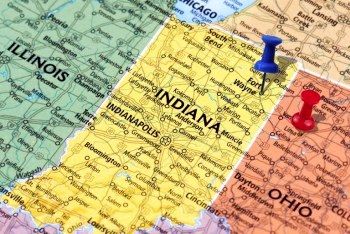
(WASHINGTON, D.C.) - In late 2015 through early 2016, vulnerable girls
as young as 14 and 16 were being exploited as part of a sex trafficking
ring run by a group of conspirators in Ohio and Indiana.
But thanks to a joint law enforcement effort conducted by the FBI-led
Toledo Child Exploitation Task Force, the ringleader of the conspiracy
as well as the other six participants were eventually brought to justice
and sentenced to lengthy federal prison terms.
The case started in December 2015, when the Lima (Ohio) Police
Department began investigating allegations of human trafficking and
forced prostitution involving a juvenile victim.
One of the Lima officers who originally interviewed the victim was also a
member of the Child Exploitation Task Force. That officer—based on his
previous task force experiences—understood that the interstate aspects
of the case made it a good candidate for federal jurisdiction, which
often results in enhanced investigative resources and stronger criminal
justice penalties.
So the case was referred to the task force—specifically to Special Agent
Devon Lossick, the task force coordinator who works out of the FBI
Cleveland Division’s Toledo Resident Agency.
According to Lossick, Lima resident Lorenzo Young was the leader of the
group and was assisted, in varying degrees, by his longtime friend
Aundre Davis, as well as by his girlfriend, mother, and three
acquaintances.
“Members of the conspiracy would go after vulnerable and trusting young
girls—usually runaways and others estranged from their families—by
promising them money and then coaxing them into posing for sexually
explicit photos,” Lossick explained.
The photos would be posted to the adult entertainment sections of a
classified ads website; when interested customers reached out, the girls
would be transported to apartments in Lima or to motel rooms in nearby
Fort Wayne across the Indiana state line.
“Especially in these kinds of cases, the victims always come first.”
Devon Lossick, special agent, FBI Cleveland (Toledo Resident Agency)
“And the financial proceeds of the transactions would go straight into
the pockets of Young and his co-conspirators,” said Lossick.
Once the task force was on the case, investigators began to question
some of the victims, gathered motel records and receipts, reviewed video
surveillance, and conducted physical surveillance and court-authorized
electronic surveillance on the suspects.
At one point, Young suspected he might be under federal investigation
and began instructing his mother to delete text messages and e-mails
related to the criminal activity. Young also directed others in the
conspiracy to post threatening messages on social media to discourage
the victims from talking to law enforcement.
By June 2016, investigators had enough evidence, and seven
individuals—including Young—were charged by a federal jury in Ohio. Five
were indicted on human trafficking charges, and two on charges related
to obstructing the investigation.
Five subjects eventually pleaded guilty and were sentenced, but Lorenzo
Young and his friend Aundre Davis opted for a trial. Both were convicted
at trial in May 2017, and in December 2017, Young was sentenced to life
in prison, while Davis received a 30-year term.
Lossick firmly believes that the successful outcome of this case was the
result of “strong and collaborative relationships between the FBI and
the law enforcement agencies on the task force—especially the Lima
Police Department, who we worked with closely on this particular
investigation.”
And of the ongoing work of the Toledo Child Exploitation Task Force,
Lossick says that “it continues to be successful at getting kids out of
harm’s way and giving victims the support they need to get on with their
lives.”
In the Lorenzo Young case, FBI victim-witness specialists from both the
Cleveland and Cincinnati Divisions worked with the juveniles exploited
by Young and his crew, providing them with emergency support, crisis
intervention help, social services referrals, information about their
case, and other victim assistance services.
“Especially in these kinds of cases,” explained Lossick, “the victims always come first.”
‘Revolutionary’
observations suggest the first stars appeared 180m years after the big
bang – and may hold information on dark matter
An
artist’s impression of the universe’s first, massive, blue stars
embedded in gaseous filaments, with the cosmic microwave background just
visible at the edges. Illustration: NR Fuller, National Science
Foundation
Hannah Devlin Science correspondent @hannahdev Wed 28 Feb 2018 18.00 GMT
Astronomers
have detected a signal from the first stars as they appeared and
illuminated the universe, in observations that have been hailed as
“revolutionary”.
The faint radio signals suggest the universe was lifted out of total
darkness 180m years after the big bang in a momentous transition known
as the cosmic dawn.
The faint imprint left by the glow of the earliest stars also appears to
contain new and unexpected evidence about the existence and nature of
dark matter which, if confirmed by independent observatories, would mark
a second major breakthrough.
“Finding this minuscule signal has opened a new window on the early
universe,” said Judd Bowman of Arizona State University, whose team set
out to make the detection more than a decade ago. “It’s unlikely we’ll
be able to see any earlier into the history of stars in our lifetime.”
Following the big bang, the universe initially existed as a cold,
starless expanse of hydrogen gas awash with radiation, known as the
Cosmic Microwave Background. This radiation still permeates all of space
today and astronomers are beginning to scrutinise this cosmic backdrop
for traces of events that occurred in the deep past.
During
the next 100m years – a period known as the dark ages – gravity pulled
slightly denser regions of gas into clumps and eventually some collapsed
inwards to form the first stars, which were massive, blue and
short-lived. As these stars lit up the surrounding gas, the hydrogen
atoms were excited, causing them to start absorbing radiation from the
Cosmic Microwave Background at a characteristic wavelength.
This led scientists to predict that the cosmic dawn must have left an
imprint in the Cosmic Microwave Background radiation in the form of a
dip in brightness at a specific point in the spectrum that ought, in
theory, to still be perceptible today.
In practice, detecting this signal has proved hugely challenging,
however, and has eluded astronomers for more than a decade. The dip is
swamped by other, more local, sources of radio waves. And the expansion
of the universe means the signal is “red-shifted” away
from its original characteristic wavelength by an amount that depends
on precisely when the first stars switched on. So scientists were also
not sure exactly where in the spectrum they should be looking –and some
predicted the task would prove impossible.
“The team have to pick up radio waves and then search for a signal
that’s around 0.01% of the contaminating radio noise coming from our own
galaxy,” said Andrew Pontzen, a cosmologist at University College
London. “It’s needle-in-a-haystack territory.”
Remarkably, Bowman and colleagues appear to have overcome these odds
using a small, crude-looking instrument the size of a small table. The
Edges (Experiment to Detect Global EoR Signature) antenna sits in a
remote region of Western Australia where there are few human sources of
radio waves to interfere with incoming signals from the distant
universe. The wavelength of the dip suggest that the cosmic dawn
occurred about 180m years after the big bang, 13.6bn years ago and nine
billion years before the birth of the sun.
The signal also indicated a second milestone at 250m years after the big
bang, when the early stars died and black holes, supernovae and other
objects they left behind heated up the the remaining free hydrogen with
x-rays.
In a paper published in the journal Nature,
Bowman and colleagues detail the elaborate experimental steps they took
to prove the signal was real – several years of replications, changing
the angle of the antenna, altering the setup.
The
Edges antenna, which consists of two rectangular metal panels mounted
horizontally on fibreglass legs above a metal mesh. It sits in a remote
part of Western Australia Photograph: Dragonfly Media/CSIRO Australia
“Telescopes cannot see far enough to directly image such ancient stars,
but we’ve seen when they turned on in radio waves arriving from space,”
said Bowman.
Emma Chapman, Royal Astronomical Society research fellow at Imperial
College London, described the result as “an incredible achievement,
constituting the first ever detection of the era of the first stars”.
The huge significance of the result, she added, meant it needed to be
replicated by an independent experiment.
The detection also contained a major surprise. The size of the dip was
twice as big as predicted. This suggests the primordial hydrogen gas was
absorbing more background radiation than predicted and would suggest
the universe was significantly colder than previously thought, at about
-270C.
One potentially groundbreaking explanation for this is that the hydrogen
gas was losing heat to dark matter. Until now, the existence of dark
matter – the elusive substance that is thought to make up 85% of the
matter in the universe – has only been inferred indirectly from its
gravitational effects. If confirmed, these results would suggest a new
form of interaction between normal matter and dark matter, mediated by a
fundamental force that until now has been entirely unknown.
The theory would also suggest that dark matter particles, the properties
of which remain completely mysterious, must be light rather than heavy,
which would rule out one of the leading hypothetical candidates for
dark matter, known as weakly interacting massive particles – or wimps.
Lincoln Greenhill, a senior astronomer at Harvard University, said that
if confirmed the dark matter observations could be revolutionary. “We
know so little about it that there are many theories as to what dark
matter is,” he said. “Many may shortly be eliminated from the running.”
This article was amended on 28 February to clarify the way new evidence on the temperature of the universe was expressed.
Women with bigger waists relative to their hips are at more risk of
heart attacks than men of a similar "apple shape", research from the
George Institute for Global Health says.
The study showed waist-to-hip ratio to be a better heart attack
predictor than general obesity - 18% stronger than body mass index in
women and 6% in men.
The report found a high BMI was linked to heart disease risk in both sexes.
The researchers interviewed nearly 500,000 UK adults aged 40 to 69.
Dr Sanne Peters, the report's lead author, from the institute, which is
at the University of Oxford, said: "Our findings support the notion that
having proportionally more fat around the abdomen (a characteristic of
the apple shape) appears to be more hazardous than more visceral fat,
which is generally stored around the hips (the pear shape)."
She said that "looking at how fat tissue is distributed in the body -
especially in women - can give us more insight into the risk of heart
attack than measures of general obesity".
Dr Peters added: "Understanding the role sex differences in body fat
distribution play in future health problems could lead to sex-specific
public health interventions that could address the global obesity
epidemic more effectively."
The report said that body composition and fat distribution differed
markedly between the sexes, with women having a predominance of fat mass
and subcutaneous fat and men having lean mass and visceral fat.
It added: "Our study has several strengths, including the prospective
design, large sample size, and direct measurement of general and central
adiposity on all participants.
"However, the UK Biobank is a largely white population, and further
analyses are needed to determine the generalisability to other
populations."
Heart attack symptoms
chest pain - a sensation of pressure, tightness or squeezing in the centre of your chest
pain
in other parts of the body - it can feel as if the pain is travelling
from your chest to your arms (usually the left arm is affected, but it
can affect both arms), jaw, neck, back and abdomen
feeling lightheaded or dizzy
sweating
shortness of breath
feeling or being sick
overwhelming sense of anxiety (similar to having a panic attack)
coughing or wheezing
Although the chest pain is often severe, some people may feel only minor
pain, similar to indigestion. In some cases, there may not be any chest
pain at all, especially in women, the elderly and people with diabetes.
Ashleigh Doggett, senior cardiac nurse at the British Heart Foundation,
said: "Considering the large amount of UK participants, this is a very
interesting study which highlights that obesity remains a risk factor
for heart attacks in both men and women.
"Interestingly, it suggests that those of us who are 'apple' as opposed
to 'pear' shape, especially women, may be at higher risk of a heart
attack.
"We know from previous BHF research that women are often misdiagnosed
initially when having a heart attack so how we store fat and our body
shape may be an important factor for medical staff to consider when
making a diagnosis.
"The study highlights the need for similar research amongst more diverse
populations, and for further research into sex differences which could
lead the way in treating patients on an individualised basis."


 Feb-27-2018



 Senior
adviser Jared Kushner’s lack of foreign policy experience has been a
concern within the White House, current and former officials say. (Jabin
Botsford/The Washington Post)
Senior
adviser Jared Kushner’s lack of foreign policy experience has been a
concern within the White House, current and former officials say. (Jabin
Botsford/The Washington Post) The cruise ship Costa Concordia off the Italian island of Giglio, on Jan. 14, 2012. (Laura Lezza/Getty Images)

 If
we take their findings as read and assume that Xi gets his way, the
prospect that this president will eventually be succeeded by another
enduring and entrenched authoritarian is more than likely. That is a
worrying prognosis. Xi has eliminated his political rivals and
emasculated alternative power centres. Should a truly dangerous dictator
come to power, he would find a cowed elite, weak institutional
constraints, and a compliant public unused to political mobilisation.
Xi’s move, perhaps ironically and however unintended, lays the
groundwork for another Mao to emerge – presenting the biggest risk of
all in Xi’s gambit.
If
we take their findings as read and assume that Xi gets his way, the
prospect that this president will eventually be succeeded by another
enduring and entrenched authoritarian is more than likely. That is a
worrying prognosis. Xi has eliminated his political rivals and
emasculated alternative power centres. Should a truly dangerous dictator
come to power, he would find a cowed elite, weak institutional
constraints, and a compliant public unused to political mobilisation.
Xi’s move, perhaps ironically and however unintended, lays the
groundwork for another Mao to emerge – presenting the biggest risk of
all in Xi’s gambit.
 FEBRUARY 28, 2018

 Astronomers
have detected a signal from the first stars as they appeared and
illuminated the universe, in observations that have been hailed as
“revolutionary”.
Astronomers
have detected a signal from the first stars as they appeared and
illuminated the universe, in observations that have been hailed as
“revolutionary”.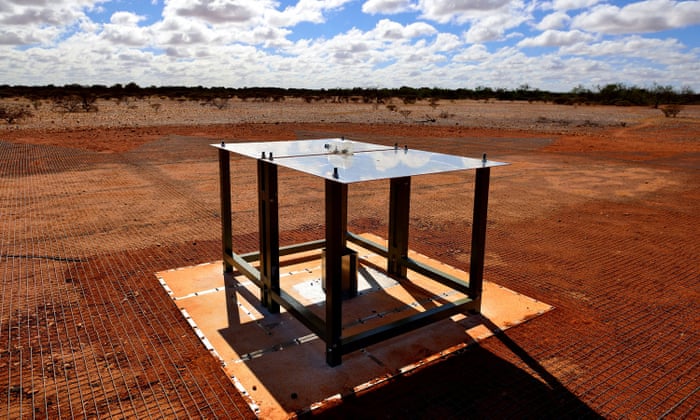 The
Edges antenna, which consists of two rectangular metal panels mounted
horizontally on fibreglass legs above a metal mesh. It sits in a remote
part of Western Australia Photograph: Dragonfly Media/CSIRO Australia
The
Edges antenna, which consists of two rectangular metal panels mounted
horizontally on fibreglass legs above a metal mesh. It sits in a remote
part of Western Australia Photograph: Dragonfly Media/CSIRO Australia