Peace for the World World ! Your War Our Lives

The Dalai Lama
A Brief Colonial History Of Ceylon(SriLanka)
Sri Lanka: One Island Two Nations
A Brief Colonial History Of Ceylon(SriLanka)
Sri Lanka: One Island Two Nations
(Full Story)
Back to 500BC.

Wednesday, August 31, 2016
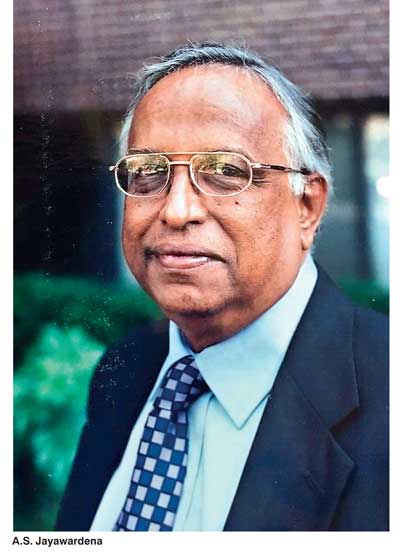
Economics of A.S Jayawardena Part III: AS’s short spell as Central Bank’s Economic Research Director

Monday, 29 August 2016
The summary of the episodes so far
The first part of this series looked at how AS, a radical socialist economist in his young days, was converted to a free market economic thinker. The second part dealt with how he took forward the mission of the Bank of Ceylon, as its GM, to transform it from the elite’s bank to the common man’s bank.
His transformation was supported by his studies at both the London School of Economics and Harvard University and his association with the world-renowned economists he met at both places.
The discipline he had got at LSE had helped him to work with Colvin R de Silva, a diehard Marxist, cordially as his advisor at the Ministry of Plantation Industry. Colvin, despite his socialist thinking and inclination, was a pragmatic thinker. His advice to AS was that the plantations were Sri Lanka’s national wealth and that wealth should not be destroyed by uneconomically breaking up and distributing to interested parties.
Thus, AS was able to change the views of planners of the day who held very strong views as converting the newly nationalised plantations into ‘collective farms’, a very popular economic policy measure at that time.
At BOC, he continued with the policy of the Bank to enter rural and remote areas with new banking products. One was pawning as a method of providing working capital to farmers between the cultivation and the harvesting periods. Another was extending agricultural credit to farmers through its new Agrarian Service Centres. It was a difficult mission for AS for two reasons.
First, it was a politically turbulent time where the opposition had been agitating in the streets for early elections. The other was that he had to deal with a Minister of Finance who had believed that the he could do anything under the Sun. Yet, reports indicate that the Minister did not interfere with the administration of the Bank unduly leaving it to the Chairman and GM. Hence, AS was able to play an apolitical role at BOC.
AS’s taking over the mantle of the Bank’s Economic Research Department
After the change of the Government in July 1977, AS returned to the Central Bank in December 1977 and was appointed as the Director of the Bank’s Economic Research Department, a position commonly known as DER, from January 1978.
But he had to head an Economic Research Department sans its ‘statistics compilation part’. That part had been under its purview ever since the Bank had been established in 1950. But when AS became DER, it had been divorced into a separate Department of Statistics. The logic for the sudden divorce, as the Central Bank had claimed at that time, was that Statistics would compile statistics and Economic Research would analyse the same.
However, AS could function as DER only for two years. In 1980, he was packed and sent to IMF as its Alternative Executive Director by the Government opening a new career chapter for him.
In effect, DER is the technical advisor to the Government
The post of DER is a prestigious position in the Central Bank. That is one of the two Departments mentioned by name in the Monetary Law Act or MLA which the Bank should necessarily have in its organisational structure. The Head of the Department is designated in MLA as Director with powers to call for information from any institution including governmental bodies. Failure to comply has been made a criminal offence in MLA.
 DER
is also the only officer who can attend the Monetary Board meetings as a
right according to MLA. Hence, by implication, DER is the technical
advisor to the Monetary Board; by the same argument, since the Monetary
Board is the technical advisor to the Government, by implication, DER is
the technical advisor to the Government as well. Hence, the person
holding the post of DER in the Central Bank should be an economist par
excellence with wide knowledge on both the local and global economic
conditions.
DER
is also the only officer who can attend the Monetary Board meetings as a
right according to MLA. Hence, by implication, DER is the technical
advisor to the Monetary Board; by the same argument, since the Monetary
Board is the technical advisor to the Government, by implication, DER is
the technical advisor to the Government as well. Hence, the person
holding the post of DER in the Central Bank should be an economist par
excellence with wide knowledge on both the local and global economic
conditions.
John Exter: Economic Research is the brain of the Central Bank
John Exter, the architect of the Central Bank, has elaborated on the importance of ERD in his report to the Government as follows: “The Department of Economic Research is given special recognition in the draft law in order to emphasise its importance. While there may be a tendency in highly developed countries to attach too much importance to economic research, the opposite is more likely to be true in underdeveloped countries. It is to be hoped that the Central Bank will be able to demonstrate in Ceylon how much a properly organised and adequately supported research unit can contribute to the formation of policy. It may not be too much to say that the solid achievements of the Central Bank in the years to come will depend as much upon the successful development of this department as upon anything else” (p 17).
DER shouldn’t be the mouthpiece of the government in power
Hence, DER is not expected to function as the mouthpiece of the Government in power or the Governor of the Bank. He should be an independent, impartial and objective economist who would guide the Monetary Board and the Government in the correct economic path.
A paradigm shift in economic policy in 1977
At the time when AS became DER, Sri Lanka’s economy had begun to undergo a complete change in its policy stance. AS called it “a watershed in economic history of the country”. Modern economists might call it ‘a paradigm shift’. This was because the package introduced in late 1977 was a complete departure from the policy package that had been in place in the previous periods.
Chapter 1 of CB Annual Report is the prerogative of DER
One of the responsibilities of DER is to prepare the annual report of the Bank which the Monetary Board submits to the Minister of Finance. The contributions to the annual report come from various divisions suitably edited at various levels. But Chapter 1 of the report has been a prerogative of DER, permitting him to present his own economic philosophy, analysis and way forward suggestions.
AS used this opportunity to bring forth a constructive criticism of the policy package that was discarded and the one that was just introduced. While highlighting the weaknesses of the discarded one, he critically examined the new package and laid out the essential ground conditions that had to be put in place for it to succeed.
Welcoming the economic liberalisation move
In the Annual Report for 1977, he made the following comment on the sluggish industrial growth of the country: “There has been a strong emphasis on the public sector with regard to investment and raw material allocations in recent times; but the productivity of the sector has been much below expectations. This can be attributed to monopoly power, lack of incentives and of managerial expertise and heavy handed interference in production, pricing and employment policies. These problems have to be resolved if this sector is to be made efficient.....Many public sector enterprises make financial losses on account of uneconomic social obligations (such as regional development, price restraint to keep cost of living low) thrust upon them; and in such instances, financial profitability would not be a reliable indicator of efficiency.” (p 2).
AS also commented on the predicaments which the private sector had to undergo in that state sector-led industrialisation policy era. He said: “On the other hand, private sector industry was faced with endemic problems of bureaucratic controls over raw material and machinery imports.....Those industries, by and large, have been protected for too long, sometimes enjoying considerable monopoly power and, as a result, have tended to be unenterprising and inward-looking.” He had therefore welcomed the liberalisation of the import of raw-materials and machinery by the new Government.
Correcting the overvalued exchange rate in 1977
Sri Lanka had maintained a fixed exchange rate system for nearly three decades since independence. This fixed exchange rate system could not survive after 1960s when the country had started to experience widening gaps between its foreign exchange inflows and foreign exchange outflows, a situation known as having a continuous deficit in the balance of payments.
Under ordinary circumstances, the exchange rate has to depreciate in order to eliminate the deficit automatically. But, since the country had maintained a fixed exchange rate system, the rupee had been overvalued against foreign currencies.
Despite this, the Government of Sirimavo Bandaranaike, on instructions from its powerful Minister of Finance, Felix R. Dias Bandaranaike, had revalued the rupee by 20%, as a political strategy to win the elections.
AS, in the Annual Report for 1977, had faulted the Government on this count. He had remarked that the revaluation had been done by the Government. He said: “Although there was no clear evidence that the improvement in the payments position was due to any structural strength in the economy,” (p 3).
Hence, the new Government had to allow the rupee to depreciate substantially, from around Rs. 8 per dollar to Rs 16 per dollar. As a consequence of this massive depreciation, the rupee value of the country’s foreign assets too increased significantly. But that increase was not a matter for rejoicing since, as the Annual Report 1977 had remarked, a fair portion of the increase was due to revaluing the external assets by using the depreciated exchange rate.
The main malaise in the economy, according to AS
AS had diagnosed the main malaise in the country’s economy and summarised in the Annual Report for 1977. Sri Lanka had been successful in the past in containing population growth and achieving a more equitable distribution of income.
However, the slow economic growth recorded by Sri Lanka had not permitted the country to sustain these achievements. Thus, the Annual Report had commented: “The new economic policy (of the new Government) stemmed from a basic diagnosis of the malaise, namely, that a continued allocation of a large volume of resources to consumption was inimical to economic growth and generation of employment; that the rigid control system that had been built up over the years had seriously distorted the relative prices, and had dampened private sector incentives; that the public sector which was fostered to fill the vacuum had become wasteful and complacent and that successive governments had failed to take corrective action but had resorted only to short-term palliatives which had only compounded the problems,” (p 4).
Thus, according to AS, the solution lay in Sri Lanka’s shifting of a large volume of resources from consumption to investment. However, he warned that the success of the corrective measures by the new Government would depend crucially on its ability to carry it to its logical conclusion and the speed at which the new policy would bring about an increase in output, incomes and employment. It was also necessary, according to AS, for various Government machineries to fully understand the thrust of the new economic policies being pursued by the Government in order to ensure mutual consistency of the policies adopted by them.
Moving from inward-looking to export oriented policy
This position was further elaborated by AS in the other Annual Report he had produced. Accordingly, in the first part of the Annual Report for 1978, he marked 1977 as a clear watershed on the economic history of Sri Lanka.
Why did he say so? That was because the policy package had turned the country “away from a predominantly inward looking, tightly controlled and welfare oriented strategy to one which primarily emphasised export growth, competition and higher capital investment for economic growth and employment generation. The year 1978 was the first full year under the new economic regime, and several problems in adjusting from a controlled regime to a liberalised one were evident. But the spontaneous and immediate response of the economy to the new economic policy in achieving a high growth rate was the most encouraging feature of 1978,” (p 8).
The need for continuing with the reform program
AS’s reference here is to the real growth rate of 8.2% which Sri Lanka’s economy had attained in 1978. But this high growth could just be one off event and not one that could be repeated successfully in the years to come unless the country had gone for a comprehensive economic reform program.
Thus, AS advised the Government in the same Annual Rate as follows: “In the immediate future and in the long run, the maintenance of such a growth momentum would require a higher level of savings and investment and further policy decisions aimed at fostering economic growth. A difficult trade-off between the interests of consumers and producers would be required. Remaining monopolistic powers and non-productive controls would have to be whittled down. An acceptable balance between growth and equity will have to be worked out. The economy, in its performance in 1978, has clearly shown that, given appropriate policy climate, it has the potential of moving to a path of sustained economic development,” P 8).
Abandoning the reform program in midway stream
The subsequent evidence has shown that this is where the Sri Lankan authorities had faltered. Instead of continuing with the liberalisation and reform program, it was stopped in midway stream and was not carried to a logical conclusion as AS had desired.
The Government in power had relied on its investment in irrigation infrastructure and not on economic reforms for generating wealth and prosperity. The result was that the high growth reported in 1978 was just one off-event and could not be repeated subsequently. Even as early 1990s, the country’s economic reform program was practically at the same stage as it was started in 1977 and 1978. It was thus left to President Chandrika Bandaranaike Kumaratunga who advocated for a market economy with a human face in her bid for Presidency in 1994 to carry it to a logical conclusion.
In her Government, AS was the Treasury Secretary for the first two years and Governor of the Central Bank for the remaining period. His contribution to economic policy reforms during this period will be discussed in a later piece.
(W.A. Wijewardena, a former Deputy Governor of the Central Bank of Sri Lanka, can be reached at waw1949@gmail.com).
Monday, 29 August 2016
The summary of the episodes so far
The first part of this series looked at how AS, a radical socialist economist in his young days, was converted to a free market economic thinker. The second part dealt with how he took forward the mission of the Bank of Ceylon, as its GM, to transform it from the elite’s bank to the common man’s bank.
His transformation was supported by his studies at both the London School of Economics and Harvard University and his association with the world-renowned economists he met at both places.
The discipline he had got at LSE had helped him to work with Colvin R de Silva, a diehard Marxist, cordially as his advisor at the Ministry of Plantation Industry. Colvin, despite his socialist thinking and inclination, was a pragmatic thinker. His advice to AS was that the plantations were Sri Lanka’s national wealth and that wealth should not be destroyed by uneconomically breaking up and distributing to interested parties.
Thus, AS was able to change the views of planners of the day who held very strong views as converting the newly nationalised plantations into ‘collective farms’, a very popular economic policy measure at that time.
At BOC, he continued with the policy of the Bank to enter rural and remote areas with new banking products. One was pawning as a method of providing working capital to farmers between the cultivation and the harvesting periods. Another was extending agricultural credit to farmers through its new Agrarian Service Centres. It was a difficult mission for AS for two reasons.
First, it was a politically turbulent time where the opposition had been agitating in the streets for early elections. The other was that he had to deal with a Minister of Finance who had believed that the he could do anything under the Sun. Yet, reports indicate that the Minister did not interfere with the administration of the Bank unduly leaving it to the Chairman and GM. Hence, AS was able to play an apolitical role at BOC.
AS’s taking over the mantle of the Bank’s Economic Research Department
After the change of the Government in July 1977, AS returned to the Central Bank in December 1977 and was appointed as the Director of the Bank’s Economic Research Department, a position commonly known as DER, from January 1978.
But he had to head an Economic Research Department sans its ‘statistics compilation part’. That part had been under its purview ever since the Bank had been established in 1950. But when AS became DER, it had been divorced into a separate Department of Statistics. The logic for the sudden divorce, as the Central Bank had claimed at that time, was that Statistics would compile statistics and Economic Research would analyse the same.
However, AS could function as DER only for two years. In 1980, he was packed and sent to IMF as its Alternative Executive Director by the Government opening a new career chapter for him.
In effect, DER is the technical advisor to the Government
The post of DER is a prestigious position in the Central Bank. That is one of the two Departments mentioned by name in the Monetary Law Act or MLA which the Bank should necessarily have in its organisational structure. The Head of the Department is designated in MLA as Director with powers to call for information from any institution including governmental bodies. Failure to comply has been made a criminal offence in MLA.
DER
is also the only officer who can attend the Monetary Board meetings as a
right according to MLA. Hence, by implication, DER is the technical
advisor to the Monetary Board; by the same argument, since the Monetary
Board is the technical advisor to the Government, by implication, DER is
the technical advisor to the Government as well. Hence, the person
holding the post of DER in the Central Bank should be an economist par
excellence with wide knowledge on both the local and global economic
conditions. John Exter: Economic Research is the brain of the Central Bank
John Exter, the architect of the Central Bank, has elaborated on the importance of ERD in his report to the Government as follows: “The Department of Economic Research is given special recognition in the draft law in order to emphasise its importance. While there may be a tendency in highly developed countries to attach too much importance to economic research, the opposite is more likely to be true in underdeveloped countries. It is to be hoped that the Central Bank will be able to demonstrate in Ceylon how much a properly organised and adequately supported research unit can contribute to the formation of policy. It may not be too much to say that the solid achievements of the Central Bank in the years to come will depend as much upon the successful development of this department as upon anything else” (p 17).
DER shouldn’t be the mouthpiece of the government in power
Hence, DER is not expected to function as the mouthpiece of the Government in power or the Governor of the Bank. He should be an independent, impartial and objective economist who would guide the Monetary Board and the Government in the correct economic path.
A paradigm shift in economic policy in 1977
At the time when AS became DER, Sri Lanka’s economy had begun to undergo a complete change in its policy stance. AS called it “a watershed in economic history of the country”. Modern economists might call it ‘a paradigm shift’. This was because the package introduced in late 1977 was a complete departure from the policy package that had been in place in the previous periods.
Chapter 1 of CB Annual Report is the prerogative of DER
One of the responsibilities of DER is to prepare the annual report of the Bank which the Monetary Board submits to the Minister of Finance. The contributions to the annual report come from various divisions suitably edited at various levels. But Chapter 1 of the report has been a prerogative of DER, permitting him to present his own economic philosophy, analysis and way forward suggestions.
AS used this opportunity to bring forth a constructive criticism of the policy package that was discarded and the one that was just introduced. While highlighting the weaknesses of the discarded one, he critically examined the new package and laid out the essential ground conditions that had to be put in place for it to succeed.
Welcoming the economic liberalisation move
In the Annual Report for 1977, he made the following comment on the sluggish industrial growth of the country: “There has been a strong emphasis on the public sector with regard to investment and raw material allocations in recent times; but the productivity of the sector has been much below expectations. This can be attributed to monopoly power, lack of incentives and of managerial expertise and heavy handed interference in production, pricing and employment policies. These problems have to be resolved if this sector is to be made efficient.....Many public sector enterprises make financial losses on account of uneconomic social obligations (such as regional development, price restraint to keep cost of living low) thrust upon them; and in such instances, financial profitability would not be a reliable indicator of efficiency.” (p 2).
AS also commented on the predicaments which the private sector had to undergo in that state sector-led industrialisation policy era. He said: “On the other hand, private sector industry was faced with endemic problems of bureaucratic controls over raw material and machinery imports.....Those industries, by and large, have been protected for too long, sometimes enjoying considerable monopoly power and, as a result, have tended to be unenterprising and inward-looking.” He had therefore welcomed the liberalisation of the import of raw-materials and machinery by the new Government.
Correcting the overvalued exchange rate in 1977
Sri Lanka had maintained a fixed exchange rate system for nearly three decades since independence. This fixed exchange rate system could not survive after 1960s when the country had started to experience widening gaps between its foreign exchange inflows and foreign exchange outflows, a situation known as having a continuous deficit in the balance of payments.
Under ordinary circumstances, the exchange rate has to depreciate in order to eliminate the deficit automatically. But, since the country had maintained a fixed exchange rate system, the rupee had been overvalued against foreign currencies.
Despite this, the Government of Sirimavo Bandaranaike, on instructions from its powerful Minister of Finance, Felix R. Dias Bandaranaike, had revalued the rupee by 20%, as a political strategy to win the elections.
AS, in the Annual Report for 1977, had faulted the Government on this count. He had remarked that the revaluation had been done by the Government. He said: “Although there was no clear evidence that the improvement in the payments position was due to any structural strength in the economy,” (p 3).
Hence, the new Government had to allow the rupee to depreciate substantially, from around Rs. 8 per dollar to Rs 16 per dollar. As a consequence of this massive depreciation, the rupee value of the country’s foreign assets too increased significantly. But that increase was not a matter for rejoicing since, as the Annual Report 1977 had remarked, a fair portion of the increase was due to revaluing the external assets by using the depreciated exchange rate.
The main malaise in the economy, according to AS
AS had diagnosed the main malaise in the country’s economy and summarised in the Annual Report for 1977. Sri Lanka had been successful in the past in containing population growth and achieving a more equitable distribution of income.
However, the slow economic growth recorded by Sri Lanka had not permitted the country to sustain these achievements. Thus, the Annual Report had commented: “The new economic policy (of the new Government) stemmed from a basic diagnosis of the malaise, namely, that a continued allocation of a large volume of resources to consumption was inimical to economic growth and generation of employment; that the rigid control system that had been built up over the years had seriously distorted the relative prices, and had dampened private sector incentives; that the public sector which was fostered to fill the vacuum had become wasteful and complacent and that successive governments had failed to take corrective action but had resorted only to short-term palliatives which had only compounded the problems,” (p 4).
Thus, according to AS, the solution lay in Sri Lanka’s shifting of a large volume of resources from consumption to investment. However, he warned that the success of the corrective measures by the new Government would depend crucially on its ability to carry it to its logical conclusion and the speed at which the new policy would bring about an increase in output, incomes and employment. It was also necessary, according to AS, for various Government machineries to fully understand the thrust of the new economic policies being pursued by the Government in order to ensure mutual consistency of the policies adopted by them.
Moving from inward-looking to export oriented policy
This position was further elaborated by AS in the other Annual Report he had produced. Accordingly, in the first part of the Annual Report for 1978, he marked 1977 as a clear watershed on the economic history of Sri Lanka.
Why did he say so? That was because the policy package had turned the country “away from a predominantly inward looking, tightly controlled and welfare oriented strategy to one which primarily emphasised export growth, competition and higher capital investment for economic growth and employment generation. The year 1978 was the first full year under the new economic regime, and several problems in adjusting from a controlled regime to a liberalised one were evident. But the spontaneous and immediate response of the economy to the new economic policy in achieving a high growth rate was the most encouraging feature of 1978,” (p 8).
The need for continuing with the reform program
AS’s reference here is to the real growth rate of 8.2% which Sri Lanka’s economy had attained in 1978. But this high growth could just be one off event and not one that could be repeated successfully in the years to come unless the country had gone for a comprehensive economic reform program.
Thus, AS advised the Government in the same Annual Rate as follows: “In the immediate future and in the long run, the maintenance of such a growth momentum would require a higher level of savings and investment and further policy decisions aimed at fostering economic growth. A difficult trade-off between the interests of consumers and producers would be required. Remaining monopolistic powers and non-productive controls would have to be whittled down. An acceptable balance between growth and equity will have to be worked out. The economy, in its performance in 1978, has clearly shown that, given appropriate policy climate, it has the potential of moving to a path of sustained economic development,” P 8).
Abandoning the reform program in midway stream
The subsequent evidence has shown that this is where the Sri Lankan authorities had faltered. Instead of continuing with the liberalisation and reform program, it was stopped in midway stream and was not carried to a logical conclusion as AS had desired.
The Government in power had relied on its investment in irrigation infrastructure and not on economic reforms for generating wealth and prosperity. The result was that the high growth reported in 1978 was just one off-event and could not be repeated subsequently. Even as early 1990s, the country’s economic reform program was practically at the same stage as it was started in 1977 and 1978. It was thus left to President Chandrika Bandaranaike Kumaratunga who advocated for a market economy with a human face in her bid for Presidency in 1994 to carry it to a logical conclusion.
In her Government, AS was the Treasury Secretary for the first two years and Governor of the Central Bank for the remaining period. His contribution to economic policy reforms during this period will be discussed in a later piece.
(W.A. Wijewardena, a former Deputy Governor of the Central Bank of Sri Lanka, can be reached at waw1949@gmail.com).

Microfinance Institutions Rake In Billions Through Unprofessional Practices


Mithula Guganeshan
Financial institution’s high-rise buildings with magnificent bill boards
trying to portray an image of success and trust is an awfully common
sight in Sri Lanka. In the meantime while the financial institutions
basks in glory, 84% of Sri Lankan’s are either financially struggling or
suffering according to the survey done by Gallup Healthways in 2014.
An ex-employee from a financial institution located in Jaffna says “We
offered loans even when we doubted about the repayment capacity of the
customer due to the high competition from other players in the region”.
He states only around 5% of the customers were able to settle the loan
and interest repayments without difficulty on time, whilst the remaining
95% are struggling. The ex-loan officer mentioned that he resigned from
his job due to the guilt associated with engaging in work misleading
and trapping people into debt in order to meet the sales target set by
the financial institution.
Debt levels are shooting up within different segments of the society
ending up as victims to opportunistic strategies designed by financial
service providers “selling happiness and freedom”
Imbalanced information
Financial institution are shrewdly exploiting and benefiting from the
existing information asymmetry. Bankers chose not to reveal certain
important information to their customers. Most of us would have had the
experience of being taken aback some of the financial institution’s
gimmicks in the form of extra charges, late payment fees and extra
charges even when one decides to settle the loan early. Some banks even
charges fees for closing bank accounts, well the excuse was to recover
the set up costs even when the account was closed, after 15 years of
use.
Financial institutions have been able to get their way with everyone from educated and financially literate customers to the poor and uneducated.
Financial institutions have been able to get their way with everyone from educated and financially literate customers to the poor and uneducated.
Microfinance institution’s exists to empower the poor or the financial institutions?
90% of microfinance loan borrowers are women according to information
published on Lanka Microfinance Practitioner’s Association. Around 77
microfinance institutions are registered with the organization, however
only 26 MFI’s have provided data thus, compromising a loan portfolio of
7.4 billion rupees. Microfinance loan portfolio is even higher as the
data provided does not compromise information on other large MFI players
posting profit in billions. [If microfinance institutions are so
effectively working towards stimulating production and alleviating
poverty, it is impossible for MFI’s to earn profit in billions?]
Mainstream media’s silence
Mainstream media could easily contribute towards creating awareness
about the unethical practices used by the financial institutions.
However, the number of financial institutions advertisements on the
papers, TV’s and radio channels would validate why media chooses to hide
the elephant in the room. Ironically, majority of the content published
about financial institutions is in the form of a paid advertisement
about products/services and the number of meaningless awards won by each
financial institution.
Advertising extravagance by the financial institutions is to mask the
truth about the core functions of modern banking system “encourage and
misguide financially illiterate customers to get into unnecessary and
excessive debts”
New bill from the PM to round up the corrupt elements

 Aug 29, 2016
According to reports this is a proposal of the Prime Minister Ranil
Wickremasinghe. This new private legislative bill is of the “Singaporean
model”. The intention of bringing in the bill is for the employees to
complete the duties entrusted with complete trust entrusting on five
areas of responsibility.. This would help the government to eradicate
irregularities to a bare minimum.
The Prime Minister had proposed the new legislative bill in response to
the 85 officers attached to various director boards representing the
Treasury had protested against the strong investigations made against
them on bribery and corruptions by submitting letters of resignation.
It is reported that the employees in the Sri Lanka petroleum
corporation, Sri Lankan Airlines, Sri Lanka Ports authority and other
such government enterprise institutions who submitted letters of
resignation would never be absorbed into the government sector. In the
meantime the private legislative bill would soon be passed in
parliament. For these vacancies it is reported that talented and
qualified persons to be absorbed to fill the vacancies, the Prime
Minister and the Minister of Finance have given instructions.
In the meantime against the investigations that are carried out in
government statutory institutions some officers have threatened to
resign. The administrative officers of the Voice against corruption
Movement have pledged that the required accountants, administrative
officers, engineers. Planning directors and other qualified personnel
would be provided for those who resign from their positions.
In this scenario it is reported that about 350 such government officers
have been formed into a forum to replace those who have threatened to
resign. The members of the Voice against corruption Movement have added
that there intention is also to create an environment where the public
service would be devoid of corruption and bribery.
At the same time it has been said that in regard to irregularities and
corruption that had taken place in the Tourist promotion authority,
against the Director General of the common enterprise division of the
treasury R Samasinghe and members director board of the previous
government the Attorney General had been notified over 02 months ago. It
is reported that by making influence to the President the arrests of
these personnel are been postponed.
These facts would make the members of the Voice against corruption
Movement more strengthened against the action taken against the corrupt
in the country was added by a spokesman of the movement..
‘Sacred’ elephants abused during Sri Lankan Buddhist festival

An amateur video shows how elephants are treated during a festival in Sri Lanka. Video shared by Saving Ganesh.
 08/29/2016
Amateur videos showing elephants being abused by handlers during one of Sri Lanka’s biggest Buddhist festivals have recently emerged. This type of abuse is not new: our Observer, a veterinarian in Sri Lanka, says that elephant owners and authorities turn a blind eye to this type of behaviour for both financial and political reasons.
The Kandy Esala Perahera festival is one of the oldest Buddhist festivals in Sri Lanka. It began as a procession that took place in the 4th century, when a relic – a tooth that was believed to belong to the Buddha – arrived on the island from India. The festival has taken place every August since 1754. During the procession, up to 200 elephants wearing beautiful costumes take turns carrying the relic. They’re the stars of the procession, which about 500,000 people gather to watch every year. During the event, they’re presented as being “sacred animals” because they are transporting the sacred relic.
Video from this year's festival, published online on August 10 and relayed by the NGO Saving Ganesh.Ganesh.
08/29/2016Amateur videos showing elephants being abused by handlers during one of Sri Lanka’s biggest Buddhist festivals have recently emerged. This type of abuse is not new: our Observer, a veterinarian in Sri Lanka, says that elephant owners and authorities turn a blind eye to this type of behaviour for both financial and political reasons.
The Kandy Esala Perahera festival is one of the oldest Buddhist festivals in Sri Lanka. It began as a procession that took place in the 4th century, when a relic – a tooth that was believed to belong to the Buddha – arrived on the island from India. The festival has taken place every August since 1754. During the procession, up to 200 elephants wearing beautiful costumes take turns carrying the relic. They’re the stars of the procession, which about 500,000 people gather to watch every year. During the event, they’re presented as being “sacred animals” because they are transporting the sacred relic.
Video from this year's festival, published online on August 10 and relayed by the NGO Saving Ganesh.Ganesh.
This status, however, doesn’t keep them from being abused. During the
past few years, Sri Lankan NGOs have published several videos filmed
during this festival and other similar ones. The video above, filmed
this August, shows trainers hitting an elephant; other videos show
elephants that the NGOs say are reacting violently to mistreatment from
humans, like this one in which an elephant runs into a crowd, or this one in which an elephant attacks cars.
Several
videos like this one, available on YouTube, show elephants attacking
humans during festivals in Sri Lanka. This video was filmed during the
Kelaniya festival in January 2016 by Shree FM.
"I’ve treated many elephants after they were injured in this festival"

Lahiru C.
This year, for the first time, the Kandy Esala Perahera festival’s
organisers admitted that they didn’t have enough elephants, and
estimated that they would need to tame about 200 more to
meet the festival’s needs in the future. According to our Observer,
Lahiru (not her real name), a veterinarian in Colombo, the animals are
treated very badly.


“The incident in the latest video is unfortunately very common. Between processions, elephants are parked in small spaces where tourists can look at them and take pictures with them. Often, elephants can’t stand being in such close proximity with other elephants and try to flee. To force them to move, trainers use spears or ankus [a type of metal hook] to poke their legs.Photos taken by a veterinarian colleague of our Observer’s. They show injuries inflicted on the animals’ feet.
I’ve treated many elephants after they were used in this festival. Some have serious wounds on their legs, which can get infected, and, in the worst cases, this leads to abscesses, pododermatitis [an inflammation of the nails and the pads under elephants’ feet], and arthritis.
"Greed often wins"The trainers behave in this manner due to a lack of experience, and due to ignorance about the consequences of their actions. For example, I’ve seen several elephants who were sent to the festival despite being in their musth phase [Editor’s Note: musth is a periodic hormonal surge that makes male elephants aggressive].
It’s very dangerous, because they behave unpredictably during this phase. But greed often wins out [Editor’s Note: an elephant can bring in between 25,000 and 50,000 Sri Lankan rupees – which equals between 150 and 300 euros – per festival day to their owners, who are usually Buddhist temples or tourism companies].
Several NGOs have complained about this abuse, leading the government to take some measures; for example they have asked organisers to be careful about the weight of the battery-powered electric lamps attached to the elephants’ clothing. It’s really heavy for them. However, we don’t know if these requests were really followed.Each year, tourists and local NGOs express shock at how elephants are treated during the festivals, notably the fact that they have to walk for kilometres with so much weight attached to them. A popular Facebook page has called on elephant lovers to give the festival bad reviews on Tripadvisor.
"The festival is a powerful political tool"
Our Observer believes that the reason that the situation hasn’t improved much is also political:
This festival showcases the importance of Sri Lankan Buddhism, whose epicentre is Kady province. Buddhism is also seen as a rampart against terrorism [Editor’s Note: it is notably a rampart against Hinduism, which is the primary religion of the Tamil people]. Keeping these traditions alive means conserving a powerful political tool, and so animal rights fall by the wayside.Sri Lankan authorities estimate than about 200 elephants are killed in the country every year, mainly by farmers trying to protect their crops. In 1900, there were about 12,000 elephants in Sri Lanka; today, there are only about 7,000 left.
Political Donations

Political parties need funds to oil their campaigns. Even before the end of one election, one campaign, funds are sought from members, well-wishers, donations and the like to fund the next.
 by Victor Cherubim
( August 30, 2016, London, Sri Lanka Guardian) Political
donations and international contracts go hand in hand. Companies vie,
seek and obtain authority to make political donations from their
shareholders and get sanction at AGM’s.
Political donations can also be kickbacks which conglomerate the world
over hand out to secure valuable contracts from governments. It is one
among many ways of competing in a highly competitive international
market for lucrative contracts.
Undercutting on contracts is big business. There are many known and
unknown ways of political donations. Offloading of commissions is also a
specialised business. There appears to be no definition of corruption.
In Sri Lanka and around the world directly asking a favour is bribery,
but there are ways around it. The loophole is that Companies and the
rich alike want to donate unlimited sums anonymously to political
parties for their own reasons. Ask a CFO and you will know why it is
done openly.
Political Campaigns
Political parties need funds to oil their campaigns. Even before the end
of one election, one campaign, funds are sought from members,
well-wishers, donations and the like to fund the next.
Political funding has been a source of controversy over years. The three
main ways a political party is funded is through membership, through
donations and through State funding, the latter only for administrative
functions.
In all three there is a requirement for transparency. Rules apply and
the Electoral Commission provides an overview and control of financial
activities of political parties.
What is the Big Deal in the Fairfax Media Australia revelation about SMEC?
Perhaps, unknown to many in Sri Lanka, this news item has more to do
with the pressure put on the Turnbull Government in Australia to reform
Australia’s maligned foreign bribery allegations.
Two Australian companies are under investigation over alleged bribery
scandals linked to the Presidents of Congo and Sri Lanka after two
different firms sought to secure multi-million dollar contracts, in
these countries. Revelations have now surfaced.
“Perth’s Sundance Resource is implicated in involving some family members of Republic of Congo President Denis Sassou Nguesso.”
“Snowy Mountain Engineering of Melbourne is being separately
investigated over claims its staff sought approval to pay kickbacks to
foreign officials including a donation to the party of Sri Lanka
President, Maitripala Sirisena, when he was Minister of Agriculture and
Agrarian Services Development, in President Mahinda Rajapaksa Government
in 2009.”
Why now?
Some seven years after the award of a World Bank Dam Project in Sri Lanka, SMEC is being investigated.
Both these allegations reflect badly on the Governments of Congo and Sri Lanka.
It could very well fit in an international pattern of whistleblowing
putting the “coalition” of Prime Minister Turnbull also on notice.
Is it too little too late especially after SMEC Holdings Ltd formerly
Snowy Mountains Engineering Corp., a Consultancy Services provider, was
offloaded by the Australian Government and taken off by staff? It has
since 1 August 2016 been acquired by Singapore-based, Surbana Jurong
(have we heard this name before).
What is the game being played? Who is hiding behind the bush? Is it in
Australia or is it elsewhere, with Japan making inroads into Africa and
South Asia recently?
17-year-old hacking suspect sent to probation school

 By Chitra Weerarathne-August 30, 2016, 10:10 pm
Chief Magistrate of Colombo Gihan Pilapitiya yesterday ordered to be
sent to a Probation School in Makola, a 17-year-old schoolboy from
Kadugannawa, suspected of hacking the Website of President Maithripala
Sirisena.
The Chief Magistrate also remanded another suspect Janith Maduwantha
from Kurunegala aged 26 years. The remand order is till Sept. 10.
The CID said a Bangladesh hacker is being suspected of aiding in the offence. It is being investigated.
The Kadugannawa schoolboy is a first year GCE A/L student studying maths in a Kandy district school.
Counsel Susantha Dolawatte appeared for the suspects.
The suspects were produced before the Chief Magistrate under Section 3, 4, 5, 7 and 8 of the Computer Crimes Act.
Minister Punchi Nilame has become anti government

Aug 30, 2016
The
paddy farmers of the Padaviya Sri Pura have accused the deputy
minister of public administration Susantha Punchi Nilame of launching
a method to curtail the scheme of purchasing the paddy of the Yala
harvest.in order to embarrass the government..
The paddy farmers of the Sri Pura had taken their Yala harvest paddy to
be sold to the Sri Pura co-operative society..They had been
inconvenienced as the required scales had not been made available.This
had been done it is learnt on the instructions of the deputy minister
Susantha Punchi Nilame had given to the co-operative authorities..Owing
to this incident the paddy farmers who had traveled a number of miles
have had to return back to Trincomalee.
It is reported that Susantha Punchi Nilame is a very close associate of
former minister of economic affairs Basil Rajapaksa.It has been made
known that during the last parliamentary general elections Basil
Rajapaksa had backed only Susantha Punchi Nilame in the election
campaign.
It is now reported that Mahinda Rajapaksa loyalists are making attempts
to interrupt the work of the government makes for the benefit of the
villages.These Mahinda Rajapaksa loyalists are been accused for making
various other attempts to curtail the activities beneficial to the
villages initiated by the government.
Suicide bomber attacks Chinese embassy in Kyrgyzstan
Kyrgyzstan’s
deputy PM says attacker died and three people were injured in Bishkek
after a car rammed the embassy’s gate before exploding
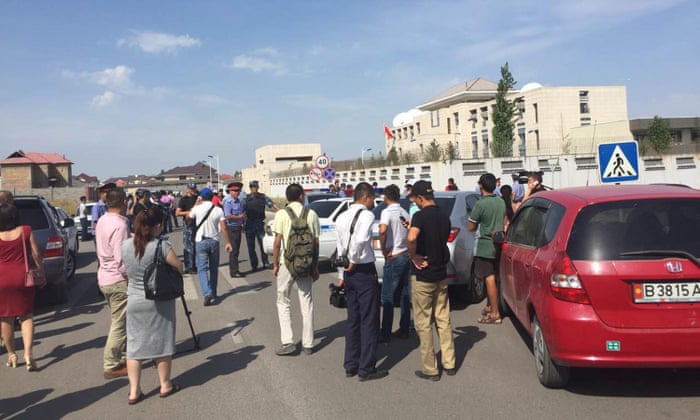
People gather near the site of the explosion in Bishkek, Kyrgyzstan. Photograph: Chen Yao/AP

A suicide bomber has rammed his car into the Chinese embassy in Bishkek, the capital of Kyrgyzstan, injuring at least three employees.
Kyrgyzstan’s deputy prime minister, Jenish Razakov, said the bomber had
died and three Kyrgyz nationals working as security guards were injured.
A source at the Bishkek police told AFP that the Mitsubishi Delica car
smashed a gate on the embassy before blowing up in the centre of the
compound, close to the ambassador’s residence.
Another source with the Central Asian nation’s security service said an “explosive device” had been placed inside the vehicle.
Video of aftermath of #China embassy car bombing in Bishkek,#Kyrgyzstan: https://youtu.be/2V2l5IRJVGU

Hua Chunying, a spokeswoman for China’s foreign ministry, said China was deeply shocked by the “extreme and violent attack”.
“We are demanding that Kyrgyzstan find out the truth rapidly and punish
[those responsible],” she told a press conference in Beijing.
Asked whether other Chinese diplomatic facilities had stepped up
security measures following the attack, Hua said: “We attach great
importance to the safety of Chinese personnel abroad. We have always
taken protective measures to ensure the safety of Chinese personnel
overseas.”
Blame for Tuesday’s attack is likely to fall on militants from the
Uighur ethnic minority who are waging what some describe as a low
intensity insurgence against Chinese rule across the border in the
Chinese region of Xinjiang.
Raffaello Pantucci, the director of international security studies at
the Royal United Services Institute, said Kyrgyzstan had a large Uighur
community and that Uighur militants were the “obvious candidates” for
the bombing. “It certainly would stack up in many ways,” he said.
Pantucci, a Xinjiang expert, said the attack appeared to have
specifically targeted the Chinese embassy, which is in an isolated
compound outside the centre of Bishkek. “The Chinese embassy isn’t
exactly in the heart of town,” he pointed out.
China has been waging what it calls a “people’s war on terror” in the
restive western region since 2014, when Uighur extremists launched
attacks on civilians, including the bombing of a street market in
Urumqi, Xinjiang’s capital.
That war has seen dozens killed and many thousands detained on terrorism charges.
“[We must] make terrorists become like rats scurrying across a street,
with everybody shouting ‘beat them!’,” President Xi Jinping declared
last year.
Advertisement
However, critics accuse China of responding to the attacks with a
campaign of fear, harassment and repression in Xinjiang. They argue that
rather than simply targeting terror groups, authorities have instead
launched a frontal assault on conservative Islam.
Critics of the crackdown believe it is breeding even greater resentment
against Chinese rule that is likely to fuel further bloodshed.
Pantucci said there was no significant history of attacks on Chinese
interests in Central Asia but there did seem to be a growing trend of
such incidents around the globe.
As well as Tuesday’s attack, the academic pointed to the deadly 2015
bombing of Bangkok’s Erawan Shrine, which was a popular destination for
Chinese tourists.
“If we take that [Thailand attack] and we take this – if it proves to be
linked to Uighur militants – you are seeing a problem which is really
starting now to export itself globally … that really lived in southern
Xinjiang and then spread across the province, then spread across the
country, and now is showing up globally.
“You are dealing with a problem that is metastasising negatively in a way that is really quite worrying.”
Additional reporting by Christy Yao
Yemen civil war has killed at least 10,000 people, says UN
UN's humanitarian coordinator almost doubles previous estimates, saying even that figure could be low due to conditions in Yemen

At least 70 people were killed in the bombing of Aden army camp on Monday (AFP)
 Tuesday 30 August 2016
At least 10,000 people have been killed in Yemen's 18-month-old civil
war, the United Nations said on Tuesday, almost double the estimates of
more than 6,000 cited by officials and aid workers for much of 2016.
Jamie McGoldrick, the UN's humanitarian coordinator, told a news
conference in the Yemeni capital of Sanaa the new figure was based on
official information from medical facilities.
That figure could still be under-reported as some areas had no medical
facilities, and people were often buried without any official record
being made.
The conflict has forced three million Yemenis from their homes, 200,000 of whom had sought refuge abroad, McGoldrick said.
The UN had information that 900,000 of those displaced intended to try to return to their homes, he said.
"This is a big challenge, especially in areas still experiencing conflict," McGoldrick said.
 UN humanitarian coordinator Jamie McGoldrick (Reuters)
More than half of Yemen's 26 million population need food aid and seven million are suffering from food insecurity, he said.
Yemen has been torn apart by fighting between Houthi rebels, who are
allegedly directly supported by Iran, and the Saudi-backed government of
president Abd Rabbuh Hadi.
The Houthis kicked Hadi and his government out of the capital, Sanaa, in early 2015 and forced him into exile in Riyadh.
Since then, Saudi Arabia launched a coalition to reinstate the president, taking Aden from the Houthis and basing troops there.
The Saudi-led coalition's campaign has been criticised by international
organisations for causing mass casualties among civilians by bombing
schools, hospitals and residential areas. The UN has called for an
investigation of violations.
The UK has been cited by various campaigners for selling billions of
dollars of weapons to Riyadh despite evidence it has broken
international law in Yemen.
Meanwhile, groups such as the Islamic State and al-Qaeda have capitalised on the growing insecurity in Yemen.
Efforts to secure a peaceful end to the war have failed, with both sides
leaving weeks-long talks in Kuwait earlier this year without
resolution.
McGoldrick's statement came a day after at least 70 people were reported
killed in a suicide bombing of an army recruitment camp in the southern
city of Aden.
The Islamic State group claimed the attack.
The questions al-Qaida’s rebranded Syria affiliate won’t answer

Jabhat Fateh al-Sham spokesperson
Mostafa Mahamed has tried to soften the Syrian armed group’s image
since it ostensibly broke from al-Qaida in July.

Al-Qaida’s affiliate in Syria refused to grant The Electronic Intifada
an interview, accusing the publication of “unprofessional” journalism.
This rejection comes as the group is reaching out to other English-language media outlets as part of a slick marketing effort.
Late last month al-Qaida’s branch in Syria launched a rebranding campaign, changing its name from Jabhat al-Nusra (Victory
Front) to Jabhat Fateh al-Sham (JFS), or Front for the Conquest of
Greater Syria, and claiming to have severed ties with its parent
organization.
The group has since received widespread attention and an increasingly
warm reception from Western media for playing a leading role among an
assortment of opposition groups in breaking the Syrian government’s
siege of Aleppo.
JFS dispatched Egyptian-born Australian fighter Mostafa Mahamed to
provide Western audiences with a kinder and gentler image of the group,
one detached from Osama bin Laden and the indelible images of the 9/11
attacks.
A charismatic and highly educated native
English speaker, the 32-year-old Mahamed, who also goes by the name Abu
Sulayman al-Muhajir, knows how to communicate with Western audiences
and portray the al-Qaida affiliate in soft focus.
Addressing Mahamed respectfully as “the Sheikh,” Sky News presented
JFS as a unifying force in Syria’s five-year civil war that has
devolved into an international proxy war among myriad foreign actors
including the US, Russia, European states, Turkey, Saudi Arabia, Qatar,
Lebanon’s Hizballah and Iran.
The Intercept’s Murtaza
Hussain posed somewhat more challenging questions to Mahamed, but so
far Western media have failed to ask JFS some key challenging questions.
Reaching out
Jenan Moussa, a reporter for Dubai-based Al-Aan TV, has criticized these
interviews, suggesting that “al-Qaida/JFS is personally approaching
western journalists via social media and offering them interviews.
Journalists then agree.” The interviews “aren’t the result of hard
journalistic work but only [the] result of JFS sending [direct messages]
on Twitter,” Moussa claimed.
The Intercept’s Murtaza Hussain told The Electronic Intifada
that his interview was not the result of JFS contacting him via Twitter,
but he would not provide additional detail, citing “operational
security.”
“I can say that I had a contact for some time before this interview was
conducted and the idea of conducting an interview with a fighter or
other representative from the Aleppo conflict was broached by me,”
Hussain said.
“This is not different from what is done with representatives of other
groups (including Hizballah), though what was different in this case was
their willingness to go on the record with a specific individual in
order to facilitate an interview,” he added.
JFS did not reach out to The Electronic Intifada, so we decided to reach
out to them via Twitter direct message and through an email address
listed in Mahamed’s Twitter bio.
Within hours, the group sent an email stating: “As-Salaamu ‘alaykum, You
have contacted the JFS Foreign Media Department, please let us know if
there is anyone in particular you wish to interview.”
We responded that we were seeking an interview with their director of
foreign relations Mostafa Mahamed or any other available spokesperson.
For two days there was no response, so we sent a follow-up inquiry.
The next day, JFS finally replied: “Apologies for the delay in
responding. There are many changes happening on the ground at present
& this is taking everyone’s time at the moment.”
JFS added: “Please can you let us know the format of the piece that you
are making, e.g. print/web/video, also is it a straight interview, part
of another piece - if so what is the piece about?”
But two hours later, before we had even responded, JFS wrote again, with a very different tone.
“Even though it is not our practice to reject requests from news outlets
that differ with our worldview, your request for an interview with
Mostafa Mohamed has been decllined [sic] due to what we believe is
unprofessional and innacurate [sic] journalistic efforts,” the group
said.
A follow-up inquiry on how the rebranded al-Qaida branch had reached
such a dim view of The Electronic Intifada’s journalism went unanswered.
Undoubtedly, the media-savvy group would have done a bit of research,
and may have come across this writer’s tweets criticizing the failure of
other media outlets to meaningfully challenge or scrutinize its
makeover.
It may also have come across this June 2015 article detailing Jabhat al-Nusra’s cooperation with the Israeli army in the occupied Golan Heights.
And indeed the questions, which can be found at the end of this article,
we were going to ask are far tougher than anything in the interviews
the group has done so far.
Softening al Qaida’s image
In his debut interview as JFS director of foreign media relations,
Mahamed told Sky News that the purpose of the name change “was to
remove any potential obstacles that may impede the success of a merger
[among rebel factions] – like unnecessary affiliations.”
Mahamed also asserted that Syrian Muslims are largely supportive of his group’s theocratic vision.
But Syrians opposed to the government of Bashar al-Assad, such as the residents of Maarat al-Numan, have alsoprotested Jabhat al-Nusra.
In addition to a series of softball questions that served as little more
than an opportunity for Mahamed to lob back his organization’s newest
talking points, Sky News failed to mention critical details about his
background.
Raised in the suburbs of Sydney, Mahamed, whose real name is Mostafa Mohamed Farag, is considered by the Australian government to be the country’s highest-ranking terrorist.
He was added to the US government’s list of “specially designated global terrorists” in May 2016 and is believed to be a target on the US government’s list for extrajudicial killing.
According to
Australia’s ABC network, Mahamed “arrived in Syria in late 2012 and
soon after was appointed as one of the most senior religious scholars
within Jabhat al-Nusra.”
Mahamed is fairly active on social media, offering guidance to jihadists and openly praising the 9/11 attacks on the World Trade Center in New York City as “the toll of injustice.”
Prior to leaving Australia, he founded a childcare network that is currently under investigation for suspicion of funneling millions of dollars in taxpayer money to the militant group ISIS, also known as Islamic State.
Al-Qaida 2.0
Though JFS claims to have completely broken ties with al-Qaida, the split appears highly choreographed andpurely cosmetic.
The group’s own leader Abu Muhammad al-Julani stated in a video released
in July that the purpose of the name change was to “unify the ranks of
the mujahidin and liberate the land of Greater Syria from the rule of
the tyrant [Bashar al-Assad] and his allies.”
Al-Julani praises al-Qaida’s executed former leader, Osama bin Laden,
and prays for God’s mercy and blessings on him, and lauds his successor
Ayman al-Zawahiri. Al-Julani explains that disaffiliation from the
parent organization will “expose the deceptions of the international
community, led by the US and Russia,” who have been bombing Syria under
the “pretext” that they are attacking an affiliate of the hated
al-Qaida.
The move also received the blessing and encouragement of
al-Qaida’s senior commanders, including al-Zawahiri, who, according to
the United States, played a major role in the 9/11 attacks as Osama bin
Laden’s longtime wingman.
Qatar played a key role in the makeover, offering generous financial incentives.
Along with other Gulf states, Qatari officials had reportedly met with
Nusra’s al-Julani on a number of occasions, promising to boost funding
and arm the group if it formally separated from al-Qaida.
“The Nusra Front [Jabhat al-Nusra] is listed as a terrorist group by the
United States and has been sanctioned by the United Nations Security
Council. But for Qatar at least, rebranding Nusra would remove legal
obstacles to supporting it,” Reuters explained in March 2015.
Jabhat al-Nusra has also indirectly received US arms supplies, either being given them by, or seizing them from, other US-backed groups.
While JFS is now selling a softer image than ISIS or Islamic State, it emerged from the Islamic State in Iraq, the precursor to ISIS, before eventually splitting with it.
Last year Human Rights Watch said that
Jabhat al-Nusra was “responsible for systematic and widespread
violations including targeting civilians, kidnappings and executions”
and, like ISIS, had “imposed strict and discriminatory rules on women
and girls and they have both actively recruited child soldiers.”
Minorities
Jabhat al-Nusra’s well-documented violence against minorities has also not been touched on in the recent interviews.
Last year, Nusra fighters massacred 20 Druze villagers in Syria’s Idlib province.
Hundreds of other Druze villagers were spared a similar fate, though they were reportedly forced to convert to Nusra’s puritanical brand of Sunni Islam.
Al-Julani told Al
Jazeera Arabic that the Alawite minority that Syrian president Bashar
al-Assad belongs to will not be harmed in a future Islamic state so long
as they “leave their doctrine and return to Islam.” In other words,
they too must convert.
In October, however, al-Julani ordered Jabhat
al-Nusra fighters to target Alawite civilians as revenge for Russian
airstrikes that have killed and injured thousands of civilians in Syria.
“There is no choice but to escalate the battle and to target Alawite
towns and villages in Latakia and I call on all factions to … hit their
villages daily with hundreds of missiles as they do to Sunni cities and
villages,” al-Julani said.
In his interview with The Intercept, Mostafa Mahamed,
representing the rebranded JFS, gave a soothing response to a question
about the future of minorities under his group’s rule: “Islam’s history
is very clear about the need to provide security and civil rights to
minorities living in Islamic nations.”
But he continued to cast the war in Syria in starkly sectarian terms.
“We are defending the majority Muslim Sunni population of Syria, who are
being slaughtered by a minority backed by an international coalition,”
he said. “Their rights, which were ripped away from them by an Alawite
minority, need to be restored.”
Al-Qaida is once again taking advantage of catastrophic power vacuums
unleashed across Syria amid the government’s vicious crackdown against
protesters and its devastating bombardments of civilians besieged in
rebel-held areas.
It is a strategy al-Qaida has employed since its inception, especially
in an Afghanistan left ruined by the decade-long US-Soviet proxy war of
the 1980s. The group’s exploitation of children in war-torn areas it has
captured is perhaps the cruelest and most cynical of its ploys.
Last year VICE’s Medyan Dairieh gained access to
a Jabhat al-Nusra camp in Syria in which the group’s “cubs” – very
young boys, some from as far away as Uzbekistan – are indoctrinated to
become fighters and demonstrate their enthusiasm with songs idolizing
Osama bin Laden.
“To all the Christians and a message to America, your grave is in Syria,
our front is victorious,” the children sing as they ride a bus to the
Jabhat al-Nusra camp in one scene in Dairieh’s documentary.
Near the end of the film, the smallest child, who looks to be around 5
or 6 years old, is asked what he hopes to be when he grows up. The
bright-eyed child responds: “I want to be an inghimasi [suicide fighter] for God’s sake.”
Questions
These are the questions we intended to put to JFS spokesperson Mostafa Mahamed:
- How many foreign fighters do you have in Syria, where are they coming from and which countries are they passing through?
- Which states or groups are financing your operations? Can you describe your relations with Saudi Arabia and Qatar, or other regional states?
- There are clear reports, both from Israeli media and independent sources, including UN observers, that Israel is providing medical care to your wounded fighters. Can you discuss the scope and reasoning behind your organization’s cooperation with Israel? Does this include military coordination?
- You have described ISIS or so-called “Islamic State” as khawarij – people who are outside Islam. What is your view of Shia?
- What is your view of the 11 September 2001 attacks on the United States? In light of your leader’s continued praise of Osama bin Laden to whom this operation is attributed, was this a justified action?
- Your group’s leader Muhammad al-Julani called for indiscriminate attacks against Alawite villages as recently as October 2015. Has JFS changed its position on indiscriminately targeting civilians?
- What is Jabhat Fateh al-Sham’s plan for minorities in a post-war Syria? Will minorities be allowed to freely practice their religion?
- How can minority communities trust JFS given that al-Nusra is reported to have killed, ethnically cleansed and forced conversions upon Christians, Druze and Alawites throughout the conflict?
- What rules will women have to follow in a post-war Syria under Jabhat Fateh al-Sham?
- What do you think of the reaction in Washington, DC, to your split from al-Qaida? Does Jabhat Fateh al-Sham follow the opinions and reports issued about them from the think tanks there?
- Your director of foreign media relations, Mostafa Mahamed (or Abu Sulayman al-Muhajir), reportedly founded a childcare network in Australia that is currently under investigation for funneling millions of dollars in taxpayer money to ISIS. Australian authorities have already made arrests in the case. How do you respond to those allegations? Is there any connection between Mahamed’s departure from Australia and this issue?
- What right does an Egyptian-born Australian such as Mostafa Mahamed, or any other non-Syrian, have to determine the future of Syria?
Ali Abunimah contributed research.
Subscribe to:
Posts (Atom)