Peace for the World World ! Your War Our Lives

The Dalai Lama
A Brief Colonial History Of Ceylon(SriLanka)
Sri Lanka: One Island Two Nations
A Brief Colonial History Of Ceylon(SriLanka)
Sri Lanka: One Island Two Nations
(Full Story)
Back to 500BC.

Saturday, December 31, 2016
Minister Harrison is hitting below the belt of Sri Lankans on their staple diet -rice :Dudley Sirisena exposes (Video and Audio)
 (Lanka-e-News
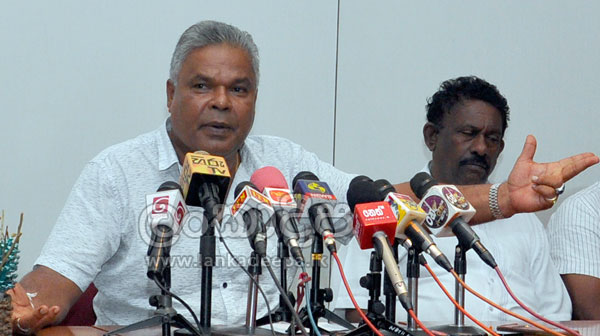
-30.Dec.2016, 7.30PM) The scarcity of rice and the price of rice
shooting up these days is solely and wholly because of the stupidity
and incapability of minister of rural economy, P.Harrison. This was
revealed by Sri Lanka ‘s most leading rice businessman Dudley Sirisena
the brother of country’s president .He made this most shocking and
vital revelation when he addressed a media briefing at JAIC Hilton
hotel on the 27 th
(Lanka-e-News
-30.Dec.2016, 7.30PM) The scarcity of rice and the price of rice
shooting up these days is solely and wholly because of the stupidity
and incapability of minister of rural economy, P.Harrison. This was
revealed by Sri Lanka ‘s most leading rice businessman Dudley Sirisena
the brother of country’s president .He made this most shocking and
vital revelation when he addressed a media briefing at JAIC Hilton
hotel on the 27 th
There are 200 million kilos of paddy already in the possession of the
paddy marketing Board , yet those have not been distributed duly or on
time to the market .While there is a ban imposed by the cabinet that
those who are not paddy mill owners cannot distribute paddy , minister
Harrison and the paddy marketing board chairman are distributing paddy
in hundreds of thousands of kilos among the intermediaries and brokers
defying the ban . The latter after collecting the paddy at Rs. 43.65 per
kilo from the government are selling them to the Mill owners at Rs.
50.00 per kilo and pocketing the illicit profits , Dudley Sirisena
disclosed.
Accordingly , when the brokers sell 200 million kilos of paddy, the
intermediaries collect Rs. 1400 million profit . When paddy is being
collected , even politicos conduct themselves as powerful officials,
he pointed out. Kataragama Basnayake Nilame who does not own a single
rice mill ,after collecting paddy in many hundreds of thousands of kilos
is selling them at higher prices . Dudley Sirisena also explained
,because the price for kiri samba was fixed , the production of nadu
rice has declined, and that is ruthlessly hitting below the belt of the
low income earners of the country.
The full text of the speech of Dudley Sirisena exposing the rackets , as
well as his answers to the questions posed by journalists are
hereunder.
The video footage is below
---------------------------
by (2016-12-30 14:14:13)
by (2016-12-30 14:14:13)

Inordinate delay in launch of Rs. 12 bn. project blamed on Health Ministry

 Saman
Samanby Shamindra Ferdinando-December 30, 2016
Multi-bn rupee tender for the construction of a special nurses' training
facility hasn't been awarded in 2016 in spite of the yahapalana
government allocating Rs 2 and half bn for the project.
Government Nursing Officers' Association (GNOA) President Saman
Ratnapriya has blamed the Health and Indigenous Medicine Ministry for
the inordinate delay in finalizing the tender process.
Addressing the media at the Centre for Society and Religion (CSR),
Maradana on Thursday (Dec 29), Ratnapriya alleged that those who had
been handling the project weren't able to award the contract, though
there were many rounds of discussions.
The accusation was made at the media briefing called by the Left Centre,
a civil society grouping which campaigned for Maithripala Sirisena at
the last presidential poll in January 2015.
Speaking on behalf of the GNOA, a constituent of the Left Centre,
Ratnapriya said that the UNP-SLFP coalition had allocated Rs two and
half bn in 2016 and a further Rs I bn in 2017.
Ratnapriya admitted that the GNOA hadn't been able to convince the
ministry in spite of constant reminders. The trade unionist quoted
senior ministry officials as having said at a recent meeting that the
tender could be awarded in August 2017.
Ratnapriya said that the total cost of the proposed project would be Rs
12 bn and it was meant to train nurses for local and foreign hospitals.
The yahapalana government hadn't been able to put in place a scheme to
finalize tender procedures within three months, though a promise was
made to that effect.
Development efforts had been badly hampered for want of an efficient
decision making process, Ratnapriya said, pointing that such delays were
rampant.
The GNOA President urged the government to accelerate and streamline the process to bring in efficiency to the public sector.

GOOD GOVERNANCE GIVETH, AND GOOD GOVERNANCE TAKETH AWAY – The
unspeakable, unutterable, unfathomable gift was the focus of Christmases
past. Maybe as the New Year dawns and the Caravans of Constitutional
Republicanism hasten toward the Desert of Nothingness, the Princes of
Peace – increasingly growing into the image and likeness of the very
Caesars they ousted – might come to realise that the Gospel has bypassed
the temple, tower, theatre; and has entered into the byways of a more
plebeian Bethlehem. Where, now as of old, the evangel (“Good News and
Great Tidings of Glad Joy”) comes with an ethical component (“God must
be pleased if the people are to be blessed”)
 Thursday, 29 December 2016
We all have selective hearing. For example, a wife may tell her husband:
“Go to the supermarket. Lay down the shopping on the kitchen table.
Clean and sweep the house. Get the kids after school today. Do something
productive instead of just sitting around. Maybe you could finish the
rest of the dishes.” But the husband hears only what he wants to hear…
“Go … lay down … and … get … some … rest!” We choose the better bits and
pieces that suit our worldview, and ignore the context and content of
the message.
At Christmas a popular message preached from many pulpits is, “Peace on earth and goodwill to all people.” The full text of the passage reads, “Peace on earth and goodwill to those with whom God is pleased.” That there is an ethical component to the evangel is forgotten in the all too human desire to find favour with whatever supernatural powers as may be. We appropriate the comfort of God with us, but are apathetic to the challenge such a Being might make on us. Sadly we live in times when the earthly powers too are not above ignoring the context and content of the message that the masses are sending out to them.
“Goodwill to those with whom Good Governance is pleased” is a rather more mundane message. It is increasingly becoming a time, therefore, when the comfortable need to be disturbed as much as the disturbed need to be comforted. It is a time, however, when the most vital parts of the most meaningful messages of Christmas – as much as the gifts of Good Governance – are being misidentified and misappropriated.
At Christmas a popular message preached from many pulpits is, “Peace on earth and goodwill to all people.” The full text of the passage reads, “Peace on earth and goodwill to those with whom God is pleased.” That there is an ethical component to the evangel is forgotten in the all too human desire to find favour with whatever supernatural powers as may be. We appropriate the comfort of God with us, but are apathetic to the challenge such a Being might make on us. Sadly we live in times when the earthly powers too are not above ignoring the context and content of the message that the masses are sending out to them.
“Goodwill to those with whom Good Governance is pleased” is a rather more mundane message. It is increasingly becoming a time, therefore, when the comfortable need to be disturbed as much as the disturbed need to be comforted. It is a time, however, when the most vital parts of the most meaningful messages of Christmas – as much as the gifts of Good Governance – are being misidentified and misappropriated.

Epiphany
The scriptures that are not often heard at Christmas time can come as an epiphany to discerning readers. The heralding of the Good News that would announce liberation from tyranny and bondage is a study in contrasts. Luke, a subversive writer, records the historical and political context in which the gospel began to be shaped and presented. “In the fifteenth year of the reign of Tiberius Caesar – when Pontius Pilate was governor of Judea, his brother Phillip tetrarch of Iturea and Traconitis, and Lysanias tetrarch of Abilene – during the high priesthood of Annas and Caiaphas, the word of God came to John son of Zechariah in the wilderness.” Rome sat enthroned over the civilised world. Religion was enshrined in holy capitals. Revelation, however, comes to the rude and rough in a far-flung corner of true spirituality far-removed from the centres of worldly power.
Could it be that the ‘Gospel of Good Governance’ has bypassed the centres of power in republican Sri Lanka today also… and that the message being pounded in the pulpits of our island’s plenipotentiaries is a false evangel: a prosperity gospel with neither grace nor truth? At first blush, the prospect seems absurd. The incumbent administration is neither corrupt nor criminally manipulative as a previous regime! There is amorphous progress being made in shaping a third republican constitution! Good news about growth, development, and progress, are all around us (whether true or false; whether propaganda and hype, or the real state of the nation)! And there is peace for most – even if it comes without the expected justice for all, yet!
But scratch the surface of the status quo, and the discerning reader will see how the Gospel of Good Governance is in danger of becoming the very beast that once slouched towards Bethlehem to be born and against which it raised its standard a long time ago. The powers that be – past and present, and possibly future – are still immune from prosecution. The people struggle under increasingly oppressive economic burdens. Progress comes at an indeterminate cost to participatory democracy, dissent, and other civil liberties – although this yoke is lighter than former crimes against humanity. And the ‘Johns’ in the wilderness – the prophetic voices that warn against “regime normalisation” and who note that a latent Caesarean dispensation is still popular (in an albeit more liberal, less repressive, avatar) are ignored and neglected.
Advent
The original gospel comes with glamour to the grubbiest and grimiest of souls. There were shepherds in the field – those outcastes of Judean society: suspected of every crime from bad morals to bad manners – who reportedly heard the angelic choir hymn of peace on earth. That Herod in his palace missed the clarion call of Heaven makes interesting reading to students of History. The ‘high holy humility’ required of Princes of Peace somehow manages to bypass the high and mighty, scattering the proud in the imagination of their hearts.
Caesar is dead, buried, lying unpraised and unappreciated on the periphery of the true power. (The Rajapaksa machine seeks to resurrect its regime through Machiavellian wiles.) Christ is alive, unburied, resurrected into the abundant life that poverty of spirit brings. (Good Governance has crucified itself on a cross of its own making.)
That the advent of the lordly goodwill intended for all people everywhere was hailed by herald voices island-wide is a fading memory. A glory has passed from the midnight of destiny, and the Spirit of the Gift has receded like a dream dies at the opening of the day. Good Governance was the present gifted in the past to the grubbiest and the grimiest; but it has no apparent future use now that the shepherds are in the palace, with silken girls bringing sherbet. Annas and Caiaphas may still conspire in some unholy complicity in some distant temple where the faux spirituality from which our isle’s rulers draw their mass appeal resides.
Pilate, in the person and the work of the magistrates who bow to private pressures in exonerating a once outspoken member of parliament’s brutal assassins, has washed his hands off innocent blood: he asked, jestingly, “What is truth?” – but did not wait for an answer. Caesar has been ousted by the Palace Guard, but the Praetorians who rule in his place bear an uncanny resemblance to their former master and reflect a growing discomfort of the hoi polloi that regime changes only consolidate the antidemocratic authoritarian imperatives the revolution once challenged. The tetrarchs are girding their loins for local government elections that will draw the battle lines for a bigger war of sedition that is yet to come. Only John is still in the wilderness. (Be that as it may!)
Revelation
All of the above may reek of religious paraphernalia dressed as political commentary. But all of us have selective hearing, too, as much as our rulers. We are not quick, neither willing nor able to see the political ramifications in the subtext of scripture. If we were willing to subject holy writ to a subversive reading, though, the republican parallels between bygone empires and burgeoning enterprises would be clearer, sharper, a treat to read… Certainly less effete than draft republican constitutions that will consolidate the imperatives of democratic Caesarianism – And more meaningful as a significant essay in the ineluctability of human nature, the inevitability of power’s corrupting influence on people’s corrosive ambitions.
The gift of Good Governance, given with arguably good intentions, has been taken back, taken away, thrown away. The present rulers in the old palace have only subjected the power structures to some trims and streamlining. The usual suspects are at it again, to the detriment of the demographics they represent. Shepherds once in the field, grubby and grimy and guilty of bad morals and bad manners, are now to be seen seated in the places of power and privilege.
Christmas has become the world’s tallest tree in the world’s smallest island-republic: A tower of fake tolerance and real extravagance. Good Governance has become no less an eyesore on the socio-political landscape; and will be uprooted and cast into the fire of trial and judgment by an electorate grown weary of promises unfulfilled, pretentious posturing, and ostentatious expenditure on its supporters and stakeholders.
May the New Year see a righteous axe laid to the tree. May we all grow less selective in our hearing. May there be peace with justice in our many splendoured isle.
Upsurge in cost of living Celebrating festive season and welcoming the new year


 As
the festive season brings to a close another eventful year many claim
the cost of living to be ‘burdensome’, and ‘overwhelmingly high’.
Economics experts point out that the rate of inflation has risen
resulting in the rise of the cost of living. The Dailymirror spoke
to a wide cross section of society - beggars, coolie labourers,
traders, businessmen, managers, and engineers - on what they felt about
the cost of living.
As
the festive season brings to a close another eventful year many claim
the cost of living to be ‘burdensome’, and ‘overwhelmingly high’.
Economics experts point out that the rate of inflation has risen
resulting in the rise of the cost of living. The Dailymirror spoke
to a wide cross section of society - beggars, coolie labourers,
traders, businessmen, managers, and engineers - on what they felt about
the cost of living.
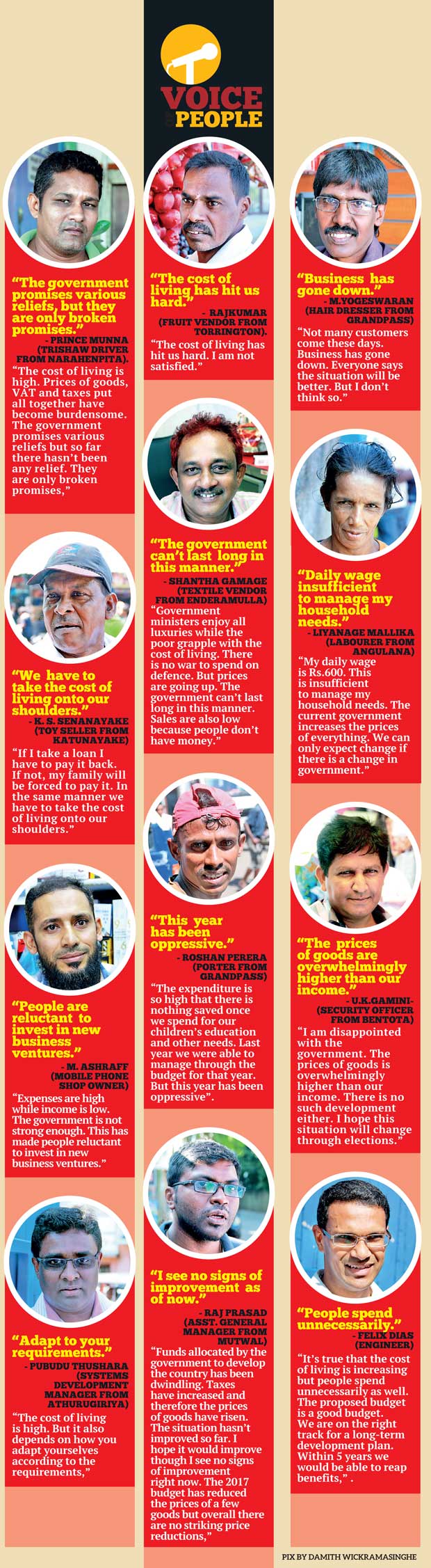 Accordingly
we found that sales have dropped and the general public were unable to
manage their household budget due to the rising cost of living. While
some expressed hope for long term prosperity envisioned through the
yahapalanaya government, there seemed to be a growing dissent against
the current government as well due to oppressive taxes which have made
the cost of living unbearable to many.
Accordingly
we found that sales have dropped and the general public were unable to
manage their household budget due to the rising cost of living. While
some expressed hope for long term prosperity envisioned through the
yahapalanaya government, there seemed to be a growing dissent against
the current government as well due to oppressive taxes which have made
the cost of living unbearable to many.
 As
the festive season brings to a close another eventful year many claim
the cost of living to be ‘burdensome’, and ‘overwhelmingly high’.
Economics experts point out that the rate of inflation has risen
resulting in the rise of the cost of living. The Dailymirror spoke
to a wide cross section of society - beggars, coolie labourers,
traders, businessmen, managers, and engineers - on what they felt about
the cost of living. Accordingly
we found that sales have dropped and the general public were unable to
manage their household budget due to the rising cost of living. While
some expressed hope for long term prosperity envisioned through the
yahapalanaya government, there seemed to be a growing dissent against
the current government as well due to oppressive taxes which have made
the cost of living unbearable to many.
As
the festive season brings to a close another eventful year many claim
the cost of living to be ‘burdensome’, and ‘overwhelmingly high’.
Economics experts point out that the rate of inflation has risen
resulting in the rise of the cost of living. The Dailymirror spoke
to a wide cross section of society - beggars, coolie labourers,
traders, businessmen, managers, and engineers - on what they felt about
the cost of living. Accordingly
we found that sales have dropped and the general public were unable to
manage their household budget due to the rising cost of living. While
some expressed hope for long term prosperity envisioned through the
yahapalanaya government, there seemed to be a growing dissent against
the current government as well due to oppressive taxes which have made
the cost of living unbearable to many.
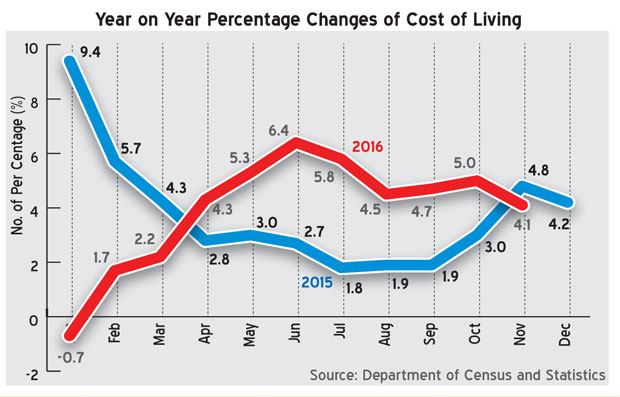
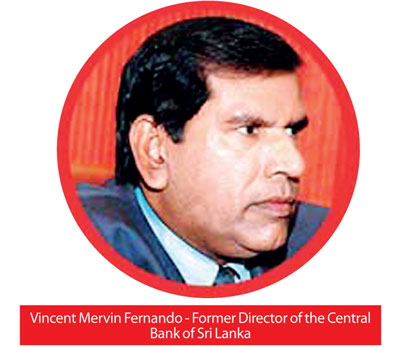
“The annual average inflation increased from 0.9% in 2015 to around 4%
in 2016, increasing the cost of living of the people.”Vincent Mervin
Fernando - Former Director of the Central Bank of Sri Lanka “Colombo
Consumer Price Index (CCPI) and the new National Consumer Price Index
(NCPI) are the two main price indices used to measure the cost of living
in Sri Lanka. The rate of inflation for the years 2014, 2015, 2016 and
2017 are 3.3%, 0.9%, 4.0% and 4.0% respectively.”
He further added, “Sri Lanka’s high inflation was an issue of concern
when considering the cost of living for many years, particularly since
the liberalization of the economy in Lanka during 1977. Sri Lanka’s
inflation was on average around 11.2% for the period 1978-2008. This
high rate of inflation has reduced to a mid-single digit average around
5.9% since 2009 to 2014.”
Speaking
of the low inflation rate seen last year, he said, “The year 2015
witnessed a generous package of welfare improving measures being
implemented across various sectors of the economy encompassing a wider
range of socio-economic strata.
Most
of such measures were fashioned in the newly formed government’s
‘100-Day Programme’ which was intended to provide immediate relief for
people, among other objectives.
Excess
taxes levied on 10 essential food items including sugar, milk powder,
wheat flour, chillies etc. were lowered immediately, thereby reducing
the market
prices substantially. The price of a cylinder was reduced on two
occasions while the increase of total allowances paid to public sector
employees stood at Rs.10,000. Such relief measures generated a
substantial amount of savings for people to meet their needs. As a
result the average inflation decreased to 0.9% in December 2015 from
3.3%, which was the lowest percentage ever recorded since 1977.”
Further
examining the sudden rise in inflation rate and subsequent rise in the
cost of living he added, “However the annual average inflation increased
from 0.9% in 2015 to around 4% in 2016, increasing the cost of living
of the people. This was mainly due to the increase of expenditure value
of food items in rice, coconut, vegetables, potatoes, lime, big onions,
tea leaves, dhal, coconut oil, red onions etc. However price decreases
were reported for fresh fish, papaw, chicken, banana, mangoes, eggs and
green chillies. Further very small increases in expenditure value were
reported for groups of Transport and Restaurant and Hotels. The
expenditure value increases in Health, Communication and Alcoholic
beverages, Tobacco and Narcotics were a result of the implementation of
the new Value Added Tax (VAT) rates with effect from November 1. However
in conclusion, the CoL in Sri Lanka is 56.7% lower than in the United
States, European and some other Asian countries.”
Negative
trends in society linked with cost of living - Prof. Daya Amarasekara,
University of Peradeniya “Social class can be interpreted as a social
group experiencing similar economy and consumerism. Changes in social
status, norms and values could be inspected within this group and all
these changes are hard-wired with increasing cost of living. Imposing
new taxes are a prominent cause for increased cost of living and that
has affected all the social classes, namely the higher middle class,
middle class and lower class. Poverty, prostitution and anti social
activities are all connected with the struggle of life. People tend to
be attracted to earn in secretive ways due to the high cost of living.”
he explained.
“Exploitation
of child labour is also increasing, because school leavers crushed by
economic difficulties try to earn money without furthering their
studies. Child labourers, flower vendors and candlestick sellers we see
during rush hour traffic are some examples of child exploitation. The
sociologist Frantz Fanon has pointed out a group of urban orphans called
urban loompon group. They are generally jobless, lives day to day by
doing both good and bad. Drug peddling, vehicles theft, printing of
counterfeit currency are some of these illegal activities they are
engaged in. There is another group of people who leave the country with
disappointment and determined not to return. There’s also a very
negative trend of elderly parents being left alone by their children
employed in foreign countries. Or after marriage they settle far from
their parents; children and parents have weak relationships. As a
result, the elderly are rendered helpless and lonely.”
Professor
Amarasekara opined.
Israeli police shoot Palestinian woman at checkpoint
After
approaching the checkpoint with a knife, the woman, whose injuries were
described as 'serious,' was left on the ground for an hour before
receiving medical treatment

A screengrab from mobile phone footage shows the Palestinian woman on the ground after being shot (Twitter)
 Friday 30 December 2016
A Palestinian woman was shot and wounded Friday after approaching an Israeli security checkpoint near Jerusalem with a knife, Israeli police said.
The woman approached the crossing point in Qalandia, between Jerusalem
and the occupied West Bank, in a lane designated for vehicles despite
repeated calls from guards to stop, a statement said.
She was wounded when security forces opened fire, police spokesman Micky Rosenfeld said.
Police said she was 35 and from Issawiya, a neighbourhood in east Jerusalem - local sources named her as Jihan Mohammed Hashima.
She was left on the ground for around an hour after the attack before
receiving treatment, an AFP photographer at the checkpoint said.
Footage emerged that appeared to show the woman lying on the ground with
her arms in the air just after she was shot before being wheeled into
an ambulance.
لحظة اطلاق قوات الاحتلال النار على الشابة "جيهان محمد حشيمة" (35عاما) على حاجز قلنديا شمال القدس المحتلة صباح اليوم . pic.twitter.com/mmLgOBYXON— Nayef-saif (@naifsif2) 30 December 2016

Translation: The moment when
occupation forces opened fire on Jihan Mohammed Hashima (35) at Qalandia
checkpoint in the north of occupied Jerusalem this morning
A spokeswoman for the Israeli hospital she was taken to described her condition as "serious".
Israel public radio said forces checked her for explosives before allowing her to be transported to hospital.
The latest violence came a day after a local Israeli committee in
Jerusalem approved the building of a three-storey settlement bloc in
East Jerusalem, amid a wave of international criticism of settlement
building.
Since October 2015, 246 Palestinians, 36 Israelis, two Americans, a
Jordanian, an Eritrean and a Sudanese national have been killed in a
wave of violence, according to an AFP count.
Most of the Palestinians killed were allegedly carrying out knife, gun or car-ramming attacks, according to Israeli authorities.
Others were shot dead during protests or clashes, while some died in Israeli air strikes on the Gaza Strip.
Israeli soldiers who beat journalists escape punishment
Charlotte Silver-30 December 2016
 In 2012, Israeli soldiers attacked a group of foreign and Palestinian journalists, beating them with clubs before detaining them.
It has taken the Israeli army three years to conduct disciplinary
proceedings against the commanding officers who gave the orders.
Footage from the incident, which took place in the occupied West Bank village of Kufr Qaddum, shows a crew of five journalists wearing gas masks, helmets, and vests marked as “PRESS,” as they walk down an empty street.
The video, filmed by a Palestinian volunteer with the human rights group B’Tselem , can be seen above.
The journalists had been covering the village’s weekly demonstration against being cut off from their land.
Two Israeli military jeeps speed up the road towards the journalists,
who move to the side of the road. Soldiers then exit the vehicles, stop
the journalists and begin grabbing their equipment and hitting their
bodies with clubs.
At least two of the journalists appear to be detained, while another is forced to the ground as he screams in agony.
One of the injured journalists in the ambush was Jaafer Ashtiyeh, a photographer with the AFP news agency.
Ashtiyeh was only informed last month that the commanding officer and
the battalion commander were disciplined over a year ago, after three
years of the investigation languishing.
Dormant
According to the Tel Aviv newspaper Haaretz, the military
police immediately opened an investigation at the time of the incident
but it was left dormant until 2014, when Ashtiyeh filed a civil suit
against the Israeli government.
Israel’s military investigations are notoriously ineffective.
Earlier this year, B’Tselem stopped cooperating with them, stating “We
will no longer aid a system that whitewashes investigations and serves
as a fig leaf for the occupation.”
Of the 739 cases of alleged abuse of Palestinians since 2000 that B’Tselem has demanded the army investigate, only 25 ever resulted in disciplinary action.
B’Tselem says that a quarter of the complaints never prompted an investigation at all.
The military police only began to complete its investigation into the
assault on journalists in Kufr Qaddum after Ashtiyeh’s lawsuit was
filed.
A year later, in August 2015, former Military Advocate General Danny Efroni recommended that disciplinary proceedings against the commanding officers begin.
Just following orders
According to Haaretz, the military found the company commander
had ordered the use of excessive force. After he was reprimanded, the
commander left the army. Haaretz does not indicate that he was asked to resign.
In fact, Haaretz reports that the army deliberately chose to
enact low-level disciplinary proceedings out of consideration for an
unrelated personal tragedy in the commander’s life.
The battalion commander was reprimanded for negligence for not sufficiently training soldiers on how to use clubs.
“It was found … that while preparing for violent disturbances of the
peace, and while intending to limit the use of potentially lethal means,
it was decided to equip some of the members of the [Israeli army] force
with clubs,” the military said in a statement to Haaretz.
“Still, in carrying out arrests, the soldiers used force that exceeded what was necessary.”
None of the soldiers who beat the journalists were disciplined or charged, on the grounds that they were following orders.
Ashtiyeh’s civil suit ended in a settlement that includes monetary compensation.
Human rights groups have documented habitual physical attacks by Israeli forces against Palestinian journalists.
Earlier this month, the Committee to Protect Journalists revealed that Israel remains one of the world’s worst jailers of reporters, all of whom are Palestinians.

British
Prime Minister Theresa May speaks at the annual Conservative Party
Conference in Birmingham, Britain, Oct. 2, 2016. /File Photo (Toby
Melville/Reuters)

The rare diplomatic spat between Britain and the United States, which
was met with surprise by the State Department, highlighted the
fast-collapsing influence of the lame-duck White House. It also pointed
to a vast reordering of international affairs expected after Trump takes
office in three weeks, as U.S. allies position themselves to curry
favor in the new order.
The transatlantic split was particularly unexpected given that May’s
government acted as a key broker between U.S. and Palestinian interests
ahead of a U.N. Security Council vote last week to declare Israeli
settlement construction “illegal.” British diplomats worked as
go-betweens in shaping the measure to ensure that the language was
acceptable to the United States, Britain’s Guardian and Israel’s Haaretz
newspapers reported this week.
Kerry on Wednesday offered a harsh assessment of the government of
Israeli Prime Minister Benjamin Netanyahu, saying that “his current
coalition is the most right-wing in Israeli history, with an agenda
driven by its most extreme elements.” He criticized persistent Israel
settlement expansion on the West Bank as a threat to the “two-state
solution” under which Israel and a new Palestinian state would coexist
side by side.
In major speech, outgoing U.S. Secretary of State John Kerry defends the U.S. abstention of a U.N. resolution vote that demanded Israel end settlement building, saying the vote reflected U.S. values and was intended to defend the two-state solution to the Israeli-Palestinian conflict. (Reuters)
In major speech, outgoing U.S. Secretary of State John Kerry defends the U.S. abstention of a U.N. resolution vote that demanded Israel end settlement building, saying the vote reflected U.S. values and was intended to defend the two-state solution to the Israeli-Palestinian conflict. (Reuters)
In major speech, outgoing U.S. Secretary of
State John Kerry defends the U.S. abstention of a U.N. resolution vote
that demanded Israel end settlement building, saying the vote reflected
U.S. values and was intended to defend the two-state solution to the
Israeli-Palestinian conflict. (Reuters)
May’s office retorted that “we do not believe that it is appropriate to
attack the composition of the democratically elected government of an
ally.” It said in an emailed statement late Thursday that “we are also
clear that the settlements are far from the only problem in this
conflict. In particular, the people of Israel deserve to live free from
the threat of terrorism, with which they have had to cope for too long.”
The move was an olive branch both to Netanyahu and to President-elect
Donald Trump, who railed against the Obama administration’s decision to
abstain from a U.N. Security Council resolution condemning
the settlements and who has urged Israel to “stay strong” until he
assumes office Jan. 20. Trump has expressed near-unconditional support
for actions by the Israeli government, breaking with long-standing U.S.
policy that has sought a middle ground between the two sides.
Kerry’s speech and the U.S. abstention in the Security Council vote were
received warmly by Germany and France, among other European nations,
which led to a stunned reaction in Washington to the message from May’s
office.
“We are surprised by the U.K. Prime Minister's office statement given
that Secretary Kerry's remarks — which covered the full range of threats
to a two-state solution, including terrorism, violence, incitement and
settlements — were in line with the U.K.'s own longstanding policy and
its vote at the United Nations last week,” the State Department said in a
statement.
British leaders have publicly embraced Trump since his victory last
month, despite his urging that Nigel Farage, a lead campaigner for
Britain’s exit from the European Union and a thorn in the side of the
British government, be named British ambassador to Washington. Britain,
which is preparing to negotiate the terms of a messy exit from the E.U.,
is hoping that a strong economic relationship with the United States
will help smooth out the disruptions from leaving the union’s common
market.
During his presidential campaign, Trump praised Britain’s vote to leave
the European Union and took to calling himself “Mr. Brexit.”
For the first time in 36 years, the U.N. Security Council passed a resolution critical of Israel's Jewish settlements on Palestinian territory. The United States abstained. (Reuters)
For the first time in 36 years, the U.N. Security Council passed a resolution critical of Israel's Jewish settlements on Palestinian territory. The United States abstained. (Reuters)
For the first time in 36 years, the U.N.
Security Council passed a resolution critical of Israel's Jewish
settlements on Palestinian territory. The United States abstained. (Reuters)
This week, Britain’s ambassador in Washington, Kim Darroch, expressed hopethat
Trump and May would build “on the legacy of previous leaders such as
President Reagan and Prime Minister Margaret Thatcher.”
Kerry’s hour-long speech Wednesday was unusual in its breadth and
frankness, coming from a man who devoted much of his energy as the top
U.S. diplomat toward Israeli-Palestinian negotiations that were
ultimately abandoned.
Kerry said Wednesday that Israeli settlement activity, which has
accelerated in recent years, was extending far into the West Bank, “in
the middle of what, by any reasonable definition, would be the future
Palestinian state.”
“No one thinking seriously about peace can ignore the reality of what the settlements pose to that peace,” he said.
The speech came at a historic low in relations between Israel and the
United States, the Jewish state’s staunchest international ally. The
Obama administration intended the abstention on the U.N. resolution as a
warning sign to the Netanyahu government that international support
would not be unconditional, as settlement populations swell on territory
extending beyond the pre-1967 armistice lines that defined Israel’s
boundaries.
The Australian government also distanced itself Friday from the Obama
administration’s stance on settlements and the U.N. resolution.
Australia supports negotiations leading to two independent states, Foreign Minister Julie Bishop told the Australian Broadcasting Corp.
But she said that Australia — which is not a member of the Security
Council where the vote was taken — did not support the U.N. resolution
condemning settlements.
“In voting at the U.N., the coalition government has consistently not
supported one-sided resolutions targeting Israel,” the statement said.
The impending realignment of U.S. foreign policy that apparently led to
the rare break between Downing Street and the White House could also be
seen Friday in Russia, where President Vladimir Putin opted not to retaliate publiclyagainst fresh U.S. sanctions and the expulsion of 35 Russian diplomats from U.S. territory.
Russian Foreign Minister Sergei Lavrov had recommended Friday the
expulsion of 35 U.S. diplomats in retaliation. But Putin appears to be
banking on markedly warmer relations with Trump. The president-elect has
praised the Kremlin and expressed disbelief at an assessment by the
U.S. intelligence community that Russian-government-backed hackers were
responsible for the leaks of sensitive emails from Democratic Party
officials in a bid to help Trump win the White House.
Carol Morello in Washington contributed to this report.
India's cash crunch making some in Modi's party anxious
A
notice is displayed on the gate of an automated teller machine (ATM)
counter which is no longer dispensing cash in Chandigarh, India,
November 21, 2016. REUTERS/Ajay Verma/Files
A
woman checks her wallet as she stands in a queue outside the Reserve
Bank of India (RBI) to exchange her old high denomination bank notes in
New Delhi, India, December 30, 2016. REUTERS/Adnan Abidi
 By Rupam Jain-
Cash shortages weeks after Prime Minister Narendra Modi's decision to
abolish large currency notes are making allies and members of his ruling
party anxious, with some distancing themselves from the move ahead of a
series of state elections.
Modi removed 500 and 1,000 rupee notes, worth around $7.50 and $15
respectively, on Nov. 8, billing it as an attempt to root out
corruption, end terror financing and move the country into the age of
digital payments.
He promised to replace all old bills with enough new currency notes by
the end of this month. But his government has struggled to do that,
leading to long lines at banks and a slump in economy activity. Nearly
90 percent of transactions in India used to be in cash.
Interviews with six lawmakers from Modi's Bharatiya Janata Party (BJP)
and a senior leader of the party's ideological parent, the Rashtriya
Swayamsevak Sangh (RSS), show his party cadre is starting to worry that
the cash crunch could hurt their prospects in several states that go to
the polls next year.
Some parliamentarians said that while they thought Modi's decision was
good, its execution had been botched and they were faced with
constituents who were increasingly upset.
"There is no doubt that it is difficult to convince voters that
everything will be fine," said Santosh Gangwar, the junior finance
minister who is leading the BJP campaign in Uttar Pradesh.
"Every candidate who will be contesting polls is nervous because
they feel people may not vote for the BJP ... There is tension and we
cannot deny it," he said.
Of the BJP's 71 MPs from Uttar Pradesh, 28 have been to BJP
President Amit Shah and the finance minister's office to seek solutions
for the cash crunch, said a senior finance ministry official.
BJP EXPECTS "BIG VICTORY"
BJP spokesman G.V.L. Narasimha Rao said that despite temporary
difficulties, the prime minister continued to enjoy overwhelming
support.
"Party cadres are highly enthused about a big victory in upcoming
elections, and if a few are apprehensive, they will realise the reality
soon," Rao said.
Disquiet within the BJP underscores how Modi's unprecedented bet is
turning into a test of popularity, and could go some way to determining
his political future.
It has become a central issue in Uttar Pradesh, India's most populous
state, where the outcome of elections early next year will be key for
Modi's expected bid for a second term in 2019.
The opposition, led by the Congress party, has joined forces,
mocking the government for being ill-prepared for so-called
"demonetisation" and blaming it for hardships faced by the poor as a
result. It has called for Modi's resignation.
The senior RSS official said they had counselled Modi days before
the move to take time to prepare the ground for such a massive exercise,
including setting up two new mints and expanding the banking network,
and to roll it out in phases.
But the prime minister decided to press ahead, and he alone would
bear responsibility for its failure or success, the official added.
Earlier this month, N. Chandrababu Naidu, chief minister of Andhra
Pradesh and a political ally of Modi, abruptly distanced himself from
the move.
Modi and senior members of his cabinet defend demonetisation. In an
interview with India Today magazine on Thursday, Modi said it would give
the economy a boost and provide long-term benefits, including forcing
the country's vast shadow economy into the open.
"GRIM SITUATION"
Modi's announcement enjoyed popular support at first, with many people
prepared to endure hardship as long as others were forced to give up
ill-gotten wealth or pay tax.
But shortages of new 500 and 2,000 rupee notes have caused tempers to rise as millions queue at banks and ATMs to draw money.
Last week, more than three dozen BJP lawmakers, many of whom came
from states that go to polls next year, met with Shah to demand that the
government sends more cash to their constituencies, and quickly.
The MPs told Shah about severe cash shortages and hardship to local
businesses and ordinary people, according to several lawmakers who
attended the meeting.
They told the BJP president that they did not have the courage to hold
election rallies at a time when people still had to stand in line,
sometimes for hours, to get money. Some said they had not started
door-to-door campaigning.
"The situation is grim, and we cannot ignore it," Jagdambika Pal, a
BJP lawmaker from Uttar Pradesh who attended the meeting, told Reuters.
"It is a challenge for every BJP lawmaker to manage the situation, but
we cannot do anything if there is no money in the banks."
($1 = 67.9550 rupees)
US evicts Russians for spying, imposes sanctions after election hacks
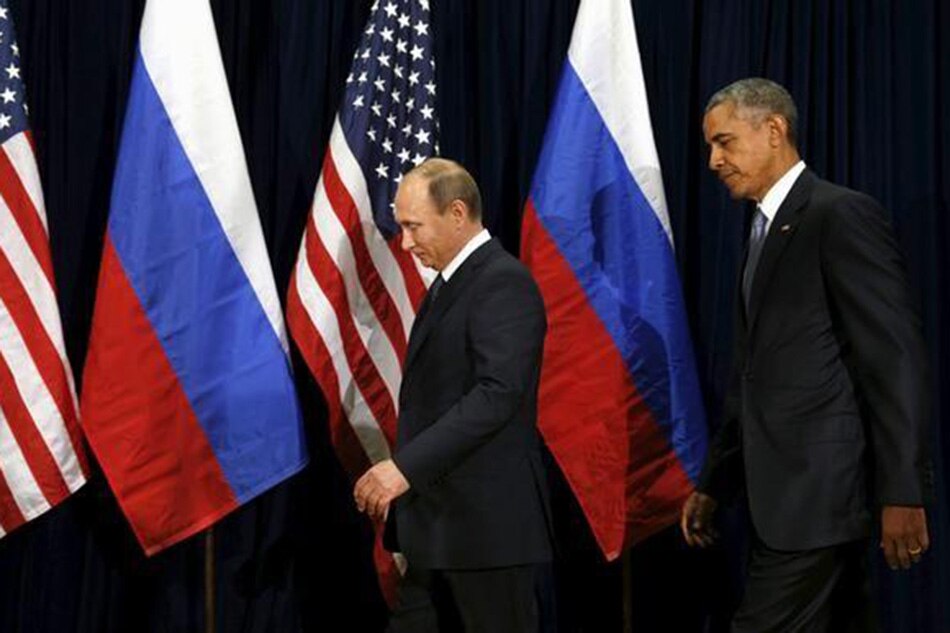
US President Barack Obama and
Russian President Vladimir Putin walk into a photo opportunity before
their meeting at the United Nations General Assembly in New York
September 28, 2015. Kevin Lamarque, Reuters
Jeff Mason and Lesley Wroughton, Reuters-Dec 30 2016

HONOLULU/WASHINGTON - President Barack Obama ordered the expulsion of 35
Russian suspected spies and imposed sanctions on two Russian
intelligence agencies over their involvement in hacking U.S. political
groups in the 2016 presidential election.
The measures, taken during the last days of Obama's presidency, mark a
new post-Cold War low in U.S.-Russian ties which have deteriorated over
Ukraine and Syria.
Allegations by U.S. intelligence agencies that Russian President
Vladimir Putin personally directed efforts to intervene in the U.S.
election process by hacking mostly Democrats have made relations even
worse.
"These actions follow repeated private and public warnings that we have
issued to the Russian government, and are a necessary and appropriate
response to efforts to harm U.S. interests in violation of established
international norms of behavior," Obama said in a statement from
vacation in Hawaii.
It was not immediately clear whether President-elect Donald Trump, who
has repeatedly praised Putin and nominated people seen as friendly
toward Moscow to senior administration posts, would seek to roll back
the measures once he takes office on Jan. 20.
The Kremlin, which denounced the sanctions as unlawful and promised
"adequate" retaliation, questioned whether Trump approved of the new
sanctions. Moscow denies the hacking allegations.
U.S. intelligence agencies say Russia was behind hacks into Democratic
Party organizations and operatives ahead of the Nov. 8 presidential
election. U.S. intelligence officials also say that the Russian cyber
attacks were aimed at helping Trump, a Republican, defeat Democrat
Hillary Clinton.
Trump has rejected that conclusion and said on Wednesday that "we ought
to get on with our lives," when asked about possible tough sanctions for
the cyber attacks.
Should Trump seek to overturn Obama's measures, he would likely encounter wide bipartisan Congressional opposition.
U.S. House of Representatives Speaker Paul Ryan, the top Republican in
Congress, said Russia "has consistently sought to undermine" U.S.
interests and the sanctions were overdue.
Republican Senators John McCain and Lindsey Graham said they intended to
lead effort in Congress to "impose stronger sanctions on Russia."
The actions on Thursday were the strongest response by the Obama
administration to Russia's cyber activities, however, a senior
administration official acknowledged that Trump could reverse them and
allow Russian intelligence officials back into the United States once he
takes office. He said that would be "inadvisable".
"We believe these steps are important because Russia is not going to
stop," one official said. "We have every indication that they will
interfere in democratic elections in other countries, including some of
our European allies," the official said.
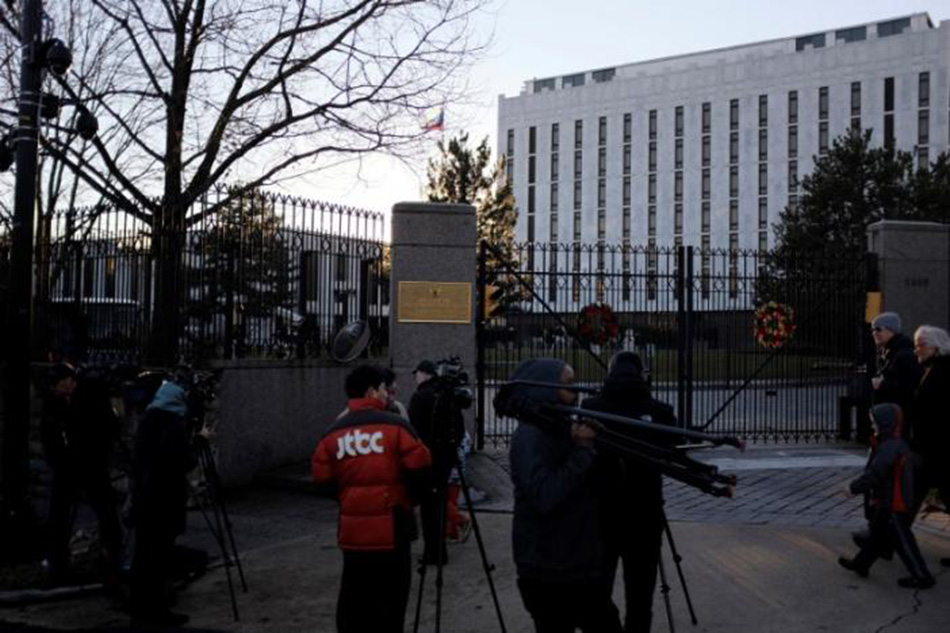
Television crews assemble outside the Russian embassy on Wisconsin Avenue in Washington, U.S., Wednesday. James Lawler Duggan, Reuters
PERSONA NON GRATA
Obama is seeking to deter Russia and other foreign governments from
leveraging cyber attacks in the future to meddle in U.S. politics,
former officials and cyber security experts said.
Obama put sanctions on two Russian intelligence agencies, the GRU and
the FSB, four GRU officers and three companies "that provided material
support to the GRU’s cyber operations.
Obama said the State Department declared as "persona non grata" 35
Russian intelligence operatives and is closing two Russian compounds in
New York and Maryland that were used by Russian personnel for
"intelligence-related purposes". The State Department originally said
the 35 were diplomats.
A senior U.S. official told Reuters the expulsions would come from the
Russian embassy in Washington and consulate in San Francisco. The
Russian embassy declined to comment on the expulsions.
The Russians have 72 hours to leave the United States, the official
said. Access to the two compounds will be denied to all Russian
officials as of noon on Friday, the senior U.S. official added.
"These actions were taken to respond to Russian harassment of American
diplomats and actions by the diplomats that we have assessed to be not
consistent with diplomatic practice," the official said.
The State Department has long complained that Russian security agents
and traffic police have harassed U.S. diplomats in Moscow, and U.S.
Secretary of State John Kerry has raised the issue with Putin and his
foreign minister, Sergei Lavrov.
The U.S. official declined to name the Russian diplomats who would be
affected, although it is understood that Russia's ambassador to the
United States, Sergei Kislyak, will not be one of those expelled.
The United States also released an analysis report by the FBI and
Department of Homeland Security examining forensic evidence officials
said linked the cyberattacks to computer systems used by Russian
intelligence services.
The report largely corroborates the existing findings of private sector
cyber firms that investigated the breach at the Democratic National
Committee and elsewhere.
(Additional reporting by Dustin Volz and Yeganeh Torbati in Washington
and Katya Golubkova and Svetlana Reiter in Moscow; Writing by Yara
Bayoumy; Editing by Alistair Bell)
Subscribe to:
Posts (Atom)