Peace for the World World ! Your War Our Lives

The Dalai Lama
A Brief Colonial History Of Ceylon(SriLanka)
Sri Lanka: One Island Two Nations
A Brief Colonial History Of Ceylon(SriLanka)
Sri Lanka: One Island Two Nations
(Full Story)
Back to 500BC.

Friday, June 15, 2012
How much can Sri Lanka help itself?

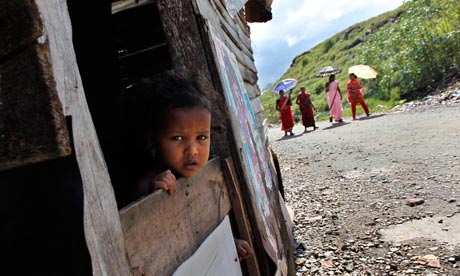
A Sri Lankan child. An oft-heard claim in Colombo today is that 'charity begins at home'. Photograph: Eranga Jayawardena/AP
 ndigenous
charity and philanthropy could transform development in Sri Lanka – but will it
be for better or for worse?
ndigenous
charity and philanthropy could transform development in Sri Lanka – but will it
be for better or for worse?
The role
of charity and philanthropy in development is a subject of growing interest
within the global aid community. As a
result of slowing support from traditional
funding sources, the activities of private foundations and voluntary
initiatives now account for increasingly larger amounts of development
assistance. Meanwhile, mounting calls for a more "moral
capitalism" following the banking crisis have led to greater pressure on
companies to develop inclusive business practices.
But
much of the discussion so far has concentrated on the contribution of big global
players such as the Gates Foundation. Less attention has been paid to indigenous
charity and philanthropy in the
developing world, and how local giving practices are being mobilised for
development. Yet indigenous
philanthropy has played an important rolein the development process, and
that role is likely to increase in the future.
Our research in
Colombo, Sri Lanka, is exploring indigenous forms of charity, philanthropy
and development in the country. By scoping patterns of giving within the city
and around Sri Lanka's global diaspora,
we're building an understanding of the drivers and impacts of charitable and
philanthropic activities on poverty alleviation.
An
oft-heard claim in Colombo today is that "charity begins at home", and
ostensibly levels of charitable giving in Sri Lanka are huge. For two years in a
row, it has ranked eighth in the Charity Aid Foundation's World
Giving Index, ahead of any other developing nation. The reasons are complex,
but giving is central to the traditions of Buddhism, Hinduism, Christianity and
Islam that exist in the country. Our research is highlighting the multi-layered
relationships forming between different kinds of social engagement, from
traditional gift-giving through communal religious charity to corporate social
responsibility.
However,
the long-term potential of these practices – and where they may lead – is an
open question. Much depends on whose definitions of charity and philanthropy we
use, and what counts as development. Our work is drawing attention to four key
issues.
First,
due to huge suspicion
and hostility from the government and many ordinary people, civil society
organisations are limited in how they raise funds. "We know we can't collect
money locally," said the director of a Sri Lankan NGO, "because people think
we're a front for the LTTE [Tamil Tigers]." It's also not uncommon for
successful charities and philanthropists to be seen as a political threat by the
ruling party of the day. The result has been dependency on foreign donors, but
almost every organisation we've spoken to expects this money to dry up
soon.
Second,
although Sri Lankans do give generously, they don't give to the kinds of causes
that international donors gave to. For many organisations we've contacted, the
loss of foreign funding is creating a gulf that local charity is unlikely to
fill. "Once people have given to poorer relatives, the temple and their old
school, there's nothing left for us," said one local fundraiser. Greater space
for non-traditional actors can only be a good thing, yet development
organisations fear they are going to disappear.
Third,
the traditions of giving that do exist tend to focus on humanitarian relief
rather than long-term change. Preference is given to direct, in-kind donations
to individuals, families and welfare organisations, including orphanages and
elders' homes. Fear of corruption or financial mismanagement explains part of
this, but so too does a reluctance to pay for charities' administration costs.
It also reflects religious beliefs and obligations. Yet even the biggest
beneficiaries of in-kind donations complain they struggle to pay utility bills
and wages because of this, and would like to encourage more by way of cash
donations if they could.
Finally,
indigenous charity and philanthropy is rarely co-ordinated. Giving tends to be
impulsive and private, and few organisations work together. Some large Sri
Lankan companies are seeking to develop joint projects, as part of which they
will conduct need assessments and impact evaluations. But private business
owners – whose activities account for the majority of large-scale giving – pick
and choose causes according to personal preferences, and rarely bother to
follow-up. Although often donating very large sums, they avoid issues that
require smaller but ongoing commitments.
Indigenous
charity and philanthropy has the potential to transform development in Sri
Lanka. A few years after the economy was raised to middle-income status by the
IMF, there seems to be huge potential to encourage the growth of new development
actors and opportunities. Yet there is also mounting uncertainty in the local
development sector about which way things are going to go. Whether indigenous
charity and philanthropy can be harnessed and leveraged for development, or
whether what is meant by development will change to accommodate indigenous
giving preferences – and what either of these mean for poverty alleviation –
remains to be seen.
•
Dr Tom Widger is a research fellow at the department of anthropology, School of
Global Studies, University of Sussex
