Peace for the World World ! Your War Our Lives

The Dalai Lama
A Brief Colonial History Of Ceylon(SriLanka)
Sri Lanka: One Island Two Nations
A Brief Colonial History Of Ceylon(SriLanka)
Sri Lanka: One Island Two Nations
(Full Story)
Back to 500BC.

Sunday, October 28, 2012
Still Counting the Dead: Survivors of Sri Lanka's Hidden War - Frances Harrison

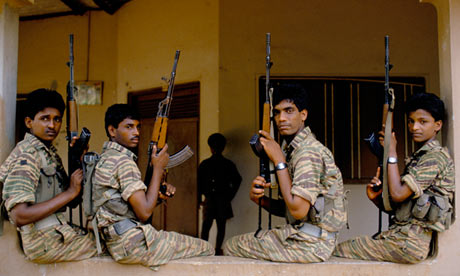
Young
Tamil Tiger rebels in Jaffna, 1991. Photograph: Roger
Hutchings/Corbis
 In
the bloodbath that ended the 26-year civil war in Sri Lanka in
2009, tens of thousands of civilians lost their lives in a few terrible months.
The world's politicians looked the other way. Some governments even praised Sri
Lanka for its "victory over the terrorists", in reference to the defeat of the
rebel Tamil Tigers. The UN Human Rights Council passed a remarkable resolution
that praised the Sri Lankan government's "commitment to promotion and protection
of human rights".
In
the bloodbath that ended the 26-year civil war in Sri Lanka in
2009, tens of thousands of civilians lost their lives in a few terrible months.
The world's politicians looked the other way. Some governments even praised Sri
Lanka for its "victory over the terrorists", in reference to the defeat of the
rebel Tamil Tigers. The UN Human Rights Council passed a remarkable resolution
that praised the Sri Lankan government's "commitment to promotion and protection
of human rights".
Many
find it difficult to imagine that those few months in Sri Lanka may have cost
more civilian lives than all those killed in Syria in the past 18 months. The
satirist Kurt Tucholsky wrote: "One man's death: that is a catastrophe. A
hundred thousand dead: that is a statistic." InStill
Counting the Dead, Frances Harrison reclaims the human catastrophe from the
statistics.
As
BBC correspondent, Harrison lived in Sri Lanka from 2000 to 2004. Her book tells
the stories of individuals – doctor, nun, teacher, shopkeeper, volunteer and
more. From these stories emerges a tapestry of suffering.
Harrison
does not shy away from the "callous brinksmanship" of the Tamil Tigers, but it
was ordinary Tamils who suffered most from the government's final onslaught.
They suffered when the Tigers treated them as human shields; they suffered when
Sri Lankan commanders cynically declared a "zero civilian casualty policy", even
as they targeted civilians inside the misleadingly named no-fire zone. The third
and last of the official no-fire zones meant tens of thousands were crammed onto
a sliver of sand in north -east Sri Lanka – "a tropical beach transformed into a
place of random slaughter".
Hospitals
whose GPS details were shared with the authorities were regularly shelled by
government forces. "Eventually [doctors] learned their lesson," Harrison writes:
unmarked and unannounced hospitals were not targeted. One doctor is still amazed
at the conclusion he was forced to draw: "They wanted to kill as many as
possible."
The
interviews are mostly with those now in exile, in cafes, homes or hotel rooms in
unnamed towns and countries – fear of the Sri Lankan authorities remains strong.
Some have never told even those closest to them the full nightmare of what they
experienced, including rape or being forced to witness it.
Occasional
acts of generosity pepper the narrative. Above all, though, the story is one of
horror. One woman describes watching a grandmother with a child in her arms,
blasted into pieces. With bitter humour, the woman telling the story comments
that if there is indeed a God he had better watch out: "Then He's like the
United Nations and Red Cross people who abandoned us, I will punch Him in the
eye."
Anybody
who has worked on Sri Lanka knows this story has had too little impact. With
luck, this book can help change that. It can perhaps increase pressure on Sri
Lanka to allow accountability before a Commonwealth summit in Colombo next year.
As a nun who travelled to the heart of the war zone to help people tells
Harrison: "Justice has to be done. It's not enough to talk of peace. You cannot
have injustice and speak of peace."
