Peace for the World World ! Your War Our Lives

The Dalai Lama
A Brief Colonial History Of Ceylon(SriLanka)
Sri Lanka: One Island Two Nations
A Brief Colonial History Of Ceylon(SriLanka)
Sri Lanka: One Island Two Nations
(Full Story)
Back to 500BC.

Wednesday, February 13, 2013
Sri Lankans expelled from UK allege torture after deportation to Colombo
Tuesday 12 February 2013
 Sri Lankans held in Colombo
after being arrested while trying to sail to Australia illegally to seek asylum.
One of the asylum seekers deported from Britain said she was tortured and raped
by Sri Lankan security services. Photograph: Dinuka
Liyanawatte/Reuters
Sri Lankans held in Colombo
after being arrested while trying to sail to Australia illegally to seek asylum.
One of the asylum seekers deported from Britain said she was tortured and raped
by Sri Lankan security services. Photograph: Dinuka
Liyanawatte/Reuters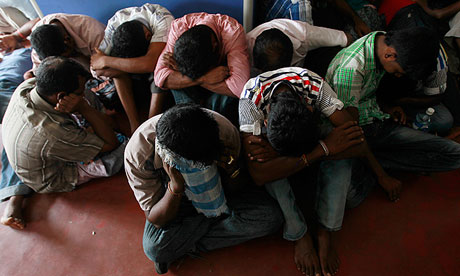 Fifteen Sri Lankan nationals have claimed they
were tortured and subjected to inhuman and degrading treatment after they were
forcibly removed to the country by the UK Border Agency, the Home Office has
said.
Fifteen Sri Lankan nationals have claimed they
were tortured and subjected to inhuman and degrading treatment after they were
forcibly removed to the country by the UK Border Agency, the Home Office has
said.
In
a freedom of information (FoI) request, the Home Office revealed that between
the end of the island's
civil war in 2009 and September 2012, 15 failed asylum seekers managed to
escape back to Britain after being removed by the agency, the UKBA. They
subsequently won refugee status after giving evidence to officials saying they
were tortured in Sri Lanka.
Kulasegaram
Geetharthanan, a solicitor in the UK, said that one of his clients, understood
to be one of the 15 mentioned in the FoI statement, had been gang raped and
tortured by Sri Lankan security services after being forcibly removed to the
capital, Colombo, on a specially chartered UKBA flight in 2011.
The
woman, in her late 40s, who now lives in London, told the Home Office that she
was tortured and raped by security services who wanted her to reveal the
whereabouts of her two sons, who had an affiliation to the Tamil Tigers (LTTE).
After her ordeal she escaped the country a second time by bribing officials and
re-returning to Britain on a false passport.
In
the summer of 2012 her account of the attacks was accepted by immigration courts
and she won refugee status.
The
stories of torture following UKBA
deportation come a little over a week after the Foreign Office minister Alistair
Burt told the island's BBC bureau that the
UK had no direct evidence that people returned by the border agency were being
tortured by Sri Lankan security services.
The
comments were widely picked up in the country and the Sri Lankandefence
ministry posted them on its website.
Questioned
by the BBC's correspondent, Charles
Haviland, Burt said he had looked into the issue "extremely carefully" but
found the UK did "not have direct evidence" of torture. He said the concerns of
human rights groups had not been substantiated.
Speaking
to the Guardian, Burt stood by his comments. However, the Foreign Office told
the Guardian that following the Home Office release it was "urgently seeking
further information from the Home Office about any allegations". Having seen the
Home Office's FoI response, Burt said: "I'm well aware of claims of abuse having
been made … We are also aware of claims [of torture] being made more widely –
that is why some asylum claims from Sri Lanka are accepted. But what I'm not
aware of is evidence that those who've returned have substantiated [their]
claims in relation to torture."
The
Tory minister, who is responsible for the brief for south Asia, the Middle East,
and terrorism, added: "No one will be returned to Sri Lanka if there is a threat
of risk of torture."
Another
charter flight removal of Tamils – the ninth in under two years – is due on 28
February, before a judgment in the upper immigration tribunal, which will
scrutinise UK government guidance on removing failed Tamil asylum seekers and
could halt the practice.
Asked
if Sri Lanka's security services were torturing people on their return to the
island, the country's deputy high commissioner in the UK, Neville de Silva,
said: "I think you should pose that question to the Foreign Office and the
British high commission in Colombo, because as Mr Burt has said, the British
high commission … keeps tabs on people who are returned, and, as far as they are
concerned, there's been no evidence of torture. That is what Alistair Burt told
us."
De
Silva said people who had left Sri Lanka illegally would obviously "claim
torture or any other means" in order to claim asylum. "That's an obvious thing
to do even if you are not tortured," he said.
Keith
Best, chief executive of Freedom from Torture, who
filed the FoI request with the Home Office, said: "It beggars belief that the UK
government is still prepared to forcibly return more Tamils when its removals
policy for Sri Lanka remains so out of date, and before the judiciary, which is
considering the policy right now, has a chance to rule on the matter.
"We
have shown that those with even low-level LTTE links, whether real or perceived,
are at risk of torture, but our warnings have not been acted upon."
The
British Tamils Forum said that it had received information from numerous sources
confirming the torture of deportees from the UK, and it had called for the
latest flight to be halted.
The
forum's spokesman, Shan Sutha, said: "The sad reality is that the people are
frightened to come forward to reveal the facts as their lives will be in grave
danger.
"UKBA
must temporarily halt all deportations to Sri Lanka until allegations are
verified independently."
In
a statement, the Foreign Office said: "We remain concerned about human rights in
Sri Lanka. Mr Burt has both publicly and privately raised our concerns, and
called on the Sri Lankan government to investigate human rights infringements
and prosecute those responsible."
The
minister was "extremely concerned about the allegations of torture but has not
seen any evidence that substantiates the allegations". But the Foreign Office
was "urgently seeking further information from the Home Office about any
allegations".
The
UKBA said each asylum case was "considered on its individual merits and where we
find individuals are in need of our protection we will give it".
The
agency added: "The current position, supported by the European court of human
rights, is that not every Tamil asylum seeker requires our protection.
"We
do not want to prejudice the outcome of the court case by commenting further at
this time.
"The
cases referred to in the FoI [request] are individual cases, assessed on the
evidence available at the time. This is not direct evidence that all asylum
seekers are at risk on return."
