Peace for the World World ! Your War Our Lives

The Dalai Lama
A Brief Colonial History Of Ceylon(SriLanka)
Sri Lanka: One Island Two Nations
A Brief Colonial History Of Ceylon(SriLanka)
Sri Lanka: One Island Two Nations
(Full Story)
Back to 500BC.

Friday, April 19, 2013
Getting Our Priorities Right
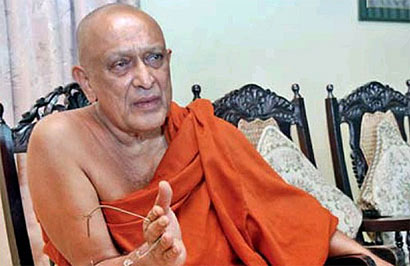
The
Ven Maduluwawe Sobitha has launched a movement where he has identified the
Executive Presidency as the root cause for our problems of injustice and
conflicts

Word
over all, beautiful as the sky,
Beautiful that war and all its deeds of carnage must in time be utterly lost,
That the hands of the sisters Death and Night incessantly softly wash again, and ever again, this soil’d world:
For my enemy is dead, a man as divine as myself is dead,.
I look where he lies white-faced and still in the coffin – I draw near,
Bend down and touch lightly with my lips the white face in the coffin.”
from Reconciliation, Walt Whitman (1819-1892)
Beautiful that war and all its deeds of carnage must in time be utterly lost,
That the hands of the sisters Death and Night incessantly softly wash again, and ever again, this soil’d world:
For my enemy is dead, a man as divine as myself is dead,.
I look where he lies white-faced and still in the coffin – I draw near,
Bend down and touch lightly with my lips the white face in the coffin.”
from Reconciliation, Walt Whitman (1819-1892)
“Less
passionate the long war throws
its burning thorn about all men.
caught in our grief, we share one wound,
and cry one dialect of pain.
its burning thorn about all men.
caught in our grief, we share one wound,
and cry one dialect of pain.
We
have who fired the house,
whose easy mischief spilt first blood,
under one raging roof we lie
the fault no longer understood.
whose easy mischief spilt first blood,
under one raging roof we lie
the fault no longer understood.
But
as our twisted arms embrace
the desert where our cities stood,
death’s family likeness in each face
must show, at last, our brotherhood.”
- from The Long War, Laurie Lee (1914-97)eaneHeany)
the desert where our cities stood,
death’s family likeness in each face
must show, at last, our brotherhood.”
- from The Long War, Laurie Lee (1914-97)eaneHeany)
Over
the week-end before our National New Year, Christians celebrated the Festival of
Easter. It was preceded by Maundy Thursday when Jesus, on the day before he was
crucified and in an act of humility, washed the feet of his disciples. It is a
tradition that Christians have maintained over the years. On that Thursday this
year, Pope Francis visited the Casa del Marmo, a youth detention centre just
outside Rome, and washed the feet of twelve inmates including two women.
Similarly, in Canterbury, Archbishop Justin Welby washed the feet of twelve lay
persons of both genders, of all ages and all faiths. It was no doubt a symbolic
gesture but full of meaning for humility, healing and reconciliation in the
secular world. It is in that same spirit that Walt Whitman wrote the above poem
at the conclusion of the American Civil War. A soldier laments that war, in the
final analysis, clashes with the natural order of life. He grieves over the
death of a soldier on the ‘other’ side, and as an act of reconciliations, kisses
that dead body as it lies in the coffin. Laurie Lee’s poem was also written
after another civil war – the Spanish Civil War in which Lee reportedly
participated and found disenchantment in the end. .
Margaret
Thatcher who died last week was the Prime Minister when the British
forces inflicted a crushing defeat on Argentina in the Falklands War. At the
conclusion of the war, a thanksgiving service was held at St Paul’s Cathedral.
The then Archbishop of Canterbury Robert Runcee preached the sermon at what was
expected to be a triumphalist moment. But Archbishop Runcee reportedly
disappointed and even infuriated Thatcher and the leading figures in the
Conservative establishment. Instead of triumphalism , the Archbishop, who in the
Second World War had won the Military Cross as a Tank Commander, spoke of
reconciliation, and of the need to see our neighbours in the world as brothers
and sisters. We should not be just mouthing opinions and thanksgivings that the
fashion of the moment judges acceptable. We need to deepen and enlarge our
compassion and to purify our thanksgiving He added, ‘The parent who comes here
mourning the loss of a son may find here consolation, but also a spirit that
enlarges our compassion to include all those Argentinian parents who have lost
sons.’ As the good Archbishop pointed out, triumphalism is a dangerous attitude
to possess. Peace and reconciliation will be mere empty words if we are not able
to show understanding, respect and compassion to the ‘other’. Life will be
fraught with danger and uncertainty for all of us if confrontation and
polarisation continues as now, four years after the LTTE has
been decisively crushed. We need to take a hard look at ourselves, at the
priorities we have set ourselves in our development plans and to change course
where necessary if the country is to move forward. We need to move away from
confrontational politics to diverting our resources to genuine
development.
Health
Sector
Last
week’s newspaper reports quoted the Chairman of the State Pharmaceuticals
Corporation as saying that there was an acute shortage of essential drugs in our
Hospitals. Some of the drugs in short supply were for treating life-threatening
illnesses like cancer but there was no budgetary allocation available to
purchase them. We have no reason to believe that the Chairman was exaggerating
the actual position. Surely, this is a scandalous state of affairs. Is it
therefore any wonder that seriously ill patients are advised to take treatment
in private hospitals. Sadly the majority of our people cannot afford the
treatment that is available in private hospitals even if such hospitals are
located near their homes. It also happens that expensive drugs are often not
available in state hospitals and patients are advised to purchase those drugs in
the open market and bring it to the hospital for the treatment to be given.
Patients with limited financial resources just cannot afford to buy drugs and
injections in the open market at prices which can run into several hundreds of
thousand rupees.
One
cannot fault the Ministry of Health for this state of affairs. They have to work
within the amount allocated to them which obviously is far too little to meet
the needs of our population. Just as for the education sector, the budgetary
allocation is unrealistic. We do not think it is government policy to run down
the state health services but that is what is happening as a result of the
allocation of the limited resources to sectors other than for health and
education which should receive priority. Last month, the Island quoted a report
from Verite Research, an independent think tank and research organization: “The
2012 budget had allocated 1.31% of GDP for the health sector. The 2013 budget
allocates about the same: 1.33%. However, the actual disbursement in 2012 was
cut down to 1.26%. The direct expenditure on education, represented by the
allocations made to the Ministry of Education, Higher Education and to the
Provincial councils on education amounted to only 131 billion accounting for
1.51% of GDP (5.21% of government expenditure). A clear downward trend is
evident in the allocations made to the education sector as a percentage of GDP
in four successive budgets from 1.81% in 2010 to 1.51% in 2013. This is driven
by sharp decreases in current expenditure on education.” Verite Research further
stated that Sri Lanka’s huge defence budget which refused to shrink post war has
continued to grow, and at almost 19% in Budget 2013. Capital expenditure has
been growing faster than recurrent expenditure in the post-war period, and in
Budget 2013. Urban development now comes under the Ministry of Defence. But it
will be a mistake to think that the huge increase in the allocation fort defence
is because of urban development. Verite Research have analysed the Defence
budget and found that less than 5% of it is for urban development.
Education
Sector
Like
health, education is another sector that is being run down. It may not be
deliberate but it is happening. When FUTA launched
their strike last year, one of their main demands was that the budgetary
allocation for education should be 6% of
GDP, at least in the longer term. In negotiating a settlement of the
strike, the Ministry of Higher Education pledged to work towards that. But they
have reneged on that promise, as they seem to have on all other issues as well.
The allocation for 2013 is a mere 1.51% of GDP, continuing the trend over the
past few years. It is not so much the academic staff but it should be the
Committee of Vice Chancellors and Directors and the University Grants Commission
which should be agitating for increased allocations. Some months ago,
Professor Arjuna
Aluwihare, a former Vice Chancellor and Chairman of the UGC, in a
newspaper interview, when asked what the problem was with the UGC and CVCD was,
stated that there were a lot of good people in them but they were too far
removed from the university dons and the Senates and too close to the government
in power. Aluwihare hit the problem right on the head. In all sectors, the
authorities should be in constant consultation with the professionals in that
field and be able to pick their brains and act taking their advice into
consideration. That is what happened when we became independent and that is why
our health and education services were the pride not just of Asia but of the
world. In higher education, our students had no difficulty in gaining admission
to the best universities in the world and our academics and medical
professionals could have obtained plum positions anywhere. In fact, some of them
did, though sadly to our detriment. But most of them opted to remain and work
here under conditions which allowed them academic and professional freedom.
Because of their integrity and professional stature, the civil servants and
other professionals in the years immediately after independence, were able to
deny requests from politicians and Cabinet Ministers that were unjust or that
violated the establishment code.
An
apolitical public service
Today,
we have got our priorities wrong. Those holding high offices in administration,
in the university system, among the security forces and the Police and even
among those upholding the law and dispensing justice see the need to bow down to
the politically powerful. It is outrageous that politically powerful persons are
openly associating themselves with groups that not only preach hatred against
minority groups but actually use violence against them. While the law is being
openly flouted, the Police are mere onlookers seemingly safeguarding the
violators. There is not even a semblance of trying to appear impartial. We have
succumbed to a culture where public servants deem it more important to please
their political masters by taking sides rather than by holding the scales of
justice evenly.
The
Ven Maduluwawe
Sobitha has launched a movement where he has identified the Executive
Presidency as the root cause for our problems of injustice and conflicts. Most
thinking people would agree with him on that. Indeed, our last two Executive
Presidents, including Mahinda
Rajapakse, were elected on the basis of a pledge to abolish the
Executive Presidency. Chandirika
Bandaranaike Kumaratunge at least presented constitutional proposals
in 2000 to abolish the Executive Presidency. It is now time to support, without
any party political stance, this demand of Ven Sobitha’s movement. The other
major demand of his movement that deserves our support is the need to restore
the principles of the 17th
Amendment and have Commissions for the public services where its
members, once appointed, will have the independence and security of tenure for a
fixed period, so that they do not have to be subservient to politicians.
The
two major political parties are publicly committed to abolishing the Executive
Presidency. Many of the other parties have expressed their support for such a
step. Civil Society organizations must urge the senior leaders of the SLFP and
UNP to bring in constitutional proposals on those lines. Only then can the
country move forward. Only then can we prevent obscurantist forces from
derailing democracy, pluralism, justice and communal harmony in our
country.
