Peace for the World World ! Your War Our Lives

The Dalai Lama
A Brief Colonial History Of Ceylon(SriLanka)
Sri Lanka: One Island Two Nations
A Brief Colonial History Of Ceylon(SriLanka)
Sri Lanka: One Island Two Nations
(Full Story)
Back to 500BC.

Monday, April 22, 2013
Shocks, aftershocks and Govt’s glossy statements
- Sunday, April 21, 2013
- Blackout blow to millions with huge increase in electricity rates; CEB, CPC losses mainly due to mismanagement of economy
- US-Lanka ties take a nose-dive despite Cabraal’s multi-million-dollar PR stunt; US human rights report claims secret unit set up to protect Rajapaksa family

By
Our Political Editor
Rise
in electricity tariffs given shocks even to cabinet have ministers. At their
weekly meeting on Thursday, Minister Vasudeva Nanayakkara urged President
Mahinda Rajapaksa to convene a separate cabinet meeting to discuss the
matter.�
Rajapaksa surveyed those seated before him to locate Power and Energy Minister Pavithra Wanniarachchi. Noting that she was absent, he told Nanayakkara he would speak to her and let him know. That put paid to plans by a handful who wanted to complain it was a big blow to consumers, coming as it does after the National New Year.
Rajapaksa surveyed those seated before him to locate Power and Energy Minister Pavithra Wanniarachchi. Noting that she was absent, he told Nanayakkara he would speak to her and let him know. That put paid to plans by a handful who wanted to complain it was a big blow to consumers, coming as it does after the National New Year.
Seeking
special or emergency cabinet meetings to discuss what they deem urgent issues
was first made weeks ago by Justice Minister Rauff Hakeem. The Sri Lanka Muslim
Congress (SLMC) leader wanted to discuss issues related to Bodu Bala Sena.
Rajapaksa rejected the call and said if he wished, a meeting of the Government
Parliamentary Group could be summoned. The SLMC leader did not take that offer
and left matters to rest.
Whether
such a meeting would be held this time kept ministers, most of whom were
complaining privately they could not face their electors, remains a big
question. Even if it does, some said, it was too late, for the unprecedented
price revision was now a fait accompli. This is without any opportunity for them
to air their views on various aspects. The price increase in electricity rates
came into effect from yesterday.
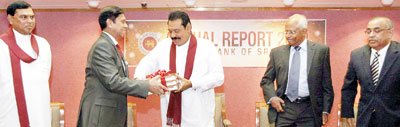
Economy
doing well: Central Bank Governor Nivard Cabraal formally hands over the Central
Bank Annual report 2012 to President Rajapaksa
There
was still a tragic irony. For weeks and months an upward revision of electricity
rates was only too well known. The Ceylon Electricity Board (CEB), which owed
billions to the state-owned Ceylon Petroleum Corporation (CPC) was forced to
shut down some of its generation capacity and even resort to unannounced power
cuts in some areas. Of course, such cuts were not officially admitted. This was
until the Public Utilities Commission approved the CEB’s request for the latest
price hike. When that was done, the CEB chose to allow consumers to enjoy
Avurudhu and give them the shock later. Both the Government and the Opposition,
which had a forewarning of what was ahead, did little and appear to have been
caught off guard — the government unable to cohesively explain what prompted the
increase and the opposition unable to mobilise its full force.
The
Government, however, did not explain why such a steep increase, which would have
a paralysing effect on lower and middle class income earners, was necessary.
That raised more questions than answers. Official spokesperson Minister Keheliya
Rambukwella, well known for his profound remarks, declared the increase would
not “affect poorer sections” and added that “no government could continue to
subsidise utility services.” His remarks came at Thursday’s news briefing after
the weekly cabinet meeting.
“We
cannot subsidise TV watching, lighting up tamashas, lighting various festivals.
They will have to pay for it. They will have to pay the actual cost of power
generation,” International Monetary Co-operation Minister Sarath Amunugama told
an interviewer. He did not perhaps realise that the vast volume of power being
abused for illuminations of different sorts is during tamashas held by the
Government. Hence, it is the taxpayer who is forced to subsidise the use of
electricity by various state sector concerns. A case in point, a CEB engineer
said yesterday, was the lighting at last month’s Deyata Kirula exhibition in
Ampara. “The electricity consumed would have been sufficient to provide power to
a whole village for three months or more free of charge,” he said speaking on
grounds of anonymity.
The
opportunity of proving its mettle as a vibrant opposition in a democracy fell
again on the main opposition United National Party (UNP). Other than a few
comments and voice cuts by different parliamentarians, the party has not been
able to mobilise itself to highlight the devastating consequences of the latest
electricity tariff hike. This is much the same way the party missed out on the
events related to the impeachment of Chief Justice 43 Shirani Bandaranayake.
With an upcoming May Day and some provincial council elections due in the coming
months, such a lackadaisical attitude to major issues affecting the people will
no doubt affect the UNP’s vote base. The Janatha Vimukthi Peramuna (JVP), on the
other hand, recommended the extreme step of asking consumers not to pay
electricity bills. Leave alone the consumers, none of its own leadership would
want to live in the dark thereafter. The consumers have been left to fight their
own battle.
How
the new tariff structure and the varying increases will affect different
categories of consumers will play out in the coming weeks. However, if one is to
go by the Central Bank’s latest report, released with much fanfare last week,
some thought-provoking questions do arise over why a drastic price rise in
electricity rates became necessary. The report for 2012 reveals the loss
incurred by the Ceylon Petroleum Corporation for 2012 was Rs. 61.2 billion
(provisional) as against Rs. 19.3 billion in 2011. The Ceylon Petroleum
Corporation reported an operational loss of Rs. 89.7 billion in 2012 compared to
Rs. 94.5 billion in 2011.
The
CPC maintained throughout that its losses were due to global oil price
fluctuations. However, the Central Bank report notes, “During 2012 crude oil
prices were highly volatile, although the average crude oil price remained
largely unchanged when compared to 2011�”
Thus,
it is clear that crude oil or refined oil prices — contrary to claims — did not
increase during 2012 when compared to 2011. Hence, the main reason why the CPC
and the CEB were incurring heavy losses in 2012 was due to the rapid
depreciation of the rupee and to a lesser degree the drought that prevailed. The
latter factor necessitated increased fuel-based power generation.
In
2012, CEB sources say, the total import cost for CPC was US$ 6 billion whilst
CEB’s imports (including coal, equipment and other material) were about US$ 615
million. That totals some US$ 6.6 billion. As at June 1, 2012, the rupee cost ($
6.6 billion into Rs. 110) would be Rs. 726 billion. However, due to
depreciation, the cost was worked out at the rate of Rs. 130 per dollar bringing
it to a total of Rs. 858 billion. The same sources said this was why both the
CEB and the CPC had to extract an additional Rs. 132 billion from consumers. The
drought that prevailed had cost the CEB Rs. 30 billion due to additional 1000 GW
hours being generated using heavy fuel and diesel. Hence, the additional cost
the CPC and the CEB incurred was due to the rupee depreciation and drought. It
amounted to Rs. 150 billion.
“That
not only takes the issue back to why the rupee depreciation came about. It also
raises the all-important question of a subsidy. If indeed there was one, where
was it in force and in what form?” a CEB expert asked and added “this is only
propaganda.” He pointed out that contrary to claims of there being a subsidy;
the long term debts of both the CPC and the CEB were either partly or wholly
absorbed by state banks. He lamented that the consumer would be compelled to
face the brunt not due to a so-called subsidy, but the depreciation of the
rupee.
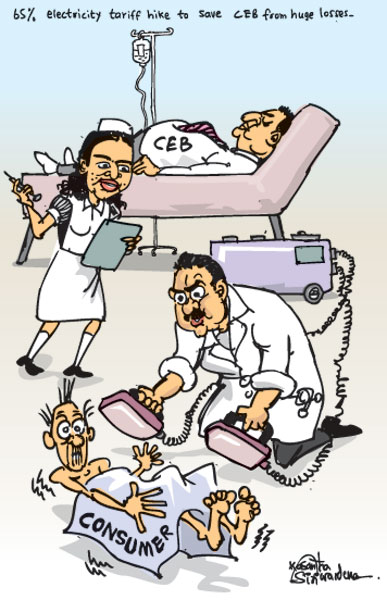
He
asked, “what happens if the rupee depreciates further?” Inevitably, it would
compel further price revisions; all caused by what is clearly a mismanagement of
the economy, he argued. That would naturally turn the spotlight on the Central
Bank of Sri Lanka (CBSL) which took the bold step of depreciating the rupee
vis-�-vis the US dollar, a question that requires deeper study by economists
after trying to resist the move all of 2012. That had a drastic impact on the
country’s Balance of Payments and it was President Mahinda Rajapaksa who first
announced the depreciation in his 2011 Budget presentation even without the
knowledge of Central Bank Governor Nivard Cabraal. Later, the Central Bank was
forced to make a further depreciation of the rupee last year.
This
is whilst the CBSL has embarked on new foreign policy initiatives by tying up
with Thompson Advisory Group, a lobbying firm in the US as exclusively revealed
in the Sunday Times (Political Commentary) of April 7. Details of an agreement
the CBSL signed with TAG, and as US law requires registered under Foreign Agents
Registration Act (FARA), were disclosed.
This
week, the CBSL issued a news release. It did confirm, though only after the
revelations by the Sunday Times, that there indeed was an agreement. However,
the CBSL which is now the exclusive domain of Governor Cabraal, the architect of
many a revolutionary economic measure, had this to say:
“The
Central Bank of Sri Lanka embarks on extensive local and international Awareness
Programme to portray accurate picture of Sri Lankan Economy
“In
the recent times, the Central Bank of Sri Lanka has observed an aggressive and
well-funded misinformation campaign that is being carried out by various groups
with dubious agendas, both locally and internationally to tarnish the political
image and true economic successes of Sri Lanka. The Central Bank also notes with
concern, that if such campaign continues without a counter campaign to correct
the misconceptions it may have the potential to create a highly detrimental
image for Sri Lanka, and erode the growing confidence of international investors
in Sri Lanka.
“Since
such an outcome would adversely affect the country’s economy and its economic
and financial system stability, the Central Bank has embarked upon a robust
local and international Awareness Programme to refute such misinformation, and
to provide the factual position of the economy and the political environment to
all relevant stakeholders.
“Towards
that objective, the Central Bank has also secured the services of a competent
international professional firm to assist in the effort to convey the true and
factual position regarding Sri Lanka and its economy, particularly in the USA.
Such an endeavour will be particularly significant, since the USA is a major
market for Sri Lankan exports, while US investors have made a substantial
foreign direct investment and are the leading holders of Sri Lankan
bonds.”
It
is only after the revelations of the contents of the Agreement that the CBSL has
realised there is a “well-funded misinformation campaign that is being carried
out by various groups with dubious agendas, both locally and internationally to
tarnish the political image and true economic successes of Sri Lanka.” Since,
the CBSL is the authority to monitor financial transactions; it will not be a
bad idea if it comes out with who is funding whom and what the “misinformation”
campaign is all about. A mere “press release campaign” will not wipe out the
truth and that requires the CBSL to answer every point raised. The Sunday Times
revealed that the CBSL is paying US$ 66,000 (or Rs. 8.3 million) every month
from the tax payers’ money to the US lobbying firm for its “robust local and
international Awareness Programme.” Why a US lobbying firm when there is a Sri
Lanka embassy in Washington DC?
The
embassy has not even been consulted. It is now known that even a “hire driver”
or a man who runs a taxi service in Washington DC — who helped in the deal — has
been recruited by what CBSL calls a “competent international professional firm”
for US$ 7,000 (Rs. 889,000) a month as a consultant. Surely, is there no one
better qualified in the Sri Lanka embassy in Washington DC than a taxi service
operator? Is it not an admission that even a taxi service operator will have to
be paid to convey CBSL’s “true and factual position regarding Sri Lanka.”
Neither the Ministry of External Affairs nor the Cabinet has approved the
endeavour of Governor Cabraal, the all-powerful economic Czar responsible for
many a controversial move in the country’s economy.
By
last Friday, it became clear that it would be a difficult task both for the
Central Bank and the Thompson Advisory Group to pursue the objectives they have
agreed upon at a cost of more than Rs. 8.3 million a month. Secretary of State
John Kerry released the US country reports on human rights practices. The report
on Sri Lanka, compared with the previous one in 2011, or the ones before,
contains some highly critical remarks with some pointed references to Defence
Secretary Gotabaya Rajapaksa too. It has accused the Government of “co-ordinated
moves” “to undermine the independence of the judiciary.” Added to that are 2014
budget cuts announced by Secretary Kerry where funds for military training and
assistance have been pruned.
(The
report on Sri Lanka can be accessed on the following website: http://www.state.gov/j/drl/rls/hrrpt/humanrightsreport/index.htm?year=2012&dlid=204411#wrapper)
The lengthy Sri Lanka US human rights report for 2012 notes, “��. The major human rights problems were attacks on and harassment of civil society activists, persons viewed as Liberation Tigers of Tamil Eelam (LTTE) sympathizers, and journalists by persons allegedly tied to the government, creating an environment of fear and self-censorship; involuntary disappearances as well as a lack of accountability for thousands who disappeared in previous years; and widespread impunity for a broad range of human rights abuses, particularly involving police torture, and attacks on media institutions and the judiciary.
The lengthy Sri Lanka US human rights report for 2012 notes, “��. The major human rights problems were attacks on and harassment of civil society activists, persons viewed as Liberation Tigers of Tamil Eelam (LTTE) sympathizers, and journalists by persons allegedly tied to the government, creating an environment of fear and self-censorship; involuntary disappearances as well as a lack of accountability for thousands who disappeared in previous years; and widespread impunity for a broad range of human rights abuses, particularly involving police torture, and attacks on media institutions and the judiciary.
“Other
serious human rights problems included unlawful killings by security forces and
government-allied paramilitary groups, often in predominantly Tamil areas;
torture and abuse of detainees by police and security forces; poor prison
conditions; and arbitrary arrest and detention by authorities. Lengthy pre-trial
detention was a problem. Denial of fair public trial remained a problem, and
during the year there were coordinated moves by the government to undermine the
independence of the judiciary. The government infringed on citizens’ privacy
rights. There were restrictions on freedom of speech, press, assembly,
association, and movement. While citizens generally were able to travel almost
anywhere in the island, there continued to be police and military checkpoints in
the north, and de facto high-security zones and other areas remained off limits
to citizens.�
“Authorities
harassed journalists critical of the government and self-censorship was
widespread. The president exercised authority under the 18th amendment to
maintain control of appointments to previously independent public institutions
that oversee the judiciary, police, and human rights. Lack of government
transparency was a serious problem. Violence and discrimination against women
were problems, as were abuse of children and trafficking in persons.
Discrimination against persons with disabilities and against the ethnic Tamil
minority continued, and a disproportionate number of victims of human rights
violations were Tamils. Discrimination against persons based on their sexual
orientation and against persons with HIV/AIDS were problems. Limits on workers’
rights and child labour remained problems.
“The
government prosecuted a very small number of officials implicated in human
rights abuses but had yet to hold anyone accountable for alleged violations of
international humanitarian law and international human rights law that occurred
during the conflict that ended in 2009. During the year unknown actors suspected
of association with pro-government paramilitary groups committed killings,
kidnappings, assaults, and intimidation of civilians. There were persistent
reports of close, ground-level ties between paramilitary groups and government
security forces.”
Among
other significant highlights in the report are:
- The law prohibits arbitrary arrest and detention; however, in practice such incidents frequently occurred. There were numerous reports throughout the year of victims randomly selected by police to be arrested and detained on unsubstantiated charges.
- Widespread impunity persisted, particularly for cases of police torture, corruption, human rights abuses, and attacks on media institutions. By law authorities are required to inform an arrested person of the reason for arrest and bring that person before a magistrate within 24 hours, but in practice several days and sometimes weeks or months elapsed before detained persons appeared before a magistrate. A magistrate could authorize bail or continued pre-trial detention for up to three months or longer.
- Following the September 2010 passage of the 18th amendment, executive influence over the judiciary significantly increased. The 18th amendment repealed the 17th amendment and eliminated the Constitutional Council, a multiparty body created to name members of independent judicial, police, human rights, and other commissions. In place of the Constitutional Council, the 18th amendment established the Parliamentary Council, which submits nonbinding advice on appointments to the president, who has sole authority to make direct appointments to the commissions. The president also directly appoints judges to the Supreme Court, High Court, and courts of appeal.
- The law provides for freedom of speech, including for members of the press, but the government did not respect these rights in practice. Government officials criticized, pressured, harassed, and arrested members of the media, and most journalists practiced self-censorship.
- Police, under the authority of the Ministry of Defence, reportedly maintained a special unit to monitor and control all references in the media to members of the Rajapaksa family. Official pressure reportedly was regularly exerted through orders to government and private firms to cease advertising in critical newspapers and television stations and advertise in pro-government outlets. Newspapers critical of the government faced difficulty obtaining credit from major banks, all of which the state owns or has interest through pension schemes and other investments. While the media could operate freely, independent and opposition media practised self-censorship. Media freedom suffered from severe government pressure throughout the island, and most journalists practised self-censorship, particularly on matters of accountability, human rights, and criticism of government officials, particularly in regards to the president and his family.
- The LLRC report stated that it was “deeply disturbed by persistent reports concerning attacks on journalists and media institutions and killing of journalists and the fact that these incidents remained to be conclusively investigated and perpetrators brought to justice�any failure to investigate and prosecute offenders would undermine the process of reconciliation and the rule of law.” The LLRC recommended steps be taken to prevent harassment and attacks on media personnel and institutions and priority be given to investigate and prosecute those responsible for such incidents. During the year the government did not make progress on implementing this recommendation, nor did it take concrete steps to protect media freedom as laid out in the government’s National Action Plan.
- The law provides criminal penalties for official corruption; however, the government did not implement the law effectively, and officials in all three branches of the government frequently engaged in corrupt practices with impunity.
- There was an increase during the year in bribery and corruption complaints against public officials, particularly divisional secretariats, police personnel, and school principals.�
- The government often criticized local NGOs critical of government actions, failed to respond to requests for assistance, and put pressure on those that sought such assistance. The NGO Secretariat was moved from the Social Services Ministry to the Ministry of Defence in 2010 and remained under the Ministry of Defence at the end of the year. Several NGOs noted a lack of clarity in defence ministry procedures and enforcement of regulations.
- The military seized significant amounts of land during the war to create security buffer zones around military bases and other high-value targets, which the government called high security zones (HSZs). The declaration of HSZs displaced large numbers of persons, particularly in the Jaffna Peninsula, who did not receive restitution for their lands. A degree of progress was made in reducing the size of the HSZs during the year, with some lands being demilitarized.
It
is clear even further from the contents of the US Human Rights country report on
Sri Lanka that its second resolution at the UN Human Rights Council in Geneva is
an extension. With the stance of the Obama administration toughening, as is
evident from the report, both the CBSL-TAG tie up and the Sri Lanka Embassy in
Washington DC will find their tasks even more difficult. CBSL chief Cabraal
wants a “re-calibration of US policy” towards Sri Lanka. On the other hand,
still officially, the Sri Lanka Embassy in Washington DC wants the country to be
a part of the “US pivot” with defence and economic co-operation as
hallmarks.
On
top of that, the Embassy has entered into another contract with The Majority
Group, another US lobbying firm, paying US $50,000 per month.
Yet,
another issue seems to cause irritation at the highest levels. Recently, Allison
V. Areias-Vogel, Economic Counsellor of the US Embassy in Colombo, wrote to
Ceylon Electricity Board Chairman W.B. Ganegala. A US Embassy spokesperson
admitted it was to seek a meeting “after media reports about a possible
electricity price revision.” Ganegala sought, quite rightly, clarification from
the External Affairs Ministry. This is on the grounds that requests from
diplomatic missions must be routed through the EAM. The US move angered UPFA
leaders at the highest levels. Some said that it was “interference in the
internal affairs of the country.” However, a diplomatic source whilst conceding
the procedure may have been wrong declared the query was to determine matters
relating to tariff hikes. This was particularly to advise prospective US
investors of the new tariffs they would have to factor in their plans for
investment. In fact the Central Bank statement (see above) admits that “US
investors have made a substantial foreign direct investment” in Sri Lanka.
This
week’s events show that Washington-Colombo links, which remained at a low ebb,
are taking a nose dive. None other than External Affairs Minister G.L. Peiris
has declared in Parliament that there would be no change in Sri Lanka’s US
policy. Against this backdrop, Cabraal’s US$ 66,000 a month to a lobbying firm
in the US to change President Obama’s attitude towards Sri Lanka is money down
the drain.
However,
a more important challenge lay in how long more could Sri Lanka keep the rupee
at around Rs. 126 per US dollar with an ever widening Balance of Payments
(imports expenditure versus exports earnings) gap. If the rupee value decreases,
so will import cost rise and the consumer will have to face the brunt. So will
be fuel tariffs that could come as an even bigger after shock to the electricity
bills. The time has come for the Government to go beyond the glossy media
statements of economic prosperity and achievements. The sooner the dark truth is
ascertained, the better it is for the country and the people. Or is it a fool’s
paradise that we live in?
