Peace for the World World ! Your War Our Lives

The Dalai Lama
A Brief Colonial History Of Ceylon(SriLanka)
Sri Lanka: One Island Two Nations
A Brief Colonial History Of Ceylon(SriLanka)
Sri Lanka: One Island Two Nations
(Full Story)
Back to 500BC.

Sunday, April 21, 2013
Three fundamental economic challenges
Sunday,
April 21, 2013

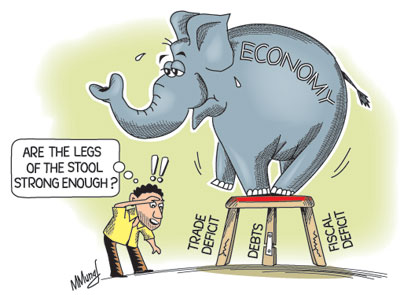
 The three most important challenges facing the
economy are the containment of the fiscal deficit, lessening the trade deficit
and reducing the public debt: especially its foreign debt component. Unless
there is significant progress in reducing these, the resultant economic
instability would hamper sustained economic growth.
The three most important challenges facing the
economy are the containment of the fiscal deficit, lessening the trade deficit
and reducing the public debt: especially its foreign debt component. Unless
there is significant progress in reducing these, the resultant economic
instability would hamper sustained economic growth.
The
most important economic objective of the government should be to reduce the
fiscal deficit from the current 6.4 percent of GDP to around 5 percent in the
next few years. The reduction of the fiscal deficit is essential, as a large
deficit has diverse adverse impacts on the economy. Large fiscal deficits
generate inflationary pressures, increase the public debt and distort public
expenditure priorities.�
Fiscal
deficits increase the cost of living that lead to strikes with demands for
higher wages and industrial unrest. Wage increases add to the costs of
production and reduce export competitiveness. The depreciation of the currency
to restore export competitiveness would lead to further inflation and increased
hardships. Inflation causes severe hardships to lower wage earners pensioners
and fixed income earners.
Large
fiscal deficits lead to borrowing and in turn to huge debt servicing costs. Sri
Lanka’s huge accumulated debt is a result of persistent deficits over the years.
The massive public debt servicing costs distort public expenditure priorities
and hampers economic development.
Committed
to reduce deficit
In
spite of strong official commitment, the government failed to achieve its fiscal
deficit target of a 6.2 percent last year. Even the 6.4 percent fiscal deficit
was achieved by several expenditures that should have been brought into the
government accounts remaining as debts to state banks.�
The
target to bring down the fiscal deficit to 5.8 percent of GDP this year is
difficult to achieve owing to the continuing high government expenditure, high
debt servicing costs, losses of public enterprises and declining revenues. It
is, however, important to cut government expenditure and reduce losses in public
enterprises to achieve a lesser deficit.
One
of the disappointing features of recent fiscal performance has been the decline
in the revenue to GDP ratio from an already low 14.3 to 13 percent last year.
The collection of 15 percent of GDP as revenue should be the objective for this
year. In the next few years government revenue should be enhanced to around 20
percent of GDP to achieve a fiscal deficit of 5 percent or less.
Losses
in public enterprises
Losses
incurred by public enterprises are a huge fiscal burden. Reforms of these public
enterprises to reduce losses provide a significant means of reducing
expenditure. The Central Bank has argued this cogently in its Annual Report for
2012. “Improving the financial viability of state owned enterprises would be
crucial towards strengthening macroeconomic stability and financial system
stability.
Continuous
operational losses at the two key state owned enterprises (SOEs), i.e., the
Ceylon Electricity Board (CEB) and the Ceylon Petroleum Corporation (CPC), have
led these entities to rely heavily on bank borrowings to cover their losses and
to continue operations. While revisions to energy prices are a step in the right
direction, measures need to be taken to improve the operational efficiency of
these entities and introduce a cost reflective flexible pricing policy to
transform these enterprises into commercially viable entities and to reduce
pressure on commercial banks, thereby making available more resources to the
private sector.”
While
agreeing that measures need to be taken to improve the operational efficiency of
public enterprises, it is difficult to concede that revisions of energy prices
are a step in the right direction. Reforms in the management of these public
enterprises should be the priority and should precede price increases. The
increase in electricity prices would increase the costs of living and the costs
of industrial production.
Debt
burden
There
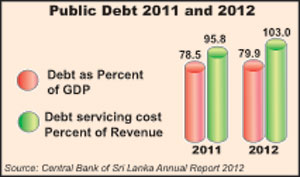
has been a decrease in the public debt as a proportion of GDP in recent years.
In 2002 the public debt was as much as 105 percent of GDP. In subsequent years
it has been brought down as a proportion of GDP. In 2011 it was 78.5 percent of
GDP. However in 2012 the debt to GDP ratio increased to 79.1 percent of
GDP.
Although
the debt to GDP ratio declined till last year, the public debt increased
substantially. The debt to GDP ratio declined owing to the GDP increasing and
the appreciation of the rupee till 2012. (The appreciation of the rupee leads to
a lowering of the ratio as the debt is in rupees, while a depreciation has the
opposite effect). The debt to GDP ratio is an inadequate, even misleading,
indicator of the country’s indebtedness. In 2012, the increase in debt resulted
in an increase in the debt to GDP ratio to nearly 80 percent. This was due to
increased borrowing, the depreciation of the currency, and the slower economic
growth of last year.
Debt
servicing costs
The
debt servicing cost as a proportion of revenue is a better indicator of the
crippling effect of the large public debt. In 2011, debt servicing payments
absorbed 95.8 percent of revenue. In 2012 debt servicing costs were higher than
the government revenue: 103 percent of government revenue. This means that
government has to borrow for its other expenditures. This in turn increases the
public debt.
Foreign
debt
The
increasing foreign debt is a serious concern. The increase in foreign debt was
particularly sharp after 2008. In 2011 the foreign debt was Rs. 2,329,280
million, which was 35.6 percent of GDP. In 2012 it has risen to Rs. 2,767299
million that was 36.5 percent of GDP. It is not certain as to whether all
foreign borrowings are included in these figures.�
The
foreign debt servicing costs absorbed 16.4 of earnings from exports and
services, up from 11.1 percent in 2011.
Since the large foreign debt is a continuing burden on the public finances and the balance of payments, it is important to take measures to reduce the foreign debt burden by generating a significant balance of payments surplus. This requires a reduction in the trade deficit.
Since the large foreign debt is a continuing burden on the public finances and the balance of payments, it is important to take measures to reduce the foreign debt burden by generating a significant balance of payments surplus. This requires a reduction in the trade deficit.
Trade
deficit
The
need to reduce the trade deficit is recognised by the Central Bank. “The deficit
in the external current account needs to be narrowed to a sustainable level over
the medium term. Improved access to international capital markets and a more
flexible exchange rate helped cushion the external sector in 2012. However,
policies should focus on narrowing the current account deficit to a more
sustainable level by reducing import dependence, improving export
competitiveness and diversifying goods and services exports as well as markets.
Expenditure on the importation of food and beverages could be significantly
reduced through policies being taken to encourage domestic production,
particularly in the areas of dairy and sugar production.”
There
has been a significant decrease in consumer imports. However intermediate and
investment goods continue to increase. Investment goods imports of US$ 4.5
billion that accounted for 23.5 percent of import expenditure have to be reduced
to make a significant dent in the import bill.�
The
government’s programme of infrastructure development such as roads, bridges and
energy generation will contribute to economic development in the long run.
However, in consideration of the country’s fiscal constraints, impact on debt,
balance of payments difficulties and other priorities, it is important to
reconsider the pace and priorities of investment expenditure.
Bottom
line
Good
governance is essential to achieve the three vital economic goals and to promote
an environment that is conducive to higher investment that is needed to spur
economic growth. Higher economic growth, achieved by the right composition of
output, could in turn lessen the fiscal deficit, reduce the trade gap and
decrease public debt.
