Peace for the World World ! Your War Our Lives

The Dalai Lama
A Brief Colonial History Of Ceylon(SriLanka)
Sri Lanka: One Island Two Nations
A Brief Colonial History Of Ceylon(SriLanka)
Sri Lanka: One Island Two Nations
(Full Story)
Back to 500BC.

Saturday, May 18, 2013
Blundering Politicians Continue Their Assault On Higher Education


With
blossom’d furze unprofitably gay,
There,
in his noisy mansion, skill’d to rule,
The
village master taught his little school;
A
man severe he was, and stern to view,
I
knew him well, and every truant knew;
Well
had the boding tremblers learn’d to trace
The
days disasters in his morning face;
Full
well they laugh’d with counterfeited glee,
At
all his jokes, for many a joke had he:
Full
well the busy whisper, circling round,
Convey’d
the dismal tidings when he frown’d:
Oliver
Goldsmith (1728-1774)
in
The Deserted Village
It
is said that in this poem Goldsmiith was referring to his own tutor in the
village in which he grew up and where his father was the Anglican parish priest.
Goldsmith apparently had a very high regard and respect for this village
schoolmaster; but the schoolchildren, as kids everywhere, were quick to
recognise their teacher’s varying moods and kept him in good humour and avoided
inviting his wrath, It appears that our university administrators today are
following what schoolchildren have been doing, before and after Goldsmith’s
time. They seem to think, rightly or wrongly, that they owe their positions to
politicians and bend over backwards to show their loyalty to the politicians
who have placed them in the positions they hold. Sadly this malaise has even
spread to members of the University Councils who also think that they must do
the bidding of the politicians who have placed then in their positions. Their
decision making is therefore warped by this mind-set.
In
1948, the United Nations adopted the Universal
Declaration of Human Rights which included the right to education.
Primary education was to be compulsory and free while higher education was to be
accessible to all on the basis of merit. The same Article 26 in the Declaration
of Hunan Rights further states: “ Education shall be directed to the full
development of the human personality and to the strengthening of respect for
human rights and fundamental freedoms. It shall promote understanding, tolerance
and friendship among all nations, racial or religious groups, and shall further
the activities of the United Nations for the maintenance of peace.”
Sri
Lanka has had a long tradition of learning. The village Buddhist and
Hindu temples produced scholars in all disciplines of study including science
and medicine, but particularly in the fields of art, literature and religion.
But some years before the United Nations adopted the Universal Declaration of
Human Rights.. Sri Lanka had introduced free education not just for the primary
stages but right up to university level. Compulsory education was also
introduced at the same time but it took a while to be implemented because of
inadequate facilities. But following the Kannangara reforms, there was a surge
in the provision of well-staffed quality schools in all parts of the country.
The same held for university education. Access was on merit but not available to
all. owing of inadequate material resources There was then only one University
of Ceylon. Even wIth many more now, we are still not able to meet the demands
for higher education. There is also a wide disparity between the universities in
the quality of education each of them provide.
Issues
facing higher education
These
are the deficiencies and issues that the Ministry of Higher Education should be
addressing. Free education needs to be strengthened; the Universities should be
provided with adequate material and physical resources to meet the demand for
higher education. The autonomy of the Universities should safeguarded and the
Vice Chancellors and academic staff should be selected on merit and research
encouraged.
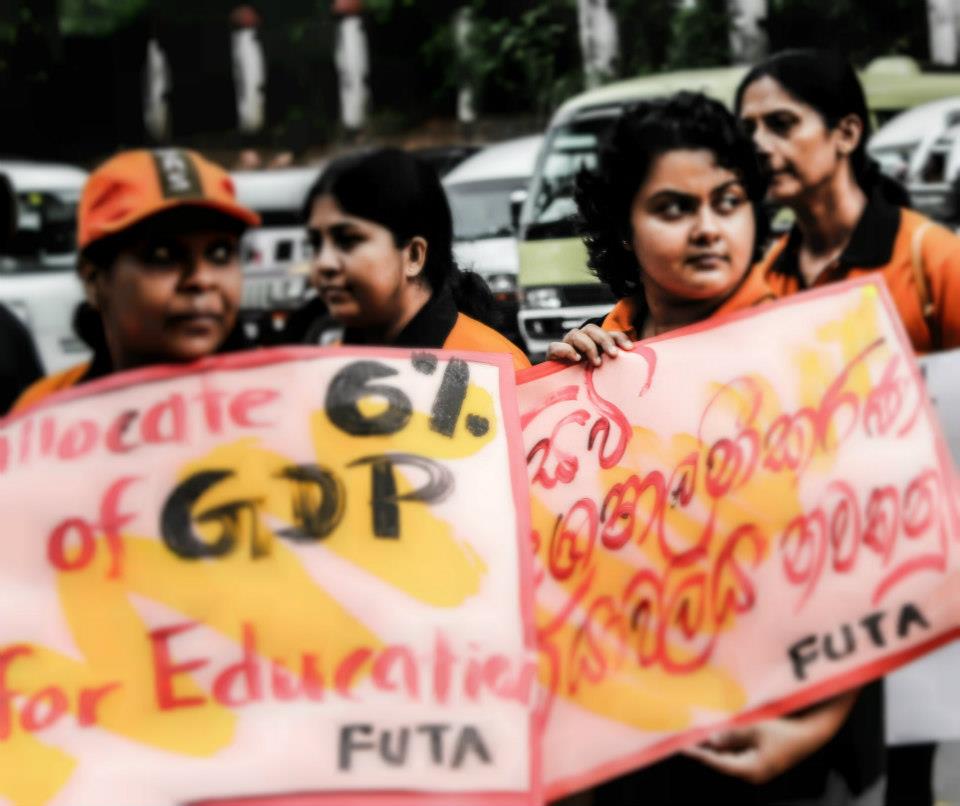
It
is now generally accepted that the recommendation of theUNESCO that
member countries of the United Nations should aim at allocating 6% of
the GDP for education to ensure that that the minimum standards in
education are met. But to our shame, the present allocation in Sri Lanka is only
1.9%. Politicians are fond of saying that Sri Lanka will become the educational
hub of Asia. This is pure rhetoric. In fact the Budget, instead of increasing
the allocation for education, actually reduced it, presumably to provide for the
huge increase in allocation for the Ministry of Defence. If Sri Lanka is to move
forward to becoming an educational hub of Asia, there must be definite
commitment by the government towards the end of allocating of GDP for education.
This cannot be achieved by the Ministry issuing diktats on political bases. The
Kannangara reforms came into being after considerable public discussion through
the media and through direct consultations with academics. No such discussions
take place now. The Ministry must give up its ‘take it or leave it’ attitude,
that only it knows what is best. All stakeholders, including the academics and
parents, need to be drawn into the decision making process. This will make for
healthy democratic governance not only in education but in all areas involving
people’s lives.
The
introduction of compulsory training in military camps for new University
entrants was also an unacceptable unilateral decision. This was perhaps not a
brainchild of the Ministry of Higher Education but a decision forced on it by
the ideologists of the Ministry of Defence. It appears that the curriculum is
more an exercise in indoctrination, in disregarding our pluralist past and
highlighting our narrow present. Obviously those who formulated the curriculum
did not think in terms of the LLRC recommendation
that we should be fostering reconciliation.
But
it is the Ministry of Higher Education that is solely responsible for the
politicisation of our Universities. The University administrators and the
University Councils have also to take their share of the blame for not resisting
the naked politicisation of our Universities The appointment of a new Vice
Chancellor for the University of Colombo has been embroiled in controversy.
Attempts are being made to appoint the spouse of the former Vice Chancellor who
is now the Chairperson of the University Grants Commission, when among the
short-listed candidates is a senior academic with unmatched academic
qualifications. But the spouse of the favourite candidate has been a loyal
political favourite and was herself rewarded by being appointed to the Chair of
the UGC.
The
crisis at Peradeniya
The
appointment of the Vice Chancellor of the University of Peradeniya has also been
mired in controversy. The person chosen was the least qualified among the
short-listed applicants the appointment was obviously a clear political
decision. So also was the Vice Chancellor’s choice of a Deputy. These are
leading to a real crisis situation in the University system.
In
a hard-hitting statement, the FUTA has written: “Having minions of unscrupulous
politicians at key positions in administration is now taking its toll of
the entire Sri Lankan University system as Vice Chancellors are appointed not
on academic merit but solely on political connections. These institutions are
now depicted in the public’s eye in negative hues due to unprecedented
politicization and deterioration of autonomy. This is despite the efforts of
FUTA and its sister unions to enlighten the public and exert relentless pressure
on the administrators and the government to realise and respect the importance
of university autonomy and academic freedom.
When
the last TUA action of FUTA ended, it was agreed to have senate meetings at each
university on autonomy, academic freedom and politicization. Despite this, the
government continues to attempt to violate the autonomy of our universities
taking political interference to an unprecedented level…..
The
University of Peradeniya is one of the oldest and most prestigious of Sri
Lankan universities has also not been spared. The government appointed the
least qualified candidate as Vice Chancellor highlighting bad governance and
vested interests. In an attempt to exert pressure on the VC to comply with
existing procedures, the Federation of Peradeniya University Teachers’
Associations (FPUTA) officially met the newly appointed VC and
communicated the importance of winning the trust of the academic community he
was appointed to lead. But this was not to be: the Deputy Vice Chancellor
appointment at the University of Peradeniya which followed also reflected the
will of government-backed administrators rather than that of the academic
community. The person appointed had antagonistic relations with both academics
and students due to high handed and unethical behaviour and no right-thinking
administration would have selected such an individual to a position of great
responsibility. In protest, the Peradeniya Academic community through the Union
submitted a petition signed by members of all faculties, requesting the Vice
Chancellor to replace the Deputy Vice Chancellor. This was ignored. To stall
these unprecedented breaches on autonomy, the Peradeniya Univesrsity Community
through FPUTA staged a one day token strike. As there was no positive response
from the administration, the members withdrew from all the voluntary positions
that directly dealt with the Deputy Vice Chancellor. FPUTA also resolved that
its members will resort to agitations at crucial events/junctures, as deemed
necessary by the academic community to protest the deterioration of university
autonomy and academic freedom. The academic community is also considering
boycotting the convocation procession and the dinner this year. This is a final
resort since the academic community is fully aware and sensitive of the
importance of this occasion for students. This step is being considered
reluctantly to protest against the deplorable lack of sensitivity towards the
will of the entire academic community of University of Peradeniya by the
politicized administrators.”
Lowering
academic standards
Also
at Peradeniya recently, there were surreptitious moves to admit ten students to
the Medical Faculty without going through the competitive GCE Advanced Level
examination by which other students are selected for the MB BS programme.
Sadly, there were university academic administrators who colluded in these
moves. It is believed that the ten students were selected not on their academic
records but they were coming in as fee-paying students. FUTA in their
statement say: “It is learnt that interested political masters and their
flunkeys have threatened and intimidated academics who protested against this
decision. The authorities concerned clearly wanted to change the Peardeniya
Medical Faculty into a degree shop and sadly, university administrators are
letting it happen. Despite this, the Faculty Board of the Medical Faculty stood
resolutely by their principles and have been able to defeat this well planned
initiative. Similar stories of unprecedented ill-deeds are regularly
disseminating from the entire university system.
We
believe, now it is time for the academic community of Sri Lanka to step up their
fight to safeguard the university system in what is possibly the darkest period
of university education in this country. It is now time to stand united against
the tides of darkness that threaten not only our institutions, but also our
dignity. It is now time to fearlessly stand up for what we believe is
right.”
This
statement of FUTA reflects a growing disappointment with the way that some
political supporters of the government, including ministers and bureaucrats, are
helping the people to openly distance themselves from the government. The
country now needs a Mandela-type leader who will not fight evil by evil, one who
will embrace the other without abandoning principles and stand firm on ensuring
democratic governance. Is there such a leader on the horizon?
