Peace for the World World ! Your War Our Lives

The Dalai Lama
A Brief Colonial History Of Ceylon(SriLanka)
Sri Lanka: One Island Two Nations
A Brief Colonial History Of Ceylon(SriLanka)
Sri Lanka: One Island Two Nations
(Full Story)
Back to 500BC.

Tuesday, June 4, 2013
Eight bronze age boats surface at Fens creek in record find
3,000-year-old fleet discovered in a Cambridgeshire quarry on the outskirts of Peterborough
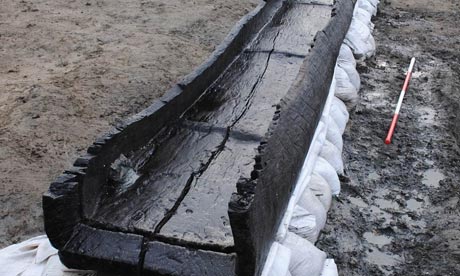
The boats, which were deliberately sunk into the long-dried-up creek, have been well preserved and still show carvings

A fleet of eight prehistoric boats, including one almost nine metres
long, has been discovered in a Cambridgeshire quarry on the outskirts of
Peterborough.
The vessels, all deliberately sunk more than 3,000 years ago, are the
largest group of bronze age boats ever found in the same UK site and
most are startlingly well preserved. One is covered inside and out with
decorative carving described by conservator Ian Panter as looking "as if
they'd been playing noughts and crosses all over it". Another has
handles carved from the oak tree trunk for lifting it out of the water.
One still floated after 3,000 years and one has traces of fires lit on
the wide flat deck on which the catch was evidently cooked.
Several had ancient repairs, including clay patches and an extra section
shaped and pinned in where a branch was cut away. They were preserved
by the waterlogged silt in the bed of a long-dried-up creek, a tributary
of the river Nene, which buried them deep below the ground.
"There was huge excitement over the first boat, and then they were
phoning the office saying they'd found another, and another, and
another, until finally we were thinking, 'Come on now, you're just being
greedy,'" Panter said.
The boats were deliberately sunk into the creek, as several still had
slots for transoms – boards closing the stern of the boat – which had
been removed.
Archaeologists are struggling to understand the significance of the
find. Whatever the custom meant to the bronze age fishermen and hunters
who lived in the nearby settlement, it continued for centuries. The team
from the Cambridge Archaeological Unit is still waiting for the results
of carbon 14 dating tests, but believes the oldest boats date from
around 1,600 BC and the most recent 600 years later.
They already knew the creek had great significance – probably as a rich
source of fish and eels – as in previous seasons at the Much Farm site
they had found ritual deposits of metalwork, including spears.
The boats themselves may have been ritual offerings, or may have been
sunk for more pragmatic reasons, to keep the timber waterlogged and
prevent it from drying out and splitting when not in use – but in that
case it seems strange that such precious objects were never retrieved.
Some of the boats were made from huge timbers, including one from an oak
which must have had a metre-thick trunk and stood up to 20 metres tall.
This would have been a rare specimen as sea levels rose and the terrain
became more waterlogged, creating the Fenland landscape of marshes,
creeks and islands of gravel.
"Either this was the Bermuda Triangle for bronze age boats, or there is
something going on here that we don't yet understand," Panter said.
Kerry Murrell, the site director, said: "Some show signs of long use and
repair – but others are in such good condition they look as if you
could just drop the transom board back in and paddle away."
The boats were all nicknamed by the team, including Debbie – made of
lime wood, and therefore deemed a blonde – and French Albert the Fifth
Musketeer, the fifth boat found. Murrell's favourite is Vivienne, a
superb piece of craftsmanship where the solid oak was planed down with
bronze tools to the thickness of a finger, still so light and buoyant
that when their trench filled with rainwater, they floated it into its
cradle for lifting and transportation.
Because the boats were in such striking condition, they have been lifted
intact and transported two miles, in cradles of scaffolding poles and
planks, for conservation work at the Flag Fen archaeology site
– where a famous timber causeway contemporary with the boats was built
up over centuries until it stretched for almost a mile across the fens.
"My first thought was to deal with them in the usual way, by chopping
them into more manageably sized chunks, but when I actually saw them
they just looked so nice, I thought we had to find another way," Panter,
an expert on waterlogged timber from York Archaeological Trust, said.
"I think if I'd arrived on the site with a chainsaw, the team would have
strung me up."
Must Farm, now a quarry owned by Hanson UK, which has funded the
excavation, has already yielded a wealth of evidence of prehistoric
life, including a settlement built on a platform partly supported by
stilts in the water, where artefacts including fabrics woven from wool,
flax and nettles were found. Instead of living as dry-land hunters and
farmers, the people had become experts at fishing: one eel trap found
near the boats is identical to those still used by Peter Carter, the
last traditional eel fisherman in the region.
The boats will be on display from Wednesday at Flag Fen, viewed through
windows in a container chilled to below 5c – funded with a £100,000
grant from English Heritage which regards their discovery as of
outstanding importance – built within a barn at the site. At the moment
conservation technician Emma Turvey, dressed in layers of winter
clothes, is spending up to eight hours a day spraying the timbers to
keep them waterlogged and remove any potentially decaying impurities.
They will then be impregnated with a synthetic wax, polyethylene glycol,
before being gradually dried out over the next two years for permanent
display.
Murrell is convinced there is more to be found down in the silt.
"The creek continued outside the boundaries of the quarry, so it's off
our site – but the next person who gets a chance to investigate will
find more boats, I can almost guarantee it."
