Peace for the World World ! Your War Our Lives

The Dalai Lama
A Brief Colonial History Of Ceylon(SriLanka)
Sri Lanka: One Island Two Nations
A Brief Colonial History Of Ceylon(SriLanka)
Sri Lanka: One Island Two Nations
(Full Story)
Back to 500BC.

Saturday, January 11, 2014
Published January 11, 2014
 COLOMBO, SRI LANKA – With
a bloody civil war over and a cautious peace at hand, a group of
hardline Buddhist monks is rallying Sri Lankans against what they say is
a pernicious threat: Muslims.
COLOMBO, SRI LANKA – With
a bloody civil war over and a cautious peace at hand, a group of
hardline Buddhist monks is rallying Sri Lankans against what they say is
a pernicious threat: Muslims. In
just over a year, the saffron-swathed monks of Bodu Bala Sena — or
Buddhist Power Force — have amassed a huge following, drawing thousands
of fist-pumping followers who rail against the country’s Muslim
minority.
In
just over a year, the saffron-swathed monks of Bodu Bala Sena — or
Buddhist Power Force — have amassed a huge following, drawing thousands
of fist-pumping followers who rail against the country’s Muslim
minority.
Buddhists have attacked dozens of mosques and called for boycotts on
Muslim-owned businesses and bans on headscarves and halal foods. At
boisterous rallies, monks claim Muslims are out to recruit children,
marry Buddhist women and divide the country.
"This is a Buddhist nation, so why are they trying to call it a
multicultural society?" said Galagoda Atte Gnanasara, the 37-year-old
pulpit-pounding monk who co-founded the group in 2012. "Not everyone can
live under the umbrella of a Buddhist culture."
There have been few if any physical attacks on people, unlike in
Myanmar, where Buddhist monks helped incite communal violence in 2012
and 2013 and even stood watch as Buddhist mobs slaughtered Rohingya
Muslims. But many Sri Lankans and human rights workers are alarmed,
saying the monks are creating communal divisions and giving Buddhism a
bad name.
Nearly all of the dozen critics of Bodu Bala Sena interviewed for this story declined to speak on the record, fearing reprisals.
The Sri Lankan government only rarely steps in to defend or protect
Muslims, who make up roughly 10 percent of the 20 million people on this
Indian Ocean island.
Many see the silence as tacit approval, but Media Minister Keheliya
Rambukwella said it’s intended to encourage community members to work
out their own problems. He said the anti-Muslim rumblings are “minor
agitations that are normal in any multicultural society.”
"If things get more serious, we will take action," he said. "These kinds of things can ruin a nation, we are aware of that."
In September 2011, Buddhists reportedly smashed a 300-year-old Islamic
Sufi shrine to rubble in the ancient city of Anuradhapura, a UNESCO
world heritage site. Police have denied that the incident happened, but
photographs taken by locals show at least a dozen officers watching as
young men hammer the shrine to pieces while a monk holds a burning green
Islamic flag.
In April 2012, a 2,000-strong Sinhalese mob including monks ransacked
Jumma Mosque in the north-central city of Dambulla as police looked on.
The government later ordered the removal of the decades-old mosque,
saying its location within a sacred Buddhist area was an affront.
In March last year, police watched as red-robed monks led a hollering crowd in trashing a Muslim-owned clothing store.
The U.S. Embassy spoke out after a stone-hurling mob attacked a suburban
Colombo mosque in August, calling it “particularly troubling in light
of a number of recent attacks against the Muslim community in Sri
Lanka.”
Muslims say they are also the targets of ludicrous conspiracy theories,
including rumors that they spit three times in any dish before serving
it to a non-Muslim, or that Muslim shops sell women’s undergarments
tainted with chemicals that cause infertility.
Many Muslims feel they are being victimized because of their visibility
in the economy — a role they have played for more than 1,000 years since
Arab traders brought Islam to Sri Lanka and allied with the Sinhalese
against Spanish and Dutch colonial forces. Today, they control at least
half of small businesses and hold near-monopolies in the textile and gem
trades.
Because most speak Tamil, and not Sinhala, they were key players in
military intelligence during the civil war against ethnic Tamil rebels.
"We never thought the government would turn on us," said Mujibur Rahman,
a Muslim member of Colombo’s provincial council. He and other critics
contend that the 2009 civil war victory left a triumphant Buddhist
Sinhalese majority searching for a new target.
"The president needs to create a new security problem to avoid actually
having to govern," Rahman said. "He has built an image for himself as a
Sinhalese Buddhist hero and savior. He needs a new enemy to keep that
up."
The government dismisses the idea as absurd, and Bodu Bala Sena denies
any role in organizing attacks. But even some Sinhalese have their
suspicions.
"The BBS is trying to push the country toward racial and religious
conflict," said a Sinhalese business owner who would only give his first
name, Susantha. "Sometimes I suspect they are carrying out a contract
for the government to turn attention away from issues such as the
economy, health care and education."
Gnanasara and Kirama Wimalajothi started Bodu Bala Sena after splitting
from a group they said was not militant enough in protecting Buddhist
interests in Sri Lanka.
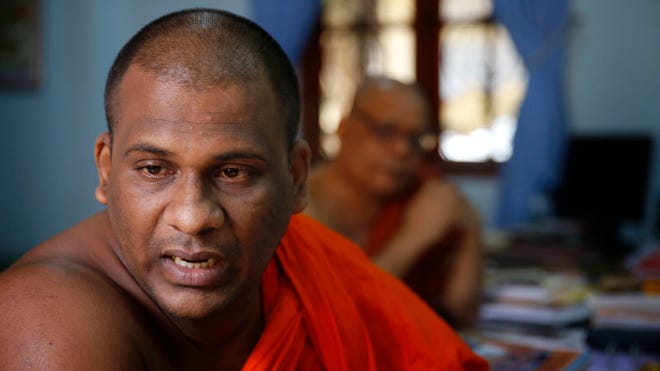
The brawny, bespectacled Gnanasara said that, with about 70 percent of
the population practicing Buddhism, the tropical nation has a duty to
uphold the religion’s traditions, preserve its heritage sites and police
against conversion to other religions.
"The secret to my popularity is that I speak the truth," he said in an
interview held within the Bodu Bala Sena headquarters, in a Buddhist
cultural center set among twisted tree trunks and a lush jungle canopy
near Colombo, the capital.
Gnanasara said there are “extremist forces trying to create divisions,
buy our lands, marry our wives and recruit our children. The same thing
happened in Malaysia, the Maldives and Bangladesh — all now Muslim
countries. The same thing may happen in Sri Lanka if we’re not careful.”
At a rally in August, Gnanasara urged Sri Lankans: “Don’t vote for any
politician who does not admit this is a Sinhalese Buddhist country.”
The aggressive tones have clashed with the country’s pledge to pursue
postwar reconciliation, a pledge still largely unfulfilled as the
government flouts international calls for an independent war crimes
probe.
Analysts say radical Buddhism is just one sign of human rights being
sidelined in Sri Lanka. With the nation reveling in postwar relief,
lawmakers loyal to President Mahinda Rajapaksa passed a constitutional
amendment in 2010 extending his term limits and revoking guarantees of
independent police, judiciary and electoral commissions.
"We’re seeing a pattern of really severe human rights violations right
across the board," Amnesty International director Steve Crawshaw said.
"The government can’t stand any forms of protest or criticism, and yet
it appears to actively turn away from violence and lawlessness against
other ethnic minorities and religions."
The justice minister and Colombo’s mayor are both Muslim, but neither has made any public moves to address tensions.
Islam is not the only religion Buddhists have targeted. In September, a
radical Buddhist monk led a group in attacking a Protestant church
during a prayer service.
The country’s Tamils, who are mostly Hindu and account for about 11
percent of the population, have remained largely quiet and cowed since
the army routed the Tamil Tiger rebels. But many Tamils today are
frustrated, too, as they await postwar reconciliation measures including
the return of all seized property and land.
Bodu Bala Sena monks make many accusations about other religions —
Christian pastors making suicide bomb kits, Islamists taking children
away to train in Pakistan — without offering supporting evidence.
"We are worried about our children. We are struggling with the
government to stop these cons," Wimalajothi, the group’s leader, said as
Gnanasara nodded by his side. "We need the government on our side. And
the government is doing its best job possible to handle this."
