Peace for the World World ! Your War Our Lives

The Dalai Lama
A Brief Colonial History Of Ceylon(SriLanka)
Sri Lanka: One Island Two Nations
A Brief Colonial History Of Ceylon(SriLanka)
Sri Lanka: One Island Two Nations
(Full Story)
Back to 500BC.

Tuesday, January 7, 2014
At last, a law to stop almost anyone from doing almost anything
 Protesters, buskers, preachers, the young: all could end up with 'ipnas'. Of course, if you're rich, you have nothing to fear
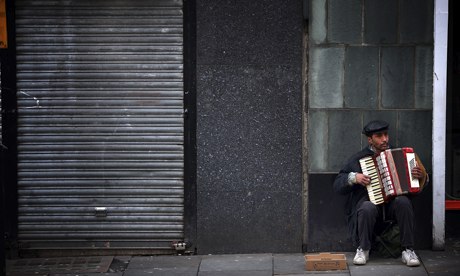
'Street life will be reduced to a trance-world of consumerism in which
nothing unpredictable or disconcerting happens.' Photograph: Christopher
Furlong/Getty

Until the late 19th century much of our city space was owned by private
landlords. Squares were gated, streets were controlled by turnpikes. The
great unwashed, many of whom had been expelled from the countryside by
acts of enclosure, were also excluded from desirable parts of town.
Social reformers and democratic movements tore down the barriers, and
public space became a right, not a privilege. But social exclusion
follows inequality as night follows day, and now, with little public
debate, our city centres are again being privatised or semi-privatised.
They are being turned by the companies that run them into soulless,
cheerless, pasteurised piazzas, in which plastic policemen harry anyone
loitering without intent to shop.
Street life in these places is reduced to a trance-world of consumerism,
of conformity and atomisation in which nothing unpredictable or
disconcerting happens, a world made safe for selling mountains of
pointless junk to tranquillised shoppers. Spontaneous gatherings of any
other kind – unruly, exuberant, open-ended, oppositional – are banned.
Young, homeless and eccentric people are, in the eyes of those upholding
this dead-eyed, sanitised version of public order, guilty until proven
innocent.
Now this dreary ethos is creeping into places that are not, ostensibly,
owned or controlled by corporations. It is enforced less by gates and
barriers (though plenty of these are reappearing) than by legal
instruments, used to exclude or control the ever widening class of
undesirables.
The existing rules are bad enough. Introduced by the 1998 Crime and Disorder Act,
antisocial behaviour orders (asbos) have criminalised an apparently
endless range of activities, subjecting thousands – mostly young and
poor – to bespoke laws. They have been used to enforce a kind of caste
prohibition: personalised rules which prevent the untouchables from
intruding into the lives of others.
You get an asbo for behaving in a manner deemed by a magistrate as
likely to cause harassment, alarm or distress to other people. Under
this injunction, the proscribed behaviour becomes a criminal offence.
Asbos have been granted which forbid the carrying of condoms by a
prostitute, homeless alcoholics from possessing alcohol in a public
place, a soup kitchen from giving food to the poor, a young man from
walking down any road other than his own, children from playing football
in the street. They were used to ban peaceful protests against the
Olympic clearances.
Inevitably, more than half the people subject to asbos break them. As
Liberty says, these injunctions "set the young, vulnerable or mentally
ill up to fail", and fast-track them into the criminal justice system.
They allow the courts to imprison people for offences which are not
otherwise imprisonable. One homeless young man was sentenced to five
years in jail for begging: an offence for which no custodial sentence
exists. Asbos permit the police and courts to create their own laws and
their own penal codes.
All this is about to get much worse. On Wednesday the Antisocial Behaviour, Crime and Policing Bill reaches
its report stage (close to the end of the process) in the House of
Lords. It is remarkable how little fuss has been made about it, and how
little we know of what is about to hit us.
The bill would permit injunctions against anyone of 10 or older who "has
engaged or threatens to engage in conduct capable of causing nuisance
or annoyance to any person". It would replace asbos with ipnas (injunctions to prevent nuisance and annoyance),
which would not only forbid certain forms of behaviour, but also force
the recipient to discharge positive obligations. In other words, they
can impose a kind of community service order on people who have
committed no crime, which could, the law proposes, remain in force for
the rest of their lives.
The bill also introduces public space protection orders, which can
prevent either everybody or particular kinds of people from doing
certain things in certain places. It creates new dispersal powers, which
can be used by the police to exclude people from an area (there is no
size limit), whether or not they have done anything wrong.
While, as a result of a successful legal challenge, asbos can be granted
only if a court is satisfied beyond reasonable doubt that antisocial
behaviour took place, ipnas can be granted on the balance of
probabilities. Breaching them will not be classed as a criminal offence,
but can still carry a custodial sentence: without committing a crime,
you can be imprisoned for up to two years. Children, who cannot
currently be detained for contempt of court, will be subject to an
inspiring new range of punishments for breaking an ipna, including three
months in a young offenders' centre.
Lord Macdonald, formerly the director of public prosecutions, points out
that "it is difficult to imagine a broader concept than causing
'nuisance' or 'annoyance'". The phrase is apt to catch a vast range of
everyday behaviours to an extent that may have serious implications for
the rule of law". Protesters, buskers, preachers: all, he argues, could
end up with ipnas.
The Home Office minister, Norman Baker, once a defender of civil
liberties, now the architect of the most oppressive bill pushed through
any recent parliament, claims that the amendments he offered in December
will "reassure people that basic liberties will not be affected". But
Liberty describes them as "a little bit of window-dressing: nothing
substantial has changed."
The new injunctions and the new dispersal orders create a system in
which the authorities can prevent anyone from doing more or less
anything. But they won't be deployed against anyone. Advertisers, who
cause plenty of nuisance and annoyance, have nothing to fear; nor do
opera lovers hogging the pavements of Covent Garden. Annoyance and
nuisance are what young people cause; they are inflicted by oddballs,
the underclass, those who dispute the claims of power.
These laws will be used to stamp out plurality and difference, to douse
the exuberance of youth, to pursue children for the crime of being young
and together in a public place, to help turn this nation into a
money-making monoculture, controlled, homogenised, lifeless, strifeless
and bland. For a government which represents the old and the rich, that
must sound like paradise.
Twitter: @georgemonbiot
