Peace for the World World ! Your War Our Lives

The Dalai Lama
A Brief Colonial History Of Ceylon(SriLanka)
Sri Lanka: One Island Two Nations
A Brief Colonial History Of Ceylon(SriLanka)
Sri Lanka: One Island Two Nations
(Full Story)
Back to 500BC.

Monday, January 6, 2014
Has the Idea of a Jewish State Become Obsolete?
 Winslow Myers for Salem-News.com-Jan-05-2014
As we express our hope that Arab countries (and even the U.S. itself)
evolve toward a more inclusive and tolerant politics, it is worth asking
if the maintenance of Israel as a Jewish state become
counter-productive to its own long-term security?
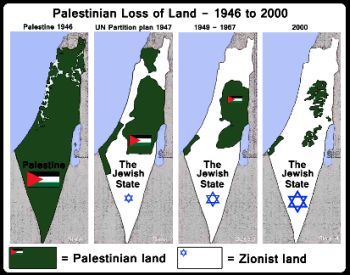
Map shows Israel's aggressive campaign to annex Palestinian land.
|
(PORTLAND, OR) - While John Kerry admirably shuttles around like the
Energizer Bunny in search of Middle East peace, is there anything new to
say about the intractable tension between Israelis on the one hand and
predominantly Muslim peoples, especially the Palestinians, on the other?
One layer of the unspoken is Israel’s implicit status as a nuclear
power. Mr. Netanyahu and Mr. Obama draw red lines in the sand concerning
the threat of Iranian nukes, but say little about the only viable
long-term solution: a negotiated and verified nuclear-free zone in the
Eastern Mediterranean—even better, a planet-wide nuclear-free zone.
Nuclear war anywhere on earth has become more unthinkable as it has
become more possible.
Also rarely spoken—lest howls of anti-Semitism ensue—is an uncomfortable
question: why do we frown upon the lack of separation of church and
state in many Muslim countries, while Israel gets a pass in privileging a
particular constellation of religion and ethnicity?
The historical rationale for the birth of the Jewish state could not be
more reasonable. In the context of Jewish history over thousands of
years climaxing in the Holocaust, no one could argue with Jewish fears
of extinction and their need for a secure homeland.
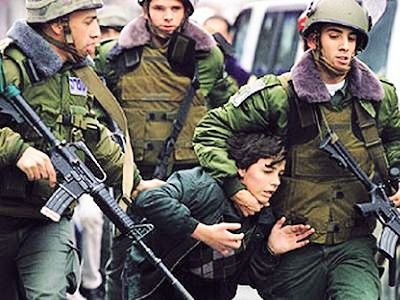
Israeli soldiers manhandle a small Palestinian boy.
|
Though all parties in the region ought to know from long experience how
futile war, terror, obstruction, and discriminatory harshness are as
tools to suppress the universal impulse toward justice, each keeps
trying one or another unworkable method, making the success of Mr.
Kerry’s quixotic mission all the more crucial.
The present Israeli government derives its identity in large measure
from fear of what it is against, and so it has encouraged injustices
like the settlements that it would never tolerate were it a victim of
similar treatment.
Obviously this is not to say that the anti-Semites of the Arab world are
innocent. And it is unfair to compare the civil rights Israel has
afforded non-Jews with the civil rights much of the Muslim world affords
women and non-believers. Israel does not order the execution of those
who abandon Judaism. However much it may wish to be even-handed, it sees
its own Muslim population growing. If this population enjoyed full
citizenship Israeli could eventually become a de facto Muslim state. So
it waters down Muslim civil rights to preserve its identity.
As we express our hope that Arab countries (and even the U.S. itself)
evolve toward a more inclusive and tolerant politics, it is worth asking
if the maintenance of Israel as a Jewish state become
counter-productive to its own long-term security? It is not that Zionism
is racism, in the crude Arab formulation, but that Zionism has been
transcended by the notion of a state relatively untethered to any one
religion.
If the identity of Israel were re-established on the basis of equal
rights for all ethnicities, ancient fears might begin to dissolve from
within. The corrosive “us-and-them” dynamic could be undermined in a way
that left Jews safer—just as Jews, while a minority in the United
States, are surely as safe there, if not more so, as they are in Israel.
For Israel to become a fully secular state, the international community
would have to guarantee the security of Jews, whether inside or outside
Israel, a task that for understandable reasons Israel has always
zealously reserved for itself. Abdication of self-determined security
is, to say the least, unlikely. Tragically however, maintaining a Jewish
state will increasingly tie its citizens in knots as they are forced to
choose between Jewish identity and full democracy.
Jews and Palestinians for the most part do not know each other as
people, and the predictable theatrics of their leaders do nothing to
help reconciliation. The entry point into a shared future beyond war is
the face-to-face engagement of ordinary citizens at the heart level. It
is people moving one by one from unfamiliarity, ignorance, and fear,
toward familiarity, empathy, and enough trust to allow the heart to
message the brain that it's safe to get creative together.
The moral basis of the secular state, the tolerance and compassion that
flows from the acknowledgement of universal rights, is ironically a
major premise of the Jewish ethical tradition. An unbeliever once asked
Rabbi Hillel if he could sum up the Torah while standing on one foot.
The simple answer was “What is hateful to yourself, do not to your
fellow man. That is the whole of the Torah and the rest is but
commentary.”
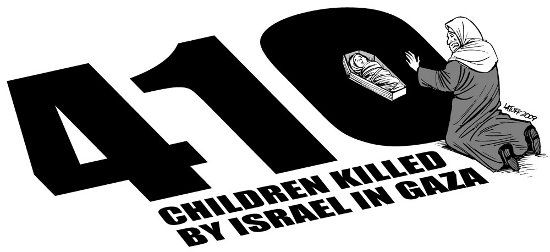
Artwork by Carlos Latuff
|
One of the many gifts world civilization owes the Jews is this
confidence in an ethical universality that transcends specific sects and
ethnicities. If I identify as a Jew but also as citizen of secular
democracy, I am better able to interact with Palestinians according to
our common identity as humans. Finding ourselves in this shared human
context, we will stand a measurably better chance of resolving our
differences. To the extent that Jews allow themselves that larger
identification with the “other,” they may not only come closer to
fulfilling the ethical promise of their heritage, but also may find the
security that has eluded them since the founding of the Jewish state.
How poignant that after thousands of years of their culture contributing
so much to the world, this idea should still feel so risky. Godspeed,
Mr. Kerry.
Winslow Myers, author of “Living Beyond War: A Citizen’s Guide,” writes on global issues for PeaceVoice and serves on the Advisory Board of the War Prevention Initiative.
