Peace for the World World ! Your War Our Lives

The Dalai Lama
A Brief Colonial History Of Ceylon(SriLanka)
Sri Lanka: One Island Two Nations
A Brief Colonial History Of Ceylon(SriLanka)
Sri Lanka: One Island Two Nations
(Full Story)
Back to 500BC.

Sunday, January 5, 2014
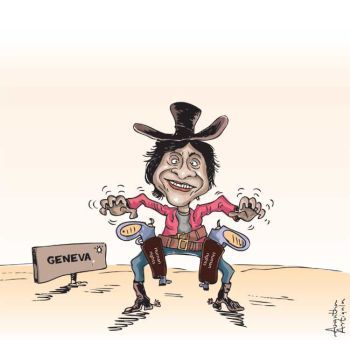
Sri Lanka on Full Throttle to Save its Skin & the Tamils Will have to Match It

If the parties could get together, many of the problems faced by the
Tamils would be solved. In addition to policy alignment, duplication of
duties could be avoided. Travelling, which is a major cost, could be
spread among all of them.
 |
(MELBOURNE) - With the dawn of the New Year Sri Lanka is slated to
experience pressing political and diplomatic challenges in 2014. Main
among them is the session of the United Nations Human Rights Council
scheduled for March 2014. The government is bracing for the event, and
already appointments have been sought with the member states for a
lobbying-spree ahead of the session. The UNHRC will appraise Sri Lanka’s
progress on the implementation of matters outlined in its resolution
adopted last March. It would like to see nearly all the clauses in the
last resolution fulfilled. From all accounts available it has little to
offer to UNHRC 2014.
So, Sri Lanka is planning to go on full throttle on an international
diplomatic spree to get all the support it can to defeat whatever
resolution that is submitted in the UNHRC in 2014. It will look for soft
spots from the third world countries in in Africa and South America,
who are not so amused with the Western policies. During this years
election in UNHRC, Algeria, China, Cuba, France Maldives, Mexico,
Morocco, Namibia, Saudi Arabia, South Africa, the former Yugoslav
Republic of Macedonia, Vietnam, Russia, and United Kingdom, were elected
by secret ballot at UN Headquarters in New York. Sri Lanka should be
pleased that Cuba, China, South Africa and Russia and perhaps Vietnam
had rejoined the UNHRC
That may not be enough to defeat the resolution. With the general
election coming soon, India may not be able to change its stand on its
voting for the resolution. Flushed with Chinese money and the inducement
of investment and trading opportunities, Sri Lanka will go on its
diplomatic offensive. It may have to draw in some of those who voted for
the resolution last year.
This puts an additional pressure on the Tamil Diaspora to go on their
own offensive. Fifty six Tamil organisations voted for a New Year
Resolution to bring Rajapaksa to books. Two other parties, GTF and BTF
abstained from signing the resolution. I suppose GTF wants to bring in
South African Truth and Reconciliation (TRC) into Sri Lanka to save the
criminal Rajapaksa clique from the gallows. To date GTF has not given
any reason why Sri Lanka needed a truth and reconciliation resolution.
Even frustrated TNA, after trying to appease Sri Lanka, now wants a
credible and independent international investigation. So,we can
understand why GTF failed to sign the resolution; but what about BTF?
What baffles an average Tamil is why about 4 million Sri Lankan Tamils
require more than 58 organisations to represent them. Even two or three
may be too much. The job before them is enormous. They had to match with
the huge funding that Sri Lanka gets. Tamils by nature are not known
for their contribution of funds.
The next problem we face is the scarcity of resources. This could be
overcome only by pooling resources. For this reason all the parties will
have to merge together, either by dissolving the minor parties or by
aligning with the major party.
Here, obviously, TGTE is in the lead. It should accommodate the other
parties without sacrificing its main policies, for example on the
question of Eelam. Soon one would notice the minor parties will all
become irrelevant and would suffer a natural death, especially those
that do not have a firm policy that appears logical to many.
If the parties could get together, many of the problems faced by the
Tamils would be solved. In addition to policy alignment, duplication of
duties could be avoided. Travelling, which is a major cost, could be
spread among all of them. The Tamils could reach out to many countries
and speak with the same voice without contradictions. Moreover, foreign
powers may not be able to manipulate one party against the other. All
these need hard work and sacrifices from all Tamils. Right now we are
depending on the Western powers to do most of our policy directions and
God-mothers like Navi Pillay, but please remember, the Western powers
have their own geopolitical priorities, which may not synchronize with
ours. So, as far as possible it is good to be on our feet.
