Peace for the World World ! Your War Our Lives

The Dalai Lama
A Brief Colonial History Of Ceylon(SriLanka)
Sri Lanka: One Island Two Nations
A Brief Colonial History Of Ceylon(SriLanka)
Sri Lanka: One Island Two Nations
(Full Story)
Back to 500BC.

Thursday, April 3, 2014
Genocide in Rwanda was a fork in the road not just for Africa but the world
 David Smith-
The horrific events of April 1994 continue to shape the thinking of today's policymakers and peacemakers
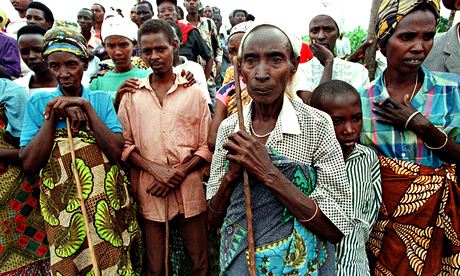
Genocide survivors listen to an address by then UN secretary general
Kofi Annan during his visit to a massacre site. Photograph: Reuters/Re
 'Rwanda is our nightmare, South Africa is
our dream," wrote the Nigerian author Wole Soyinka, reflecting on the
events of April 1994 – the most momentous month in Africa's
post-independence history. Even as South Africans formed endless human
chains to vote for Nelson Mandela as their first black president and
bury racial apartheid under euphoria, hundreds of thousands of people
were being murdered in a tiny east African country away from the the
global gaze.
'Rwanda is our nightmare, South Africa is
our dream," wrote the Nigerian author Wole Soyinka, reflecting on the
events of April 1994 – the most momentous month in Africa's
post-independence history. Even as South Africans formed endless human
chains to vote for Nelson Mandela as their first black president and
bury racial apartheid under euphoria, hundreds of thousands of people
were being murdered in a tiny east African country away from the the
global gaze.
Twenty years on from these twin eruptions, South Africa remains
a template of reconciliation studied everywhere from Northern Ireland
to Palestine, but the Rwandan genocide can be seen as a fork in the road
not just for Africa but the world.
That searing experience continues to shape the thinking of a generation
of policymakers and peacemakers anxious that there should not be
"another Rwanda" on their watch. It is a constant spectre when global
powers debate the morality of intervention – whether in Afghanistan,
Iraq, Libya, Mali, Syria, the Central African Republic (CAR) or Ukraine.
"No serious international lawyer has applauded the US's failure to act
in Rwanda," Mia Swart, a professor of international law at the
University of Johannesburg, wrote in South Africa's Business Day newspaper
"Syria should not be another Rwanda."Along with that other 1990s
catastrophe in Bosnia, the killing of 800,000 Tutsis by Hutu extremists
in Rwanda over 100 days was a signal failure of UN peacekeeping. UN
military commander Roméo Dallaire had warned of impending massacres
three months earlier but was ignored by the security council. Kofi
Annan, then head of UN peacekeeping, writes in his memoir: "We spent
days frantically lobbying more than 100 governments. I called dozens
myself … We did not receive a single serious offer. It was one of the
most shocking and deeply formative experiences of my entire career."
Scarred by memories of Vietnam and Somalia, the US government did not
publicly use the word genocide until 25 May and even then diluted its
impact by saying "acts of genocide". Bill Clinton, who was president at the time, has since described it as "my personal failure".
In his millennium report of 2000, Annan, then UN secretary-general, laid
down a challenge: "If humanitarian intervention is, indeed, an
unacceptable assault on sovereignty, how should we respond to a Rwanda,
to a Srebrenica, to gross and systematic violation of human rights that
offend every precept of our common humanity?"
The result five years later was a UN doctrine, Responsibility to Protect(R2P),
adopted as a "norm" for dealing with conflicts where civilians were
under attack. It was invoked in the deployment of peacekeeping troops to
Darfur a year later and has since been referenced in UN debates on
Libya, Ivory Coast, South Sudan, Yemen, Syria and the CAR. But whereas
the 1990s had brought Rwanda and Bosnia, the 2000s delivered a
counter-weight in the form of Afghanistan and Iraq, both widely
condemned as blundering adventures that exemplified the law of
unintended consequences. Annan was an outspoken critic of the US
decision to topple Saddam Hussein. Some analysts argued that, in effect,
it cancelled out Rwanda when it comes to weighing the balance of
intervention. "People are outraged but it is on paper and when it comes
to the practicalities they don't want to move quickly, for example in
Syria," said Koffi Kouakou, a foreign policy expert at Wits University
in Johannesburg.
"The executions of the UN's resolutions has not been vigorous. If it was
not for France in Mali or the CAR, we would have had a genocide."
Such examples illustrate how every case has specific dynamics and demand
for pragmatism. In their book, Can Intervention Work?, Rory Stewart and
Gerald Knaus write: "We both believe that it is possible to walk the
tightrope between the horrors of over-intervention and non-intervention;
that there is still a possibility of avoiding the horrors not only of
Iraq but also of Rwanda."
The biggest UN intervention of all has come in Rwanda's giant neighbour,
the Democratic Republic of the Congo, where genocide has its most
lethal legacy: millions have died in subsequent wars and clashes between
rebel groups. The presence of Hutu extremists who fled Rwanda when the
tide turned against them is cited by president Paul Kagame's government
as justification for its continued interference.
A post-1994 outpouring of western guilt has, many argue, allowed Kagame
to escape criticism for running an authoritarian regime that ruthlessly
crushes dissent, including the alleged assassination of opponents abroad.Clinton
has described him "one of the greatest leaders of our time", Tony Blair
called him a "visionary leader" and former international development
secretary Clare Short infamously said of him: "Such a sweetie."
Kagame, a bush fighter turned strongman leader, is a worrying role model
who risks legitimising autocrats in other counties, according to
Kouakou. "He is one of those ex-rebels who graduated to power through a
process of 'legal systems', as we also see in Uganda and South Sudan.
But the remnants of the rebels are still there: they still carry with
them that authoritarian or 'big man' tendency."
It is one reflection of how, as each prepares 20th anniversary
commemorations, Rwanda and South Africa have taken divergent paths. One
is among the fastest-growing economies in the world but lacking in basic
political and media freedoms. The other is its inverted mirror: a
robust constitutional democracy with a vibrant press, already on its
fourth president, but economically stagnant and among the most unequal
societies on the planet.
Soyinka's dichotomy of dreams and nightmares continues to resonate in Africa and beyond
