Peace for the World World ! Your War Our Lives

The Dalai Lama
A Brief Colonial History Of Ceylon(SriLanka)
Sri Lanka: One Island Two Nations
A Brief Colonial History Of Ceylon(SriLanka)
Sri Lanka: One Island Two Nations
(Full Story)
Back to 500BC.

Sunday, April 6, 2014
‘Is this a govt. of laws or a govt. of men?’
By Namini Wijedasa-Sunday, March 30, 2014
 Lawyers,
academics and activists hit out at the growing militarisation of every
aspect of society at a forum organised by the BASL to analyse the
implications of a gazette vesting police powers in the armed forces
Lawyers,
academics and activists hit out at the growing militarisation of every
aspect of society at a forum organised by the BASL to analyse the
implications of a gazette vesting police powers in the armed forces
Speakers at a crammed public forum this week denounced increasing
military encroachment into various aspects of civilian life and warned
that it boded ill for the country’s future.
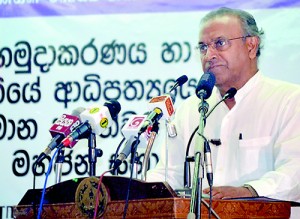
Jayantha Danapala
The gathering was held by the Bar Association of Sri Lanka (BASL) at the
Sri Lanka Foundation Institute auditorium to analyse the implications
of a gazette vesting police powers in the armed forces. A spokesman said
the BASL will also organise such discussions in other parts of the
country.
Issued under Section 12 of the Public Security Ordinance, the relevant
gazette is renewed every month. It sees President Mahinda Rajapaksa
calling out all members of the armed forces for “maintenance of law and
order” in all administrative districts of Sri Lanka. Each of the ten
speakers at the forum emphasised that this was not conducive to peace,
democracy and the rule of law.
It is nearly five years since the war against terrorism ended and “we
still unfortunately see the prevalence of a military presence, not only
in the north, but also in the south,” observed Jayantha Dhanapala,
former UN Under-Secretary General for Disarmament Affairs. It was
important to have a sustainable peace, he stressed, and “not the
securitisation of the State, which is what we see today”.
A comparison of the Defence Ministry budget allocations of 2009 and 2014 shows a substantial rise that cannot be accounted for by
A comparison of the Defence Ministry budget allocations of 2009 and 2014 shows a substantial rise that cannot be accounted for by

Upul Jayasuriya
inflation, Mr. Dhanapala said. There was also a significant increase in
the armed forces and in the strength of the armed forces which “cannot
be explained”.
Mr. Dhanapala cited the Government’s own Lessons Learnt and
Reconciliation Commission as recommending that it was important for
normal civilian life to resume in the war-affected provinces. The LLRC
called for a “viable demilitarisation” and a return to full civilian
administration. “An environment of fear and mistrust is incompatible
with reconciliation,” he said.
Every seat in the large auditorium was occupied forcing some listeners
to remain standing. The address by Chandraguta Thenuwara, spokesman for
the Federation of University Teachers’ Associations (FUTA), drew
laughter from the audience. He said the government now takes a new type
of credit called “Chi-naya”—“Chi” being short for China and “naya” being
the Sinhala word for loan. The State has cut funding to universities
while allocating more money to the Kotelawala Defence University.

Savitri Goonesekera
Mr. Thenuwara criticised the leadership programmes run for new
university entrants by the military. The university system also did not
require protection from the army’s new security company called Rakna
Lanka. Having existed for more than 100 years in Sri Lanka, universities
were capable of meeting their own protection needs.
A team of professors from Kelaniya University had for the first time
devised a course in forensics, Mr. Thenuwara said. The authorities had
feared that they would sell out the country as forensics concerned dead
bodies. It resulted in the lecturers being summoned for a “cordial”
meeting with Defence Secretary Gotabaya Rajapaksa and his staff.
The army did everything from planting flower gardens to growing
vegetables, Mr. Thenuwara said. Soldiers were being deployed like slaves
to build parks and highways. “Militarisation, in whatever form, cannot
be supported,” he asserted. “If the war is over, the army must go home.
It must be reduced, not expanded. They must become ordinary citizens.
They have today shoved aside ordinary citizens and put in their place
soldiers in civilian clothing.”
BASL President Upul Jayasuriya accepted that the army or military was an
integral part of a State’s defence system. “However, they have no role
to play in policing a society,” he said. “On the contrary, they are
regimented to act on the dictates of politicians in power.”
“In this backdrop, society has rapidly been tilted towards militarisation,” he cautioned. “The military rule which has been enforced under the guise of the civil war, is gradually over shadowing a democratic society.”
“In this backdrop, society has rapidly been tilted towards militarisation,” he cautioned. “The military rule which has been enforced under the guise of the civil war, is gradually over shadowing a democratic society.”
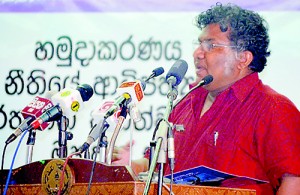
Chandraguta Thenuwara
The gradual decline of the rule of law over the last few months has now
“reached a critical point”, Mr. Jayasuriya said. “Human rights and
Humanitarian laws have been completely disregarded,” he continued. “The
entire society has fallen prey to subjective standards of a few who hold
unlimited power and a few others who are closely linked to them. Laws
that must apply to all persons irrespective of their status do not seem
to apply to them. They appear to act above the law.”
Mr. Jayasuriya accused “those in the highest level of governance” of
blatantly violating the law in the full glare of public scrutiny. “If
this situation is permitted, it would create a dangerous trend where
privileged persons would have no law to obey.”
T. Thamilmaran, Dean of the Colombo University’s Faculty of Law, held
that the relevant section of the Public Security Ordinance was more
suitable to a parliamentary system than to an executive presidential
system where the political authority empowered to involve its provisions
is “a head of State, a head of Government, head of Cabinet,
Commander-in-Chief of the armed forces and also the leader of a
political party”.
“Like in the case of proclaiming the state of Emergency, it is the sole
discretion of the President who decides on the existence of the
circumstances endangering the public security,” he explained. “Is the
discretionary power of the president subject to any check? Is it a
government of laws or is it a government of men?”
Dr. Thamilmaran also lamented that, in Sri Lanka, whenever the actions
of the Government were criticised, it was construed as being against the
State. He was supported in this view by Prof. Savitri Goonesekere who
said that, “Those who talk about the rights of people, guaranteed within
our constitution, are nevertheless considered traitors and as people
who are challenging the path to national development.”
“What we see today is a manipulation of the idea that the military is
important for national security to undermine the rule of law and the
guarantees of the rights of the people through a process of
militarisation that goes into the area of civilian governance,” Prof.
Goonesekere analysed.
Even in colonial times, the courts of Sri Lanka have upheld the
importance of the core values of human rights such as freedom from
illegal detention, she emphasised. Many cases integrated the idea of
human rights into our legal systems.
“When the constitution of 1978 actually incorporated Chapter 3 on
Fundamental Rights, that was a continuity of a legal tradition that was
very much a part of the history and experience of this country on
governance,” she remarked. “We are constantly told that human rights are
a western ideology that has come from somewhere else, that is alien
from our experience. Today is an occasion to reinforce that this is not
so at all.”
Chandra Jayasuriya, a good governance activist and a former head of the
Ceylon Chamber of Commerce criticised the “expropriation bill” under
which the government took over businesses in violation of international
agreements. He said funds are passed, enacted and spent outside the
annual Appropriation Bill despite the Constitution and the Supreme Court
holding that finance is a function of Parliament. Among other things,
he said the armed forces run businesses in competition with markets in
both the north and south.
“There is a new tendency to use revanchist logic in the beautification of the country,” he said. “Through the power of the military, the poor are suppressed.” These are shown to be positive features “but it’s a measure of control and militarisation in the guise of economic development,” he warned.
“There is a new tendency to use revanchist logic in the beautification of the country,” he said. “Through the power of the military, the poor are suppressed.” These are shown to be positive features “but it’s a measure of control and militarisation in the guise of economic development,” he warned.
