Peace for the World World ! Your War Our Lives

The Dalai Lama
A Brief Colonial History Of Ceylon(SriLanka)
Sri Lanka: One Island Two Nations
A Brief Colonial History Of Ceylon(SriLanka)
Sri Lanka: One Island Two Nations
(Full Story)
Back to 500BC.

Monday, May 5, 2014
Brutal killings on the rise in bloody month of April
 By Nadia Fazlulhaq-Sunday, May 04, 2014
By Nadia Fazlulhaq-Sunday, May 04, 2014
Ex DIG says police to blame, University expert says culture of impunity main cause
Twenty killings have been reported in April alone, marking an increasing
wave of crime around the country. A common feature in all these cases
was that the victims were in their 20s and 30s.
The killings were reported from Giriulla in Kurunegala, Moneragala,
Elpitiya, Maha-Oya, Ambalangoda, Buttala, Wellampitiya in Colombo,
Killinochchi, Hikkaduwa, Rideegama, Kuruvita in Ratnapura, Balapitiya,
Kataragama, Kolonne and Aturugiriya areas.
Last week in particular saw a string of killings. On April 26, a woman
from Wellawa, in Kurunegala and three soldiers attached to the Kokavil
military base were remanded by the Kurunegala Magistrate over the
killing of the 37-year-old husband of the woman.
According to police the woman had confessed that she had given a
contract to kill her husband, following a dispute over a coconut estate
owned by her wealthy husband, a landed proprietor. The woman who had
returned from overseas had offered Rs. two million to the soldiers to
kill her husband.
In another incident a 28-year-old man from Kuruvita, Ratnapura succumbed
to severe cut injuries sustained during a heated argument at an avurudu
festival held in the village.
On April 24, a 31 year old man from Kirillawala, in the Gampaha district
was rushed to the Ragama Teaching Hospital with severe cut injuries
where he died on admission. According to police the suspects had fled
the area after committing the crime.
On April 20, in two separate incidents reported from Kurunegala two
people died after being assaulted with sharp objects following
arguments, police said.
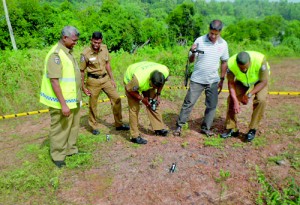
Looking for clues: Police at a crime scene (file pic)
In three killings reported from Wellampitiya, Athurugiriya and Hikkaduwa
three men in their early 20s died at the hands of men armed with guns
and knives.
In Kilinochchi the body of a 25-year-old woman whose neck had been
slashed with a sharp object was recovered while in a shooting incident
reported from Ambalangoda, Galle, a 47-year-old man was shot dead by a
group of unidentified gunmen.
In Maha-Oya, a 37-year-old man died of injuries after a shop owner in his village hit him with a pole following an argument.
In Elpitiya a monk was arrested for the alleged killing of another monk
from the same temple. The victim died of injuries sustained following an
attack with a sharp weapon. The victim passed away at the Karapitiya
Hospital, Galle.
H.M.G.B. Kotakadeniya, a former Senior Deputy Inspector General of
Police told the Sunday Times that police have to take the blame for the
increasing number of killings.
He said there was a decline in efficiency and also a lack of facilities
and financial allocations to combat crime although the police force had
increased in numbers from 70, 000 to 80,000 during the conflict. “Today,
there is a larger police force available to combat crime,” he said.
“The Police are capable of tracking down criminals involved in grave
crimes. However, there is a trend to devote more time for VIP security
and courting VIP’s than combating crime. If a politician visits an area,
top officers are on VIP duty. Political interference is another
hindrance in the fight against crime,” the former DIG said.
Meanwhile, Senior Lecturer in Criminology, Dr. M.W. Jayasundara said
crimes are being committed with impunity with only five to six per cent
of those involved being prosecuted.
“The use of firearms and weapons even during a family dispute is an
alarming trend. We are studying the changing nature of these killings,”
he said, adding that high consumption of alcohol and lack of police
personnel during the Avurudu season in April were the main reasons for
the increase in the number of killings.
Dr. Jayasundara said strict action should be taken against military and police personnel who are involved in grave crimes.
“The recruitment of police and army personnel during the latter stages
of the conflict did not consist of thorough profile checking of a
person’s background including criminal history. However, they were
trained in the use of firearms. There is a need to continue with strict
disciplinary training and monitor the behaviour of personnel in camps
even at present,” he said.
Dr. Jayasundara also said it was important to set up counselling units
at police stations where family disputes and brawls can be minimised
through mediation while a fast-track court system should be introduced
to punish those involved in homicide.
However, commenting on these incidents a police officer said many
killings were due to sudden provocation and disputes and arguments
between known parties and those arrests have been made.
Meanwhile, regarding the Wellawa killing, where three soldiers were
arrested over the killing of a man, Army Spokesman Brigadier Ruwan
Wanigasooriya said the Army Commander has directed the Sri Lanka Corps
of Military Police (SLCMP) to conduct a parallel investigation into the
alleged involvement of the three soldiers and initiate a Court of
Inquiry (CoI).
“The Commander of the Army maintains that a handful of those soldiers
who joined the organisation during the height of the humanitarian
operations, remain less convinced of the reputation and the dignity of
the Sri Lanka Army and thus contribute to anti social acts of this
nature. Instructions have already been issued to take action against
such errant soldiers in parallel with ‘zero tolerance’ policy on Army
wrongdoers and expel them from the Army upon conclusion of a CoI
hearing,” he said in a media release.
