Peace for the World World ! Your War Our Lives

The Dalai Lama
A Brief Colonial History Of Ceylon(SriLanka)
Sri Lanka: One Island Two Nations
A Brief Colonial History Of Ceylon(SriLanka)
Sri Lanka: One Island Two Nations
(Full Story)
Back to 500BC.

Monday, May 5, 2014
BURMA: Arakan Conference Calls for Creation of ''Arakan Army''

May-03-2014
This is a conspiracy against Rohingya Muslims and Arakan Army will be a
threat to the life security of Rohingya Muslims. The world community
should take measures against this conspiracy which aims to finish the
Rohingya generation in Rakhine state. - Nurul Islam
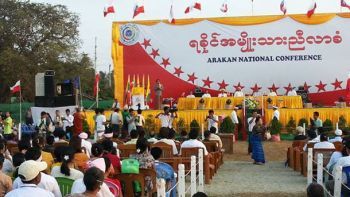
The Arakan National Conference was held in Kyaukphyu Township. (Photo: Facebook / Arakan National Conference)
|
(RANGOON The Irrawaddy) - At a conference in Arakan State’s Kyaukphyu
Township in recent days, Arakanese Buddhist politicians, monks and
community leaders have called for the creation of an “Arakan National
Defense Army” that would protect Buddhist residents from Muslim
communities in the state, a conference organizer said.
The five-day Arakan National Conference, which wrapped up on Thursday,
was the biggest gathering of ethnic Arakanese representatives in decades
and was held amid an ongoing, deadly conflict, which since 2012 has
pitted the state’s Arakanese Buddhists majority of about 2.3 million
people against the approximately one-million strong Rohingya Muslim
community in northern Arakan.
Nyi Nyi Maung, a spokesperson from Arakan National Conference, said the
majority of the participants supported a proposal by Buthidaung Township
representative Tun Aung Thein to ask the central government for
permission to create the Arakan National Defense Army.
“This decision came out from our analysis of the current situation in
our region,” he said. “This decision represents all people in Arakan and
the government has to seriously consider it.”
Union Parliament Speaker Shwe Mann and the President Office’s Minister
Aung Min, who is usually tasked with holding peace talks with ethnic
armed groups, attended the conference in recent days.
Nyi Nyi Maung said Arakanese participants were unsatisfied with current
security measures, in particular in the northern Arakan townships of
Buthidaung and Maungdaw, where the majority of the population is Muslim.
The regions, as well as other conflict-affected townships around the
state capital Sittwe, already have a heavy security presence, with armed
police and military units controlling every aspect of the lives of the
Rohingya, while also enforcing rules that segregate Buddhist and Muslim
communities.
Arakanese nationalist groups and state authorities have been accused by
international human rights groups of carrying out a campaign of
organized violence against the Rohingya in order to ethnically cleanse
Muslim communities from the state. Security forces stand accused of
committing a range of rights abuses against the Muslim community with
impunity.
Tun Aung Thein, the Buthidaung representative, said the Arakanese would
now like to have their own armed units in order to protect Buddhist
communities.
“In Buthidaung and Maungdaw, we have very few of our Arakanese people.
Therefore, we have no security. Our people face threats almost every day
even though there are police and army,” he said. “All representatives
supported my proposal for our Arakan Army.”
The Arakanese in western Burma, like many other ethnic groups, faced
repression by the Burman-dominated military during junta rule and formed
their own armed rebel groups. The organizations are small and only have
a few hundreds fighters based in Kachin rebel-controlled Laiza and
Karen rebel areas near Mae Sot, Thailand.
Tun Aung Thein said these units could form the basis of a new Arakan
National Defense Army, adding, “Our Arakan [rebel] army said they are
ready to serve their people.”
Nyi Nyi Maung said all ethnic armed groups were in talks with the
central government about political autonomy through the creation of a
federal union and a local security role for their fighters. “This is why
our Arakan people need to have our own army… this will help our future
planning and will also help during the current conflict,” he said.
The Arakan National Conference also discussed how the impoverished state
could gain greater benefits from the abundant oil and gas reserves
located off its coast in the Bay of Bengal, which are currently being
exported and used to fund central government coffers. “We held
discussions about our natural resources and we want a 50 percent share
for our people,” said Nyi Nyi Maung.
He said conference participants also planned for their leaders to exert
influence in the Emergency Cooperation Committee (ECC), which will
coordinate aid operations in the region and comprises state and central
government officials, UN agencies and international NGOs, as well as
Arakanese community leaders.
“We will work with the central government, which will let us monitor all
work from humanitarian aid groups… Aid groups that have some problem
with the locals have to come under control of the ECC,” Nyi Nyi Maung
said.
Many Arakanese oppose international aid for the Rohingya and view the UN
and NGOs as biased towards the Muslim community because of aid
operations for the Rohingya, who suffer from a lack of access to food,
health care and education.
In late March, Arakanese mobs attacked UN and NGO offices in Sittwe and
ransacked about two dozen buildings, bringing aid operations to a
temporary halt.
President Thein Sein in his monthly radio address on Thursday warned
that the Sittwe riots were “universally unacceptable, and should never
have happened. We will not accept this kind of behavior, and action
against the offenders is being taken.”
He said the ECC had been set up to improve cooperation between
“government, international organizations, and representatives of civil
groups. The public will be consulted and closer attention given when
carrying out peace, stability and development work in Rakhine State.”
Additional reporting by Khin Oo Thar.
- The Irrawaddy
