Peace for the World World ! Your War Our Lives

The Dalai Lama
A Brief Colonial History Of Ceylon(SriLanka)
Sri Lanka: One Island Two Nations
A Brief Colonial History Of Ceylon(SriLanka)
Sri Lanka: One Island Two Nations
(Full Story)
Back to 500BC.

Wednesday, June 11, 2014
Isis militants kidnap Turkish diplomats after seizing consulate in Mosul
Fighters
abduct mission head and 24 staff as residents of Iraqi city continue to
flee, with Tikrit also reportedly under their control
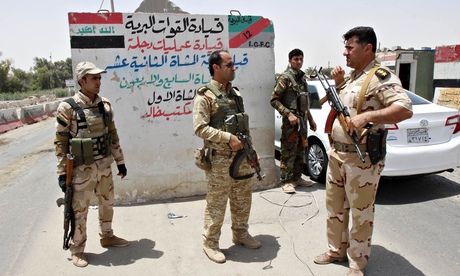
Kurdish security forces stand at a checkpoint on the outskirts of
Kirkuk, Iraq, on Wednesday following the seizure of Mosul by Isis-led
Sunni insurgents Photograph: Reuters

Fazel Hawramy in Irbil and agencies
Jihadists seized the Turkish consulate in the Iraqi city of Mosul and
kidnapped the head of the diplomatic mission along with 24 staff members
as residents fled the city in their thousands on Wednesday.
"Isil members managed to kidnap the Turkish consul and 24 of his guards
and assistants," a police colonel told AFP, referring to the jihadist
group the Islamic State of Iraq and the Levant, also known as Isis.
The colonel said he had spoken with the kidnappers who said those held
"are safe with us" and will be moved to a "safer place".
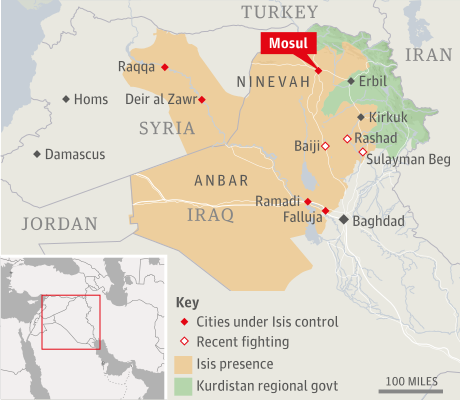
In a spectacular blow to Iraq's Shia-led government on Tuesday, Isis-led jihadists seized Mosul,
its surrounding region of Nineveh and areas of Kirkuk and Salaheddin
province. The assault by the group formerly known as al-Qaida in Iraq
saw black banner-waving insurgents raid government buildings, push out
security forces and capture military vehicles as residents fled from
Iraq's second-largest city.
On Wednesday security officials said Isis fighters had also taken
control of the Iraqi city of Tikrit – the home town of former Iraqi
dictator Saddam Hussein, less than 100 miles north of the capital,
Baghdad.
The kidnappings of the diplomats came a day after Turkey's consulate in Mosul said Isis fighters had seized 28 Turkish truck drivers. Turkish forces have targeted Isis in Syria,
and warned it against attacking a shrine in the northern province of
Aleppo that is under Turkish jurisdiction. Isis is the most powerful
militant group in Iraq, and a major force in the rebellion against
President Bashar al-Assad in Syria.
On Wednesday morning several dozen Kurdish security force officers, both
uniformed and plainclothed, manned a new checkpoint at Aski Kalak on
the road between Mosul and the Irbil, the capital of Iraqi Kurdistan.
More than a hundred cars – mostly with Nineveh number plates – had
parked outside the checkpoint. Several dozen people, including pregnant
women and children, queued in the heat to pass through the layers of
security personnel.
A 36-year-old trader from Mosul who was waiting to be let through with a
group of other men told the Guardian: "I think it will become like
Syria because now the militants have entered the city the army will come
and there will be war."
Atheel al-Nujaifi, the Ninevah provincial governor who has fled Mosul,
said on Wednesday that Iraqi authorities are determined to recapture the
northern city.
"Mosul is capable of getting back on its feet and getting rid of all the
outsiders …and we have a plan to restore security," he said. "We have
taken practical steps in order to restore order … by mobilising people
into public committees that would retake the city."
Mosul, which before the exodus had a population of 1.5 million, is the
capital of Ninevah, which along with the neighbouring Sunni-dominated
Anbar province shares a long and porous border with Syria.
The takeover of Mosul prompted the US to voice deep concern about the situation, warning that Isis poses "a threat to the entire region".
There were no immediate estimates on how many people were killed in the
assault but an estimated 500,000 people have already fled the city,
according to the International Organisation for Migration.
Iraq's foreign minister, Hoshyar Zebari, said the seizure of Mosul must
push the country's leaders towards working together to tackle the
"serious, mortal threat" facing Iraq.
Zebari made his remarks on the sidelines of a meeting of European Union
and Arab League foreign ministers in Athens. He said Iraqi troops and
Kurdish forces in the country must join together to push the insurgents
out of Mosul, though it was not clear what plans on co-operation – if
any – were in the works.
"We can push back on the terrorists … and there would be a closer
cooperation between Baghdad and the Kurdistan regional government to
work together and try to flush out these foreign fighters or elements
who have disturbed the safety, the wellbeing of the population," he
said.
Residents in Mosul told reporters on Wednesday that gunmen had gone door
to door, reassuring locals they would not be harmed and urging civil
servants to return to work. The situation appeared calm but tense, said
the residents, who spoke on condition of anonymity out of concerns for
their safety.
In an eastern area of the city, 34-year-old Ali Sameer said mosques
there were calling on people to return to work, especially those in
public services.
Mosul's fall was a heavy defeat for the Iraqi prime minister, Nouri al-Maliki, amid a widening insurgency by Isis.
The group has been advancing in both Iraq and neighbouring Syria, capturing territory in a campaign to set up a militant enclave straddling the border.
Maliki has pressed the Iraqi parliament to declare a state of emergency following the fall of Mosul.
Nujaifi accused senior security force commanders of providing Baghdad
with false information about the situation in the city and demanding
that they should stand trial.
Speaking from Irbil, he said smaller armed groups had joined Isis during the fight for control of Mosul.
Elsewhere in Iraq on Wednesday, at least four people were killed and 10
others injured by a car bombing targeting Shia pilgrims on their way to
the holy city of Karbala. Police said another car bomb killed three
people and wounded 12 in a town just south of Baghdad.
Medical officials confirmed the casualties for all attacks. All
officials spoke on condition of anonymity because they were not
authorised to speak to the media
