Peace for the World World ! Your War Our Lives

The Dalai Lama
A Brief Colonial History Of Ceylon(SriLanka)
Sri Lanka: One Island Two Nations
A Brief Colonial History Of Ceylon(SriLanka)
Sri Lanka: One Island Two Nations
(Full Story)
Back to 500BC.

Monday, June 2, 2014
Pakistan's slow but steady progress on ending child marriage
Law passed in Sindh province shows that despite religious opposition, steps taken to outlaw child marriage are taking effect
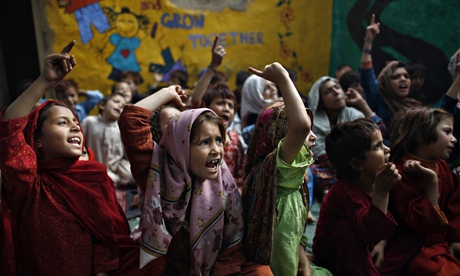
Pakistani
students sing songs during a lesson. Child marriage often spells an
abrupt end to pupils' education. Photograph: Nathalie Bardou/AP
 Mohammad Zia-ur-Rahman
Monday 2 June 2014
The Council of Islamic Ideology (CII), one of Pakistan's
most influential religious and constitutional bodies, has announced
that girls are ready for marriage the moment they reach puberty.
This is not the first time the CII has condoned child marriage.
In April, it ruled that banning such unions was anti-Islamic. While the
ruling does not have any bearing on policymaking, it could have a major
influence on local religious leaders nationwide.
But the CII's controversial statements should not detract from the
progress made on addressing child marriage in Pakistan. In fact, a new
law that prevents under-18s, irrespective of gender, from getting
married was passed unanimously by the provincial assembly in Sindh,
raising hopes for the future for girls like Mehwish. The law also
punishes those who facilitate, contract or perform such marriages with
up to three years in jail and a fine of 45,000 rupees (£455).
Sindh has the highest rate of child marriage of any province in
Pakistan. That such a law could pass in this region sets it out as a
landmark piece of legislation. If the law is implemented in letter and
spirit it will help to ensure girls' rights to stay in school and marry
later. It will help to secure their right to choose.
It is also my hope that the law will act as a deterrent against the customary practice known as vani or swara,
where girls are given in marriage to compensate for the crimes of a
male member of their family. The law also counters the religious
misinterpretations that promote early marriage, as the CII recently put
forward.
We want to see similar action across Pakistan. A bill has been
introduced in the national assembly to strengthen punishment against
perpetrators of child §marriage but has met with opposition from
religious parties. We may yet see change in Punjab, however, where a
bill that raises the legal age of marriage and toughens sanctions is
under discussion.
Nationally there are glimmers of progress too. At the open working group
on the sustainable development goals, a major intergovernmental process
that will help shape the next set of international development goals,
Pakistan proposed to end child, early and forced marriage by 2030. It is
an ambitious vision, but it will not become a reality unless
commitments turn into action.
Take the example of Mehwish, who was just eight when she got married. A
primary school pupil from a small town in Punjab, central Pakistan, she
had no understanding of the meaning of such things. She was taken out of
school shortly after her wedding day.
But Mehwish was determined to get an education. After years of pleading
with her husband to let her enrol again, she was finally allowed to
return to the classroom – or so she thought. The education authorities
would not let her back in: married girls, they said, would ruin the
environment for the other students.
Mehwish's story is not uncommon. In Pakistan, one in four girls is
married before her 18th birthday, forced into adulthood while she is
still a child. Early marriage often spells an abrupt end to a girl's
education too.
Every child needs to know the impact of early marriage and their right
to say no. We need a national awareness campaign to make sure that
families are aware that such unions are illegal. The Child Marriage
Restraint Act states that no individual under 16 should be wed, but many
families in rural areas are unaware of this fact.
Families do not always understand the significance of having a national
ID card and they often lack access to local government services to
register their children at birth. The absence of such crucial
information makes it difficult to verify the age of the bride and groom
on their wedding day.
Preventing child marriage is virtually impossible without a fully
functional birth registration system and systematic age checks before
marriage ceremonies. This requires Pakistan to invest in developing a
local government network that is operational and fully equipped to
provide critically needed services across the country.
We also need to ensure that every child has access to education. When
girls have safe, quality and accessible schooling, their parents are
more likely to choose education over marriage.And the benefits are
clear: justone extra year of secondary schooling alone boosts girls' earning potential by 15-25%, helping to break the cycle of poverty. And when mothers have at least seven years of education, their children are less likely to die before their first birthday (pdf).
The future for girls in Pakistan can be bright if the government backs
up its recent outspokenness on ending child marriage with action. We
need strong laws that make marriage before 18 illegal and a
comprehensive plan to make this a reality. Anything short of this will
simply be lip service.
Mohammad Zia-ur-Rahman is the founder and chief executive of the Awaz Foundation Pakistan, a partner of Girls Not Brides, a global partnership to end child marriage
