Peace for the World World ! Your War Our Lives

The Dalai Lama
A Brief Colonial History Of Ceylon(SriLanka)
Sri Lanka: One Island Two Nations
A Brief Colonial History Of Ceylon(SriLanka)
Sri Lanka: One Island Two Nations
(Full Story)
Back to 500BC.

Wednesday, September 24, 2014
An Analysis: Rajapaksa Needs 60-65% Sinhala Buddhist Vote To Win Another Term
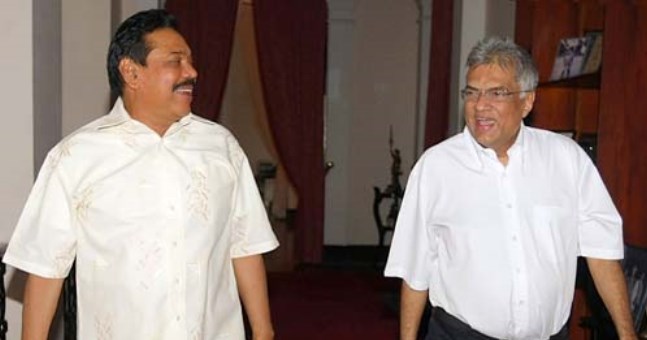
 [Who will have the last laugh?]-23/09/2014
Uva Beginning of a change?
Wishawamithra 1984
“The opportunity to secure ourselves against defeat lies in our own hands, but the opportunity of defeating the enemy is provided by the enemy himself.”~Sun Tzu
What materialized at the elections held on Saturday, September 20 was
the possibility number 3 as reasoned out in my last week’s column: “the
Government-backed UPFA would form a Provincial Administration, having
gained a marginal victory at the elections.” The United National Party
(UNP) came quite close to grabbing the Badulla district but fell short
by a mere three per cent (3%). However, the combined opposition scored a
slender victory in the district by gaining just above 50% of the total
valid votes. It is a remarkable performance aided and abetted by many
factors the most prominent being the birth of a potential political
superstar- Harin Fernando, who undoubtedly would be an object of envy
and a target of vitriol, from both inside and outside the UNP. Harin
needs to cope with that kind of internal back-stabbing, petty jealousies
and regional mud-slinging. But he must also remember that he should
make all efforts not to allow what happened to Dayasiri Jayasekera to
happen to him. He was considered a potential future leaders but now has
been relegated to the Provinces with his ‘national’ appeal now a thing
of the past.

The only way in which Harin Fernando could sustain the image that he
gained in the Uva PC elections is by either getting himself injected
into the Leadership Council of the UNP or getting some other high level
post in the party that would afford him a role of national dimensions.
His youth is to his advantage and the charismatic demeanor he displayed
right throughout the Uva campaign reminds one of two former leaders in
the UNP- Lalith Athulathmudali and Gamini Dissanayake. No person in the
present UNP leadership setup has shown such promise and at the end of
the day he has proved his worth in no uncertain terms. They say,
“Victory has many fathers but defeat is always an orphan”. Harin might
well be advised to draw inspiration from such idioms, if not to advance
his personal cause, at least to stay above water.
But let us not paralyze ourselves by analyzing the results to an absurd
degree. Such deep analysis would only cause many more unanswerable
questions to spring up rather than real and practical solutions. In a
very broad sense, the vote in the Uva Province showed more disillusion
felt by the people with the Government, the UPFA candidates and the
general direction in which the country is heading with the steering
being handled by the Government and its henchmen. In addition, the
President’s so-called invincibility and unquestioned appeal is certainly
diminishing. He is no more considered a sure bet, at least by the
Badulla voters. For instance, President Mahinda Rajapaksa in Welimada
alone had no less than eight (8) pocket meetings, which were also
attended and addressed by the local candidates. And the UPFA lost that
seat. In the Badulla District, the combined Opposition obtained more
than 50.65% as against 44.63% (UPFA+NFF) and when the 4.73% that went to
others is allotted, the anti-government vote becomes 55.38% which is
sizeable. At the last Presidential Election, the incumbent President
Mahinda Rajapaksa received 53.23% as against the combined opposition
candidate Sarath Fonseka who got only 44.55%. This year the opposite has
occurred. The Badulla District has more than 30% of minority votes of
whom Estate Tamils form the majority. In addition, the Muslim minority
vote too is close to 5% and it is quite obvious that whenever the
minorities play a role, Mahinda Rajapaksa is bound to lose ground.
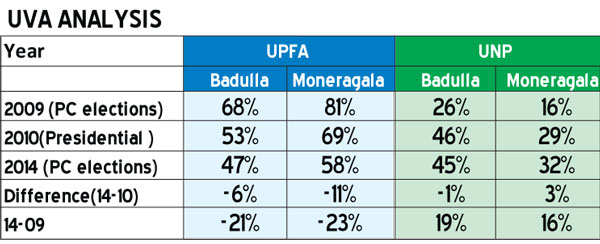
In the Moneragala District where Sinhalese Buddhists account for more
than 90% of voters, the UPFA just managed only 58%. If that is the
average percentage of voters from that segment, that the UPFA could
muster, then they are in deep trouble, which of course depends on the
acceptability of the Presidential candidate from the Opposition.
What is most salient in the whole exercise of the Uva PC election is
that the UNP by itself has obtained slightly more than General Sarath
Fonseka did as a Common Candidate of the combined Opposition at the 2010
Presidential Election. The dent that has been caused in the UPFA armor
is mainly one of a negative nature. People voted ‘against’ the governing
coalition rather than ‘for’ the UNP or Opposition. The UNP and other
opposition parties must realize that and if they want to be successful
in ousting the present incumbent, they need a common front. Presidential
Elections are a totally different story altogether. Personalities do
matter and unlike in parliamentary elections in which people cast their
votes for a particular political party, at Presidential Elections,
people weigh their choices on the personality, likes and dislikes,
trustworthiness, personal courage and bravery, political acumen and
astuteness of the candidate and his or her past history and all these
considerations come into play. In such a complex scenario, the UNP and
the rest of the Opposition have to find a common platform in the first
place and then select the best candidate who could deliver the platform
to electoral victory. The Sri Lankan electorate is increasingly
polarized and as a result, it is most prudent to see how the majority
Sinhalese Buddhists on the one hand and the Tamil/Muslim minorities on
the other would cast their votes in the upcoming Presidential Elections.
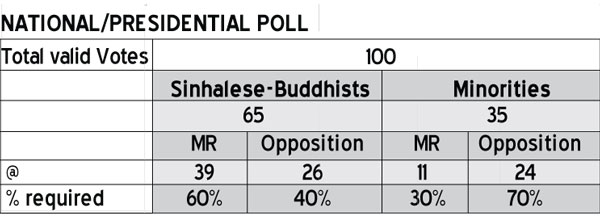
I have taken these districts which are predominantly Sinhalese-Buddhist
in ethnic composition terms. How did Mahinda Rajapaksa fare in these
elections? The average vote for Mahinda has dropped by a whopping 10%.
If that is a trend instead an outlaying statistic, then the incumbent is
in real danger of losing.
In order to come to that conclusion, I have used the following projections:
Allow me to explain:
Now you’ll see how the battle-lines are drawn. The once-unbeatable
Mahinda Rajapaksa has become vulnerable given the mood of the country as
shown in the Uva PC elections. The UNP is really in the driving seat.
What caused the electorate to change its stance?
The reasons could be summarised thus:
The reasons could be summarised thus:
Ranil Wickremesinghe has done what he should have done three years ago:
Make Sajith Premadasa the Deputy Leader of the party and secure his 100%
participation at elections. The Party today looks more united than at
any other time since Ranil took over the reins.
Harin Fernando’s magnetic personality (young blood)
Increasing economic hardships
Shedding of the fear psychosis
Harin Fernando’s magnetic personality (young blood)
Increasing economic hardships
Shedding of the fear psychosis
Now the corporate world will think twice before refusing financial aid
to the UNP. Senior ministers who are rotting away in government benches
might rethink their and their off-springs’ political future. But the UNP
and its leadership cannot afford to rest on their laurels. They must
unleash their forces through the length and breadth of the country.
Take a lesson from the person who mastered this art, J R Jayewardene. At
last there seems to be light at the end of the proverbial tunnel. The
Rajapaksa myth is brittle and beginning to crack.
