Peace for the World World ! Your War Our Lives

The Dalai Lama
A Brief Colonial History Of Ceylon(SriLanka)
Sri Lanka: One Island Two Nations
A Brief Colonial History Of Ceylon(SriLanka)
Sri Lanka: One Island Two Nations
(Full Story)
Back to 500BC.

Tuesday, September 2, 2014
Iraqi forces regain control of key road to Baghdad after breaking siege
Fighters make progress after breaking Isis hold on Amerli but relatives demand answers about fate of soldiers left behind
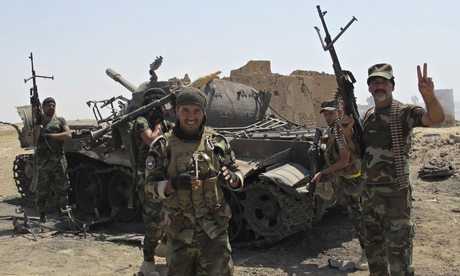
Iraqi Shia militia fighters celebrate breaking the siege of Amerli. Photograph: Reuters
 Agence France-Presse in Amerli
Tuesday 2 September 2014
Iraqi forces have made further advances in their fightback against
jihadis while hundreds of people have stormed parliament over the fate
of missing soldiers who surrendered in June.
Having broken a months-long jihadi siege of the Shia Turkoman town of Amerli by Islamic State (Isis) fighters, troops on Tuesday regained control of part of a key highway linking Baghdad to the north.
Two towns north of Amerli were also taken from the jihadis on Monday as
Iraqi forces – backed by US air strikes – scored their first major
victories since the army's collapse across much of the north in June.
The collapse left some 1,700 soldiers in jihadi hands, with many believed to have been executed.
Demanding to know their fates, angry relatives stormed the parliament in
Baghdad, attacked MPs and began a sit-in in its main chamber, an
official said.
Riot police were trying to evict the protesters, who were also calling
for some officers to be held accountable, said the official, who was
there.
Concern over those in jihadi hands has been fuelled by reports of
widespread atrocities, including accusations from Amnesty International
of war crimes and ethnic cleansing.
Isis declared an Islamic caliphate in regions under its control in Iraq and
Syria after it swept through much of the Sunni Arab heartland north of
Baghdad in June and then stormed minority Christian and Yazidi Kurdish
areas.
Isis has carried out beheadings, crucifixions and public stonings, and
on Tuesday Amnesty accused it of "war crimes, including mass summary
killings and abductions" in areas it controls.
"The massacres and abductions being carried out by Islamic State provide
harrowing new evidence that a wave of ethnic cleansing against
minorities is sweeping across northern Iraq," said its senior crisis
response adviser, Donatella Rovera.
The UN Human Rights Council unanimously agreed to send an emergency
mission to Iraq to investigate Isis atrocities, after a senior UN
official said the jihadi group had carried out "acts of inhumanity on an
unimaginable scale".
Concern over the scale of the humanitarian crisis helped prompt limited
US air strikes in support of Iraqi forces, Shia militia and Kurdish
troops battling the jihadis.
Such strikes were used in the area during the Amerli operation – the
first time Washington has expanded its more than three-week air campaign
against Isis outside the north.
Desperate residents rushed to receive aid deliveries after Iraqi forces
moved into the town, scrambling to grab food and bottles of water from
trucks.
A day after seizing Amerli, troops and Shia militiamen on Monday retook
Sulaiman Bek and Yankaja, two towns to its north that had been important
militant strongholds.
Army Staff Lieutenant General Abdulamir al-Zaidi said they had continued
the advance on Tuesday, regaining control of a stretch of the main
highway to the north which had been closed by the militants for almost
three months.
A senior militia commander said it would be several days before the road
reopened as sappers needed to clear it of mines and booby traps planted
by the retreating militants.
The US said it launched four air strikes in the Amerli area, effectively
supporting operations involving militia forces that previously fought
against US troops in Iraq.
The government's reliance on Shia militiamen in this and other
operations risks entrenching groups which themselves have a history of
brutal sectarian killings.
David Petraeus, a former commander-in-chief of US-led forces in Iraq,
has warned against the US becoming an "air force for Shia militias".
But worries over the rise of Isis seem to outweigh other concerns, with
western leaders warning the group posed a security risk far outside the
areas under its control.
Australia's prime minister, Tony Abbott, on Tuesday said that "extreme
force" was justified against Isis militants, describing them as worse
than Nazis or Communists.
"As soon as they've done something gruesome and ghastly and unspeakable,
they're advertising it on the internet for all to see, which makes
them, in my mind, nothing but a death cult," Abbott said.
Fiji, meanwhile, revealed that Al-Qaida-linked Syrian rebels who are
holding 45 UN peacekeepers hostage in the Golan Heights are demanding
they be expunged from a UN terror blacklist.
The Fijians, part of the UN Disengagement Observer Force (UNDOF), were
captured last Wednesday when Al-Nusra Front rebels stormed a Golan
Heights crossing.
Another group of 75 Philippine peacekeepers refused to surrender and
eventually escaped from two camps on the Syrian side of the demarcation
line after the rebels besieged them.
Fiji's army chief, Mosese Tikoitoga, said a UN team had arrived in the
Golan Heights from New York to take over negotiations for their release.
"Unfortunately we have not made any improvement in the situation, our
troops remain at an undisclosed location, the rebels are not telling us
where they are," Tikoitoga said, adding that the hostage takers also
want humanitarian aid for areas they control and compensation for
wounded fighters.
