Peace for the World World ! Your War Our Lives

The Dalai Lama
A Brief Colonial History Of Ceylon(SriLanka)
Sri Lanka: One Island Two Nations
A Brief Colonial History Of Ceylon(SriLanka)
Sri Lanka: One Island Two Nations
(Full Story)
Back to 500BC.

Friday, September 26, 2014
Report: Freedoms of Assembly and Association in Sri Lanka; 84 attacks in 2014
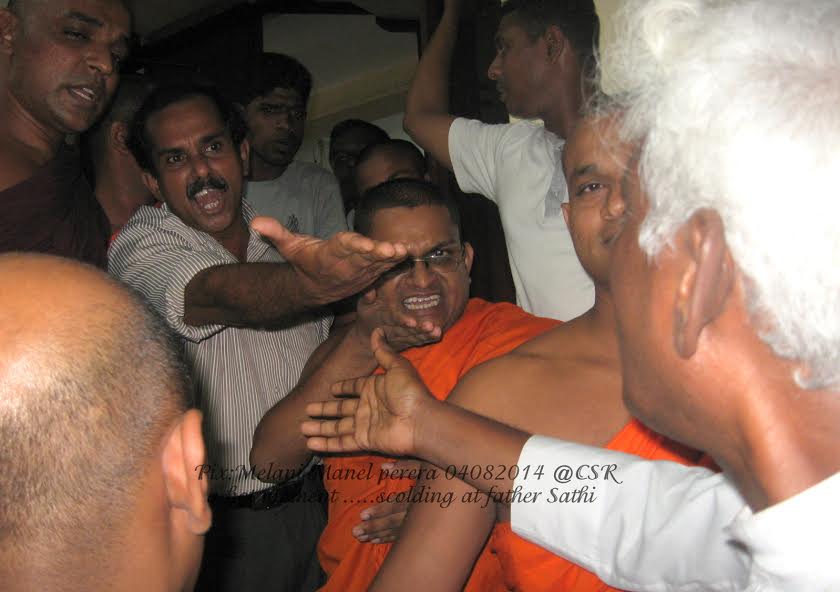
 [Monks led mobs have disrupted peaceful meetings on several occasions]-
Sri Lanka has ratified the International Covenant on Civil and Political
Rights (ICCPR) which guarantees freedom of assembly and association.
This is reinforced by the Sri Lankan constitution, which also guarantees
freedom of assembly and association[1]. However, freedom of assembly
and association is considered as a complicated and dangerous issue in
Sri Lanka, and these freedoms are often suppressed through a variety of
different avenues.
Read the full report on 84 attacks here as a PDF Freedom of Assembly + Association in Sri Lanka-INFORM-20Sep2014(1)
The legal framework:
The constitution itself offers certain exceptions to the guarantee of
freedom of assembly and association. It allows freedom of assembly to be
restricted in the “interests of racial and religious harmony”[2] , and
freedom of association could be restricted in the “interests of racial
and religious harmony and national economy”[3]. Both can be restricted
in the “interests of national security, public order and the protection
of public health or morality, or for the purpose of securing due
recognition and respect for the rights and freedoms of others, or of
meeting the just requirements of the general welfare of a democratic
society”.[4] The Prevention of Terrorism Act (PTA)[5] further restricts
and threatens freedom of assembly and association. In addition, the PTA
also restricts host of other rights, such as freedom of expression,
right to due process, right to be free from arbitrary arrest etc.
Amongst those individuals who have become victims of the repression of
freedoms of assembly and association, are the families of disappeared,
student activists, workers, lawyers, clergy, opposition politicians, NGO
workers and human rights defenders. Additionally, organisations and
groups have also been targeted, including NGOs operating at the national
level, community based organizations, trade unions and student unions.
Supressing Freedom of Assembly:
Police and Army have been documented as having used disproportionate and
maximum force against unarmed protestors, and have killed and injured
those engaged in peaceful assemblies. Participants of protests have
faced threats and intimidation. These peaceful protestors have been
discredited as people who support terrorism and international
conspiracies against the country. Police have resorted to obtaining
ex-parte judicial orders to stop peaceful assemblies. The police have
also blocked people from travelling from the North to Colombo for
peaceful assemblies. Recent cases have shown police watching mob attacks
(including those led by Buddhist monks) on peaceful assemblies,
refusing to intervene and stop the attacks with even minimum force.
Instead, police have chosen to disperse organizers and participants of
peaceful assemblies instead of dispersing mobs, and have refused to
provide security to victims. There have also been arson attacks on basic
temporary infrastructure built for assemblies. Military had ordered the
cancellation of training workshops for journalists. Surveillance of
private and public events takes place regularly. Organizers and
participants have documented intimidation tactics before, during, and
after peaceful assemblies, used in order to pressurize them not to
participate. In the North, such repression is more severe, with the
Military and Police even stopping peaceful memorial and prayer events
for those killed. Religious clergy who had organized such events have
also faced interrogation and threats.
Suppressing Freedom of Association:
Freedom of Association has been under threat for several years, but
events in recent months have become more alarming. The NGO Secretariat
sent out a circular to NGOs warning them to stop the following; doing
workshops for journalists; organizing trainings for journalists; press
conferences; and issuing press releases. Public notices were issued by
the Department of External Resources warning about accepting funds and
collaborating with NGOs. Government has also been reported as planning
to introduce new laws to register, monitor and control activities of
Private Foundations and Trusts. Intense and probing reporting procedures
have been established to monitor work of NGOs. Student Unions have been
dissolved and Student Activists suspended. Associations have also been
called unpatriotic and accused of supporting terrorism. Some
associations are being subjected to surveillance regularly.
84 Freedoms of Assembly and Association violations reported in 2014[6]
[1] Sri Lankan constitution, articles 14 (1) (b and C),
available at
http://www.priu.gov.lk/Cons/1978Constitution/Chapter_03_Amd.htm
[2] Sri Lankan constitution, articles 15 (3) available at
http://www.priu.gov.lk/Cons/1978Constitution/Chapter_03_Amd.htm
[3] Sri Lankan constitution, articles 15 (4) available at
http://www.priu.gov.lk/Cons/1978Constitution/Chapter_03_Amd.htm
[4] Sri Lankan constitution, articles 15 (7) available at
http://www.priu.gov.lk/Cons/1978Constitution/Chapter_03_Amd.htm
[5] Prevention of Terrorism (Temporary Provisions) Act No. 48
of 1979, as amended by Act Nos. 10 of 1982 and 22 of 1988
[6] Based on incidents reported in the media, compiled by
INFORM Human Rights Documentation Centre, available at
http://ihrdc.wordpress.com/repression-of-dissent/repression-of-dissent/.
This is not a comprehensive list.
- Report submitted to UN Human Rights Committee by INFORM, Human Rights
Documentation Centre, Colombo, Sri Lanka/ www.ihrdc.wordpress.com /
informcolombo@gmail.com
