Peace for the World World ! Your War Our Lives

The Dalai Lama
A Brief Colonial History Of Ceylon(SriLanka)
Sri Lanka: One Island Two Nations
A Brief Colonial History Of Ceylon(SriLanka)
Sri Lanka: One Island Two Nations
(Full Story)
Back to 500BC.

Sunday, September 28, 2014
Report:Repression of Dissent in Sri Lanka in August
 Summary:-28/09/2014
August 30th is the International Day of victims of Enforced
Disappearances, but in Sri Lanka, it was a month when families of
disappeared persons and those supporting them faced threats,
intimidations, restrictions and false accusations by Buddhist Monks led
mobs, Police and the state media. Police blocked a peaceful march on the
International Day of victims of Enforced Disappearances in the Northern
town of Vavuniya. Tamil families of disappeared in Mannar were
intimidated, urging them not to testify to the Presidential Commission
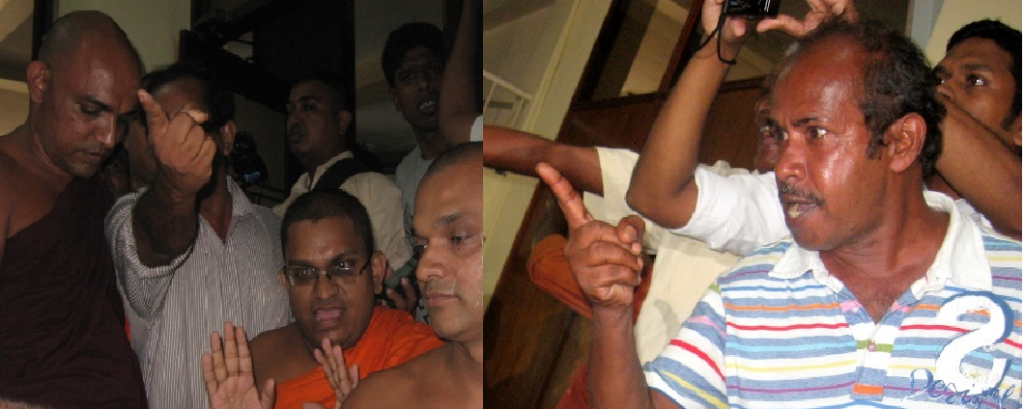
looking into Missing Persons. At the beginning of August, a Buddhist
Monk led mob stormed a private meeting of families disappeared persons
at a Church run centre in Colombo. The organizers called the Police, but
the Police refused to guarantee security for the meeting and
participants. The Police insisted that the meeting be stopped and
participants from North are sent home. Initially, the Police also
refused to disperse the mob, and only did so at the strong insistence of
the organizers and participants. This event led to a chain of events,
with Sinhalese newspapers and the mob making a variety of false
allegations against participants and organizers, including accusing them
of being linked to terrorism. One of the human rights defenders
present, Rev. Fr. Sathivel, faced a series of threatening incidents. The
Ministry of External Affairs warned diplomats about attending such
events, but didn’t condemn the disruption of the meeting by the Buddhist
Monk led mob.
A Deputy Inspector General of Police who had refused to release suspects
of anti-Muslim riots in June 2014 faced death threats. A school teacher
who had filed a lawsuit against a government politician also faced
death threats. A Tamil Provincial Councillor from the North, who had
been prominent in human rights campaigns, also complained about
surveillance and threats.
Freedom of Expression has continued to be violated. A Tamil journalist
in Vavuniya received death threats, and the Coordinator of the Jaffna
Press Club was interrogated by the Police and accused of being a part of
the LTTE by Sinhalese newspaper. An Indian academic-activist attending
an international symposium on post war developments was also
interrogated, and was detained when he tried to visit the Eastern
Province prior to the symposium. There were reports of Muslim
journalists being branded as “anti-Sinhalese and anti-Buddhist
Jihadists. A New York Times reporter complained that his visa had been
put on hold since June. Journalists were prevented from covering court
hearings when the Secretary to the Ministry of Defence was being cross
examined. An inquiry was ordered for singing the National Anthem in
Tamil at a school in Colombo.
Freedom of Assembly and Association was also under attack. The National
Peace Council (NPC) reported that 4 inter-religious reconciliation
events were subjected to surveillance. Two events of the NPC in Southern
and Central Provinces were subjected to monitoring by Police and two
events in the East by the Military. Trade Union meetings and actions
also faced obstacles. Senior government officials said NGOs pose a
threat to security and that new laws will be brought into monitor and
control foundations and non-profit organizations.
Student activists were arrested and suspended in two universities. When
student activists protested against the arrest and detention of two
Tamil university students under anti-terror laws (one was arrested after
he had been injured during an assault by a mob), the Minister for
Higher Education accused the main Student Union of inciting racial
disharmony. Opposition political parties faced continuous and systematic
intimidation and attacks in the lead up to the Uva Provincial Council
elections.
In a number of incidents, Police, Military, and government politicians
appeared to be directly responsible in repressing dissent. When dissent
was being crushed by non-state parties, the Police appeared to side with
the perpetrators, rather than enforce the law.
Read the Full report as a PDF: Repression of Dissent in Sri Lanka – August 2014 – English (26Sep2014)
Read the Full report as a PDF: Repression of Dissent in Sri Lanka – August 2014 – English (26Sep2014)
