Peace for the World World ! Your War Our Lives

The Dalai Lama
A Brief Colonial History Of Ceylon(SriLanka)
Sri Lanka: One Island Two Nations
A Brief Colonial History Of Ceylon(SriLanka)
Sri Lanka: One Island Two Nations
(Full Story)
Back to 500BC.

Wednesday, February 11, 2015
Arab nations united in fury against Isis but divided on strategy
Jordan
seeks revenge for pilot’s horrific death, with UAE, Saudi Arabia and
Bahrain in agreement – but only a ground offensive can destroy Islamic
State
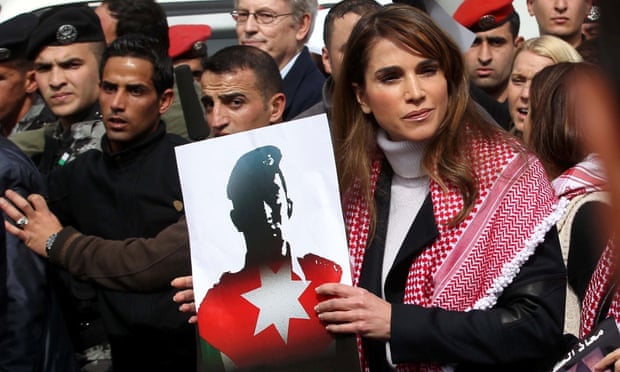 Queen
Rania of Jordan holds a picture of the murdered pilot Muadh al-Kasasbeh
at a march against Isis in Amman. Photograph: Mohammad Abu Ghosh/Xinhua
Press/Corbis
Queen
Rania of Jordan holds a picture of the murdered pilot Muadh al-Kasasbeh
at a march against Isis in Amman. Photograph: Mohammad Abu Ghosh/Xinhua
Press/Corbis
Islamic State (Isis) intended to terrorise its enemies when it filmed a Jordanian pilot being burned alive in a cage and
it clearly hoped to weaken the resolve of the Arab states that have
joined the US-led global coalition fighting the jihadi group. But the
sheer brutality of the execution, beamed round the world last week,
seems instead to have galvanised Arab governments and Muslim religious
authorities into more strident opposition to Isis – expressed in furious
condemnation and high-profile but limited military moves.
Jordan,
enraged by the immolation of Lieut Muadh al-Kasasbeh – and the threat
that other pilots will meet the same grisly fate – has sent 20 fighter
jets to bomb eastern Syria since last Thursday, its biggest air
operation since the 1967 six-day war.
“Our hearts are bleeding with sadness and anger,” Queen Rania said on
Monday. “My country, Jordan, is facing the crisis with patience, faith,
and a determination to fight terrorism and exact retribution from those
committing the most heinous and brutal atrocities of our time.”
The UAE, another Sunni Arab member of the coalition, dispatched a
squadron of F-16 fighter jets to Jordan after suspending operations in
the aftermath of Kasasbeh’s capture. Arab cooperation was necessary to
put an end to the “monstrous actions” of “terrorist gangs” and protect
moderation, it said. Saudi Arabia and
Bahrain, Barack Obama’s other Arab “partner nations”, also issued
defiant statements of solidarity with the Hashemite kingdom.
In Cairo, Sheikh Ahmad al-Tayyeb, the grand imam of al-Azhar, the
world’s leading institution of Sunni learning, condemned Isis as
“corrupters of the Earth”, who wage war against God and the prophet, and
therefore deserve the scriptural punishment of death, crucifixion and
the amputation of their limbs. Arab participation was seen as vital to
the credibility of Obama’s goal of “degrading and destroying” Isis. But
it has been more important politically than militarily. Of 2,000 or so
air strikes carried out in Syria, less than 10% were by Arab air forces, though full statistics have never been published.
Apart from an initial flourish of publicity, none advertised what their
pilots were doing out of fear of retaliation or a backlash from jihadi
sympathisers at home. “That has been part of the problem,” said one
Amman-based western diplomat. “People didn’t even know Jordan was
bombing Isis.” Revulsion, however understandable, does not appear to
herald significant change to the conduct of the campaign. “Jordan’s
anger is justified but in military terms they can’t add very much,” said
Mustafa Alani of the Gulf Research Centre in Dubai.
“They are retaliating because of the brutal killing of their pilot but
they only have 20 F-16s. And now that fixed targets and infrastructure
have been hit, air operations are reaching the limit of their usefulness
anyway. Air strikes depend heavily on human as well as electronic
intelligence and there’s a huge shortage of accurate intelligence. After
six months what has been achieved is very limited.”
Egypt,
which no longer calls for Bashar al-Assad to go and is seeking to
rebuild its regional influence, is preoccupied with the growing jihadi
insurgency in Sinai and wants western help to fight that.
Alani and other analysts say hopes for turning the tide against Isis
rest now not with air strikes but with a promised ground offensive in Iraq,
specifically the recapture of Mosul, the dramatic fall of which last
June shocked the world. Arab ground forces will not take part in that,
though the Saudis are said to be signalling readiness to provide
financial support.
Still, suspicions persist about the Shia-dominated government of Haider
al-Abadi in Baghdad, with little discernible progress in efforts to
enfranchise a Sunni community that is still smarting from its loss of
power since the overthrow of Saddam Hussein in the 2003 US-led invasion.
Sunnis fear “liberation” at the hands of an Iraqi army backed by Shia
militias – which work closely with the Iranian Revolutionary Guards –
that stand accused of carrying out sectarian atrocities in areas
recaptured from Isis.
So for all the horror of Kasasbeh’s execution, it does not look like a
turning point. “I think the Jordanian response to the killing –
appalling and grotesque as it was – cannot on its own be the answer,”
said John Jenkins, recently retired as the UK ambassador to Saudi Arabia
and now Middle East director of the Institute of Strategic Studies (IISS).
“Once vengeance is slaked we’re back to the underlying pathology: you
fundamentally can’t use Shia militias to win a sectarianised battle for
Sunni hearts and minds. And Iraq and Yemen in different ways represent
exactly that. Meanwhile, Assad is laughing.”
The US commentator Aaron David Miller observed: “Tempting
as it may be to see the killing as a transformative act, it probably
won’t be. Other than additional military coordination with Jordan, we
can expect only the continuation of the overall strategy to check
Islamic State gains in Iraq and the plan for assisting Iraqi forces in
retaking … Mosul and other areas. The air campaign will continue against
Islamic State in Syria. Broader shifts in US policy as a result of the
killing, such as deploying large numbers of ground forces, seem
unlikely.”
US officials say ground forces will be needed to defeat Isis in both
Iraq and Syria but insist those forces should consist of Iraqis and
moderate Syrian rebels. The US has already begun training Iraqi forces,
while the Syrian “train and equip” scheme is only scheduled to start in
the spring.
Arab countries still have strong reservations about Obama’s overall
Middle Eastern strategy, regional experts agree. “The horrific and
provocative nature of Kasasbeh’s execution has momentarily muted
criticism of the coalition and compelled Arab leaderships to flex some
muscles to project steadfastness and placate their own constituencies,”
said Emile Hokayem, an IISS analyst. “However, this tragedy is unlikely
to decisively change the Arab countries’ mind about the campaign. Their
disagreement about US strategy, their frustration with developments in
Iraq and concerns about Iran remain strong.”
