Peace for the World World ! Your War Our Lives

The Dalai Lama
A Brief Colonial History Of Ceylon(SriLanka)
Sri Lanka: One Island Two Nations
A Brief Colonial History Of Ceylon(SriLanka)
Sri Lanka: One Island Two Nations
(Full Story)
Back to 500BC.

Monday, April 20, 2015
Italian PM calls for emergency summit as up to 700 migrants drown
Matteo
Renzi says EU action must be a priority as death toll of drownings this
year now stands at 1,500 – 50 times more than at same point in 2014
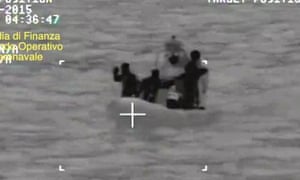 An
infra-red screengrab provided by the Italian coastguard during the
operation to rescue the migrants. Photograph: Guardia di Finanza/EPA
An
infra-red screengrab provided by the Italian coastguard during the
operation to rescue the migrants. Photograph: Guardia di Finanza/EPAPatrick Kingsley in Tripoli,Stephanie Kirchgaessner in Rome and Alessandra Bonomolo in Catania-Sunday 19 April 2015

Matteo Renzi said that concerted European Union action
had to be a priority after the latest tragedy 60 miles north of Libya
in which a prodigiously overladen vessel capsized late on Saturday,
leaving hundreds in the water.
UN and coastguard officials said that survivors spoke of as many as 700
people being in the boat. The number could not be confirmed but a dozen
rescue boats continued to comb the waters, looking for survivors.
Italian officials said that a Bangladeshi survivor flown to Sicily for
treatment told them 950 people were aboard, including hundreds who had
been locked in the hold by smugglers.
Save the children calls for better search-and-rescue systems. Link to video
If the toll is confirmed, it would be the deadliest yet of a succession
of tragedies involving desperate migrants, unscrupulous traffickers,
inadequate fishing smacks and an even more inadequate EU response.
Another 400 people drowned in the same waters last week. In the worst
incident before Sunday, an estimated 500 people drowned off the coast of
Malta last autumn.
“How can it be that we daily are witnessing a tragedy?” Renzi asked.
The drama unfolded in the watery darkness of a Mediterranean night.
Coastguard officials said the vessel probably overturned when the
migrants caught sight of a Portuguese ship and all moved to the same
side of their boat. Only 28 people were rescued, along with 24 bodies.
General Antonino Iraso, of the Italian border police, said those small
numbers make more sense if hundreds of people were locked in the hold,
because with so much weight down below, the boat would “surely” have
sunk.
“They wanted to be rescued,” said Barbara Molinario, a spokeswoman for
UNHCR in Rome. “They saw another ship. They were trying to make
themselves known to it.”
The toll, if confirmed, would bring the number of Mediterranean
drownings this year to more than 1,500 – more than 50 times greater than
at the same point in 2014, which was itself a record year.
The sudden surge in deaths has increased pressure on European powers to
come up with a proper joined-up strategy to deal with the burgeoning
crisis. Last autumn, Mare Nostrum, an Italian search-and-rescue mission
that saved more than 100,000 people at sea in 12 months was discontinued
following a row over funding and Italian exasperation that it was
shouldering the burden of responsibility alone.
It was replaced with a slimmer EU force with a weaker mandate, amid
suspicions that some European leaders did not want to fund an operation
that might encourage greater numbers of unwanted migrants to risk the
deadly crossing. Migrant smugglers have told the Guardian that the
presence or absence of rescue forces in the Mediterranean makes no
difference to people so desperate to flee that they would rather chance
their luck on the ocean than return home.
The stricken vessel sent out a distress signal at around midnight on
Saturday. Italian naval and coastguard ships and Maltese vessels were on
the scene by the morning. But it was too late.
“They are literally trying to find people alive among the dead floating
in the water,” said Joseph Muscat, the prime minister of Malta.
The survivors are still aboard an Italian rescue ship but are expected
to be brought to Sicily on Monday. Weather conditions are fair and the
water not too cold, meaning that more survivors could yet be found.
Two distinct messages emerged from European states.
Southern powers including Italy and Spain reiterated their demand that Europetake
control to avoid more deaths. Donald Tusk, the EU president, indicated
that an emergency political summit could be on the cards after he spoke
to EU leaders about “how to alleviate [the] situation”. Federica
Mogherini, the Italian EU foreign policy chief, said: “We have said too
many times ‘never again’.”
But others, while expressing the same regret and outrage, put the accent
on targeting the traffickers who make handsome profits from moving
people north. Germany’s interior minister, Thomas de Maizière, said: “We
cannot and we will not tolerate these criminals sacrificing human lives
on a large scale out of sheer greed.”
The British foreign secretary, Philip Hammond,
added: “We must target the traffickers who are responsible for so many
people dying at sea and prevent their innocent victims from being
tricked or forced into making these perilous journeys.”
The European commission issued a statement that acknowledged the need
for immediate actions to prevent further loss of life but also tellingly
pointed out that “as countries of origin and transit do not take action
to prevent these desperate trips, people will continue to put their
lives at risk”.
“That is why a large part of the approach we are working on is going to
be about working with third countries,” it said, adding that a joint
meeting of the foreign and interior ministers would address this.
Various radical plans for tackling the crisis have been floated,
including putting the onus on north African countries to patrol the seas
and process migrants in their own transit camps.
Tusk indicated that a summit could be on the cards after he spoke to EU leaders about how to alleviate the situation.
Tens of thousands of migrants and refugees have been moving north and
west in recent years, driven to desperation by war, persecution and
economic stagnation in countries as diverse as Syria and Senegal,
Eritrea and Egypt, Afghanistan and Iraq.
Huge numbers have funnelled through Libya, where the state has all but
collapsed and people traffickers operate with relative impunity. In
Misrata, a major Libyan port, coastguards said that the smuggling trips
would continue to rise because Libyan officials were woefully
under-resourced.
In all of western Libya, the area where the people smugglers operate,
coastguards have just three operational boats. Another is broken and
four more are in Italy for
repairs. Libyans say they have been told they will not be returned
until after the conclusion of peace talks between the country’s two
rival governments.
“There is a substantial increase this year,” said Captain Tawfik
al-Skail, the deputy head of the Misrata coastguard. “And come summer,
with the better weather, if there isn’t immediate assistance and help
from the EU, then there will be an overwhelming increase.”
Pope Francis calls for decisive action from political leaders. Link to video
Pope Francis, an outspoken advocate for greater European-wide
participation in rescue efforts, reiterated his call for action during
mass on Sunday after learning of the latest disaster.
“They are men and women like us – our brothers seeking a better life,
starving, persecuted, wounded, exploited, victims of war,” he said from
St Peter’s Square.
