Peace for the World World ! Your War Our Lives

The Dalai Lama
A Brief Colonial History Of Ceylon(SriLanka)
Sri Lanka: One Island Two Nations
A Brief Colonial History Of Ceylon(SriLanka)
Sri Lanka: One Island Two Nations
(Full Story)
Back to 500BC.

Monday, May 11, 2015
Banning Historical Memory: Questions Of Politics, Quality & Academic Freedom In Jaffna

The University’s War against Memory
A community that has seen decades of intense violence carries a myriad
wounds and trauma that need to be healed in order that life could become
human. While the community can more easily absorb the violence
inflicted from without, the internal violence, its divisiveness,
fractured families and guilt are much harder to heal. Healing requires
that the truth be told and the victims given the voice to speak it. The
local university must be the first place that resists ideological
twisting of history to blame exclusively the state and to shut out all
voices that challenge the monolithic narrow-nationalist version of
blame.
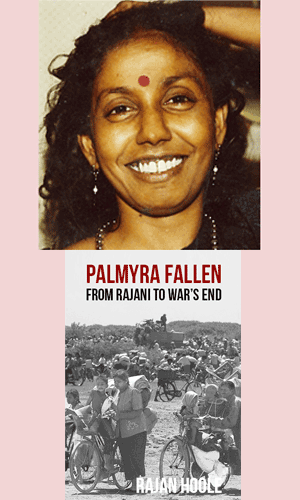 On 24th April 2015, the Jaffna University Science Teachers’ Association (JUSTA) arranged a discussion of the book Palmyra Fallen: From Rajani to War’s End, written by its member Rajan Hoole, in the Library Auditorium. The Vice Chancellor (VC) with the backing of some senior academics banned the discussion. JUSTA was left with no honourable alternative but to defy this blatant attack on academic freedom.
The Palmyra Fallen discussion was fixed for the day the Federation of
University Teachers’ Association (FUTA) delegation was due in Jaffna to
discuss problems of university teachers in the North and East in the
morning to be followed by the book discussion in the afternoon. The
speakers were Dr. Harini Amarasuriya from the Open University with Prof.
Arjuna Parakrama from Peradeniya and Dr. N. Sivapalan and Prof. Daya
Somasundaram from Jaffna. The FUTA delegation arrived in Jaffna on the
23rd and independently the organisers of the discussion placed the VC’s
notice on Colombo Telegraph and made it known that the book discussion would go on in the University as planned regardless of the ban.
Later in the afternoon of 24th April
while the book discussion proceeded, the Vice Chancellor was questioned
by BBC Tamil Service. She said the ban was requested by the University
Teachers Association (UTA) and the University Students Union and was not
taken by her, but by the deans’ committee. It was taken, she said, to
ensure the smooth functioning of the University and she had no choice
when nearly 7500 students and over 400 academics were against it. Asked
by the BBC why the book would affect the smooth functioning of the
University, the VC said repeatedly that the book was controversial.
Asked why it was controversial, she admitted not having read the book,
seen a copy or knowing what it was about. Read More
