Peace for the World World ! Your War Our Lives

The Dalai Lama
A Brief Colonial History Of Ceylon(SriLanka)
Sri Lanka: One Island Two Nations
A Brief Colonial History Of Ceylon(SriLanka)
Sri Lanka: One Island Two Nations
(Full Story)
Back to 500BC.

Wednesday, May 6, 2015
The Long Term Solution To Sri Lanka’s Ethnic Problem

By Aravinth Kumar –May 6, 2015

Aravinth Kumar
Switzerland (officially known as the Swiss Confederation) is a country
made up of four native ethnic groups; Swiss Germans (making up 2/3rd of
the population; live mainly in the north, centre and east), Swiss French
(largest minority group at 20%; live mainly in the west, which is known
non-officially as Romandie), Swiss Italians (around 7%; live mainly in
the south-east) and the Romansh (0.5%). What is striking is that each of
the three big ethnic groups live next door to their respective country
of language origin i.e. the Swiss Germans live next to Germany, the
Swiss French next to France and the Swiss Italians next to Italy.
Switzerland as a nation should not really exist! Yet, it does.
Switzerland has somehow been able to maintain all these different ethnic
groups in one united country. So how come, even though Switzerland has a
“large majority, large minority” situation like Sri Lanka, it has not
been confounded by the same ethnic problem that Sri Lanka has
had to deal with? How come the Swiss French have never fought to
separate and form a new country called “Romandie” (or even merge with
France)?
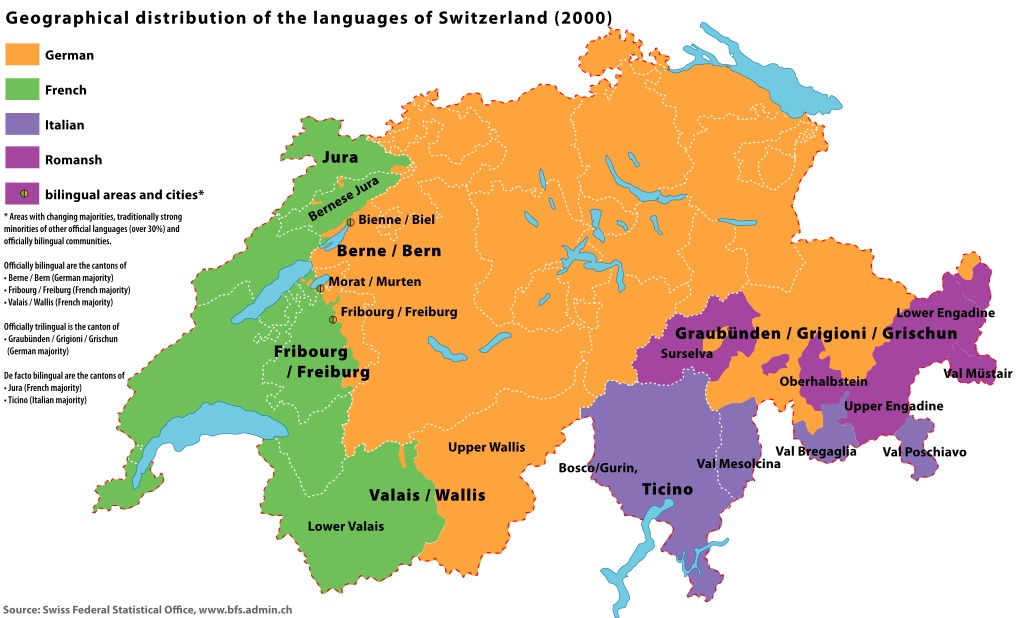
*Swiss Federal Statistical Office; census of 2000 – Source – Wikipedia, Marco Zanoli.
It
all comes down to the way in which the country is governed. Switzerland
is a federal parliamentary republic consisting of 26 cantons. The unity
of the country is upheld by the Federal Council (executive level) and a
two-tier parliament (legislative level). Collectively, they are in
charge of managing the country’s foreign affairs, defence and security
policies, financial matters and enacting legislation that applies
throughout the whole country (the federal laws always takes precedence).
The cantons are equivalent in size to a district in Sri Lanka. Just
like the districts, each canton is mainly inhibited by one ethnic group;
17 cantons are German-speaking, 4 cantons are French-speaking, 1 canton
is Italian-speaking, 3 cantons are bilingual (German and French) and 1
canton is trilingual (German, Italian and Romansh). However, unlike the
districts, each canton is provided a large degree of autonomy; they have
their own constitution, legislature, government and courts. The cantons
are responsible for their own healthcare, welfare, law enforcement,
education and taxation.
The reason behind why each canton is
provided a large degree of autonomy is due to Switzerland’s recognition
that the population needs in each canton differ due to the political,
social and economic problems peculiar to that particular canton itself
(this is even the case between two linguistically similar cantons). They
have understood that a cantonal government compared to a central
government, which may be situated on the other side of the country, has a
greater ability at formulating policies which meet the local needs.
This is because, not only do the cantonal government representatives
live in proximity to the people, they are usually from the same
community. As a result, they are in a better position to understand the
problems in their canton and offer unique solutions which take into
account the distinct culture, history, language and religious practise.
