Peace for the World World ! Your War Our Lives

The Dalai Lama
A Brief Colonial History Of Ceylon(SriLanka)
Sri Lanka: One Island Two Nations
A Brief Colonial History Of Ceylon(SriLanka)
Sri Lanka: One Island Two Nations
(Full Story)
Back to 500BC.

Sunday, June 7, 2015
G7 summit: 8,000 protesters gather as leaders prepare wide-ranging talks
Protesters
set up a tent camp and police run checks on borders, with Fifa, US
trade and climate change high on activists’ and world leaders’ agendas
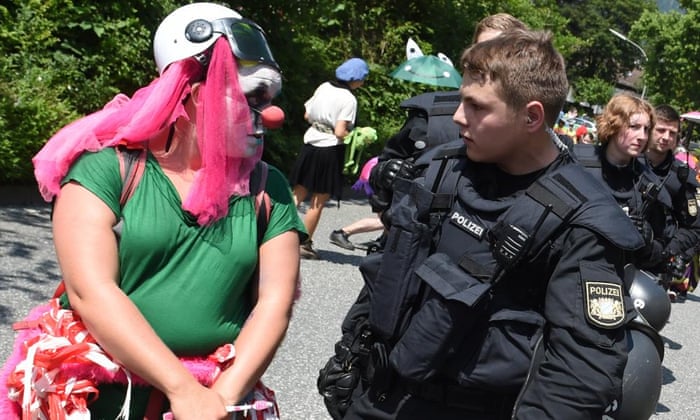
A protester talks to a police officer in Garmisch-Partenkirchen, ahead of the G7 summit. Photograph: Boris Roessler/dpa/Corbis

Thousands of activists have gathered in the German Alpine resort town of
Garmisch-Partenkirchen, as G7 leaders prepared for wide-ranging talks
on subjects from Fifa corruption to controversial free trade agreements.
At the two-day summit, David Cameron will call on his fellow members Germany, France, the US, Italy, Canada and Japan, to tackle international corruption.
In a speech on Sunday, in the wake of the crisis that has engulfed
world football’s governing body, the prime minister is set to call
corruption a “cancer” and the “arch-enemy of democracy”.
Cameron is also expected to urge fellow world leaders to come to an
agreement on the controversial US-EU Transatlantic Trade and Investment
Partnership (TTIP), to which many of those protesting have strong
objections. Negotiations on the treaty have now lasted more than 700
days.
Campaigners at Global Justice Now, one of the groups protesting in the
resort, said they expect a Europe-wide petition against the TTIP deal to
hit 2m signatures in the coming week.
GJN’s Guy Taylor said: “There is clearly no mandate for the G7 leaders to be pushing ahead with this disastrous trade deal.
“TTIP may bring some economic benefits for a tiny handful of the
business elite but for the rest of us it would mean compromising vital
public services, the stripping of regulations protecting labour rights
and the environment, and a dramatic erosion of democratic process.”
The summit is also expected to discuss the possible renewal of sanctions
against Russia (which was refused an invite to what would have been a
G8 summit over its involvement in Ukraine), funding for programmes to
combat medical epidemics like Ebola, and the risk of a Greek exit from the euro.
The Iraqi prime minister, Haider al-Abadi, has been invited to the G7
meeting to discuss the US-led campaign against Islamic State in his
country and in Syria.
Climate change is also high on protesters’ and politicians’ agendas, and
German chancellor Angela Merkel on Saturday called for the industrial
powers to throw their weight behind a longstanding pledge to seek $100bn
to help poor countries tackle climate change, agreed in Copenhagen in
2009.
Merkel said in a video message on Saturday that it was important to have a “confirmation of this fund” from the G7.
Protesters set up a makeshift tented camp early on Saturday, and many more people are expected to arrive on buses from across Germany in time for the summit’s start on Sunday.
Police spokesman Hans-Peter Kammerer said the 8,000-strong crowd had so
far been peaceful but added that 22,000 officers were on standby over
fears more extreme factions from Germany, Austria, Italy and Britain
could join the demonstrations.
German police said they would carry out spot-checks at the country’s
borders, which, because Germany is a member of the Schengen agreement,
are normally openly accessible.
Police had planned to keep all demonstrators away from the venue, which
is in a tiny village five miles from Garmisch-Partenkirchen, but a court
ruled that 50 protesters could be allowed inside the security zone, so
G7 leaders would be able to hear them outside.
Simon Ernst, one of the organisers of the Stop Elmau demonstration,
called the G7 leaders “the henchmen of bankers and corporations” and
said that having just 50 demonstrators allowed to be near the actual
venue was far too few.
“We think it shows an arrogant attitude toward freedom of assembly,” he said.
The group takes its name from the luxury hotel where the summit will
take place, nestled 3,000 ft high in the snow-capped Bavarian mountains,
from Sunday until Monday.
Stop Elmau said it
is also demonstrating in opposition to free trade agreements like TTIP ,
as well as expressing opposition to Nato, and solidarity with migrants
and refugees.
It will also draw attention to the “surveillance society and the dismantling of democratic liberties”.
At the demonstration on Saturday afternoon, participants ranged from
anarchists with their faces covered, to peace protesters wrapped in
rainbow flags, as well as many families with children.
One of the most striking groups were six clowns who blocked a main road
in the town and forced a police van to seek an alternative route.
Monika Lambert, from the Bavarian city of Erlangen, said she had come
“to exercise my democratic rights to say that everything the G7 decides
is in the interest of the banks and capitalists”.
“I asked my parents what they did during the Nazi period and they did
nothing,” she said. “I don’t want to tell my children and grandchildren
the same thing.”
