Peace for the World World ! Your War Our Lives

The Dalai Lama
A Brief Colonial History Of Ceylon(SriLanka)
Sri Lanka: One Island Two Nations
A Brief Colonial History Of Ceylon(SriLanka)
Sri Lanka: One Island Two Nations
(Full Story)
Back to 500BC.

Tuesday, June 9, 2015
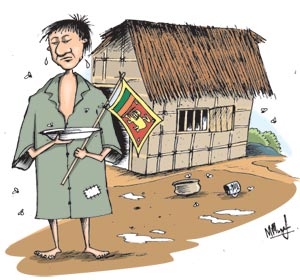
Sri Lankan government facing deepening financial crisis
By Saman Gunadasa
8 June 2015
 Just
six months after coming to office, the minority government in Sri Lanka
has borrowed 378 billion rupees ($US2.8 billion) via treasury bills and
bonds, surpassing the figure of 260 billion rupees for the whole of
last year. In addition, the government raised $US1 billion last week by
issuing 10-year sovereign bonds and development bonds at an interest
rate of 5.26 percent per annum.
Just
six months after coming to office, the minority government in Sri Lanka
has borrowed 378 billion rupees ($US2.8 billion) via treasury bills and
bonds, surpassing the figure of 260 billion rupees for the whole of
last year. In addition, the government raised $US1 billion last week by
issuing 10-year sovereign bonds and development bonds at an interest
rate of 5.26 percent per annum.
At a press conference on May 29, Central Bank governor Arjuna Mahendran
and Finance Minister Ravi Karunanayake boasted that the purchase of the
bonds in a short time was an “expression of confidence on the
government.”
This is not the case. The government issued the bonds to offset its
expenditure. More than 75 percent of the bonds were bought by global
funds, mainly from the US but also from Europe and Asia, seeking
relatively high returns. As in the past, the money could be withdrawn
when investors find more profitable prospects, sending a shock wave
through the economy.
Most of the latest borrowings are needed just to repay loan instalments
and interest on existing debt. The previous government of President
Mahinda Rajapakse took out large loans to finance the war against the
Liberation Tigers of Tamil Eelam (LTTE) and substantial infrastructure
projects following the LTTE’s defeat in 2009.
A recently published 2014 Central Bank Report noted that total
government debt increased to 7.39 trillion rupees last year, up from
6.79 trillion rupees in 2013. Total foreign debt increased by 5.2
percent to 3.33 trillion rupees in 2014, from 2.96 trillion rupees in
2013. Karunanayake recently admitted that country’s debt service payment
was “extremely high”—equivalent to 95.4 percent of government revenue.
The increased borrowing demonstrates that the government is facing a
dire financial crisis. Last month, former President Chandrika
Kumaratunga warned that the government was not in a position “to pay
state sector salaries to everyone.”
Karunanayake made a desperate appeal last Friday to exporters and
expatriate workers to send their money back to Sri Lanka, promising
higher returns. The Central Bank imposed a 5 percent penalty on
exporters who hold their US dollars for more than 90 days and a 2
percent monthly penalty after that—effective as of last Monday.
The parliamentary opposition parties opposed some tax proposals
announced in the interim budget in February, including a 25 percent tax
on company profits last year of over 2 billion rupees and a 250 million
rupee tax on mobile phone operators. This “one-time tax” is mainly aimed
at the big business supporters of former President Rajapaske.
Karunanayake told reporters last week that the minority government “is
being held hostage by a majority Opposition.” In April, the opposition
rejected Karunanayake’s proposal to increase the government borrowing
limit by 400 billion rupees, claiming it would increase inflation.
Compounding the government crisis, strong downward pressure on the rupee
led to a devaluation of nearly 4 percent last week. Even though the
Central Bank intervened to try to prop up the currency, it reached 138
rupees to the US dollar last Monday, before recovering to 135 rupees.
For some time, the International Monetary Fund (IMF) has demanded a
“more realistic exchange rate,” as have exporters. However, the
government is seeking to prevent a further devaluation before a general
election expected in the next few months.
A fall in the value of the rupee would lead to rising prices, further
fuelling opposition to the United National Party (UNP)-led government
installed after President Maithripala Sirisena won the January 8
presidential election.
Sections of the corporate elite have expressed deepening concern over
the political uncertainty and worsening economic problems. They are
demanding major economic “reforms” that will drastically affect jobs,
wages and price subsidies for workers and the poor.
Indrajith Coomaraswamy, deputy chairman of the big business think tank
Pathfinder, told a media conference in late May: “[T]he longer you wait,
the more intense the pain will be, so we need to achieve macroeconomic
stabilisation as soon as the elections are over... It’s not enough to do
incremental changes. We need major reforms.”
“Macroeconomic stabilisation” means reducing the budget deficit by
implementing the IMF’s austerity measures, which will hit working
people. Last year’s budget deficit of 6 percent of gross domestic
product (GDP) surpassed the IMF’s target of 5.2 percent. The IMF warned
that without a huge effort to increase tax revenues, this year’s budget
deficit target of 4.4 percent of GDP would not be achieved.
The IMF turned down the Sirisena government’s request for a $US4 billion
loan to restructure the ballooning public debt—in effect, a vote of no
confidence in the government’s failure to slash spending.
Coomaraswamy called on the government to stop further borrowing. “The
debt dynamics have changed substantially and the scope for the state to
borrow is no longer there,” he said. “The budget deficit is likely to
deteriorate as a result of the non-fundable ‘budget handouts’ that we
saw in the recent past... It’s only a matter of time that we will have
tax increases, expenditure cuts, interest rate increases and
depreciation of currency or some mix of this prescription.”
Pathfinder executive director Luxman Siriwardene bluntly justified the
austerity agenda by attacking workers and the poor, and blaming them for
the economic crisis. “Is it fair that people who are sitting around and
doing nothing get a wage increase of 10,000 rupees?” he declared. “We
must change this entitlement mentality.”
The right-wing UNP government has no disagreement with the anti-working
class agenda being demanded. However, with a general election due to be
called, it has held off implementing far-reaching attacks on living
standards in the hope of gaining a majority in parliament.
Whichever parties form the next government after the election will
quickly ditch their promises and launch a far-reaching assault on the
social conditions and democratic rights of the working class and the
urban and rural poor.
