Peace for the World World ! Your War Our Lives

The Dalai Lama
A Brief Colonial History Of Ceylon(SriLanka)
Sri Lanka: One Island Two Nations
A Brief Colonial History Of Ceylon(SriLanka)
Sri Lanka: One Island Two Nations
(Full Story)
Back to 500BC.

Saturday, August 1, 2015
Sri Lanka: Muslim Racism – Izeth Hussain
A protest by Muslims in Sri Lanka
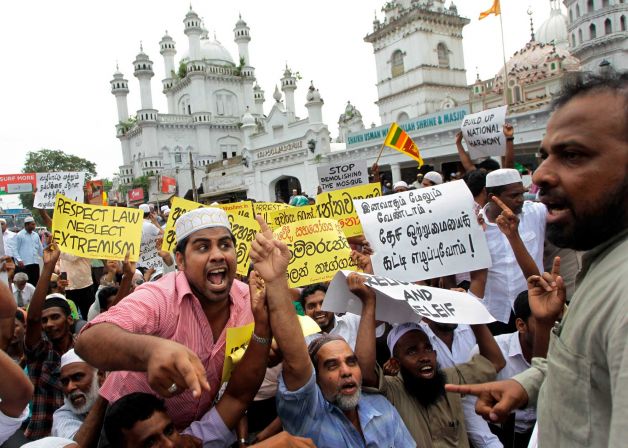

I have been frequently berated for writing about Sinhalese and Tamil racism but never about Muslim racism. This charge has been made not only by Tamil lunatic fringe anti-Muslim racists, whose ranting and ravings need not be taken too seriously, but also by Sinhalese who seem to be genuinely perplexed by that omission. They refer frequently to the horrors perpetrated by the IS. Actually I have covered the subject of Islamism, political Islam, Islamic fundamentalism, of which the IS is the most horrible example so far, in the series of articles that I wrote some time ago on the Sri Lankan Muslims. There I made absolutely clear my utter abhorrence of all the forms of Islamic fundamentalism spawned by the original monstrosity of Wahabism. But readers have forgotten all that and berate me over my alleged disingenuousness and hypocrisy over Muslim racism.
There is more than one reason why I haven’t written on the problem of
Muslim racism in Sri Lanka. There is no such problem – that’s my first
reason. Certainly there will be racist attitudes among some Muslims but
their racism does not constitute a national problem meriting articles by
me and others. Am I to write an article on The Non-problem of Muslim
Racism? It is widely recognized that there is the problem of Sinhalese
racism towards the Tamils. It is also widely recognized – particularly
after the antics of the BBS – that there is the problem of Sinhalese
racism towards the Muslims. You can therefore expect articles on those
subjects but not on the non-problem of Muslim racism. It is therefore
absurd to charge me with disingenuousness and hypocrisy because in
writing an article about Sinhalese or Tamil racism I haven’t included in
it my views on Muslim racism. The reader must bear in mind another fact
also. Bishop Butler observed in the eighteenth century that “Everything
is what it is and not something else”. I observe today “Every article
is about something and not about something else”. That’s another reason
why I shouldn’t be expected to cover Muslim racism when I write on
Sinhalese racism or Tamil racism.
However there has been alleged Muslim racist violence against Tamils in
the Eastern Province in the past. That alleged racist violence has not
continued into the present and therefore does not constitute an urgent
national problem today. But of course what happened in the past can
impact on the present and influence the future. It is therefore
something that should be examined by the political analyst, not
something that should be left only to the historians. My problem in
writing about it has been that I have not been able to get detailed,
accurate, and complete information about what really happened. I have
only very recently been provided with information that is detailed and
looks accurate, but it is not complete according to the person who
provided it. However that does not matter because the information
certainly suffices for an article on alleged Muslim racist violence
against the Tamils in the EP.
But the information is incomplete, very seriously incomplete, in another
sense. It is one-sided. We know that the Muslim violence in the EP led
to the eviction of 80,000 Muslims from the North. But what were the
antecedents of that Muslim violence? Did it just happen like a
thunderclap out of the blue? This is what Rajan Hoole writes in his
recently published book Palmyra Fallen. “In the East, though tensions
between Tamils and Muslims have a longer history, the situation at
present is largely the result of the great harm inflicted upon Tamils by
a nationalism that under the LTTE behaved like its savage Sinhalese
counterpart. Tamils readily remember the massacres of Tamils by Muslim
home guards and thugs in the early 1990s, but few remember that these
were reprisals for senseless LTTE massacres of Muslims. Moreover, rather
than the work of Muslim leaders, these were instigated or supported by
the Armed Forces – unlike massacres by putative sole leaders of the
Tamils. It is mainly the Tamils who are holding back on dialogue”.
I request the reader to scrutinize that quotation scrupulously. He must
bear in mind that Rajan Hoole is an eminent Tamil and is also a
prominent member of the University Teachers for Human Rights (Jaffna),
an institution which at great risk to life and limb has produced
material of great value on the ethnic problem. We can therefore presume
that behind that quotation there are standards of the highest integrity.
One point to note is that massacres of Tamils by Muslim home guards
were reprisals for senseless LTTE massacres of Muslims. Therefore the
notion is wrong that the Muslims brought it – the eviction from the
north – on themselves. The responsibility for that horror is
unequivocally on the Tamil side.
The other and more important point to note is that the massacres of
Tamils by Muslim home guards were instigated or supported by the Armed
Forces, not by Muslim leaders. I believe that it would be very plausible
to say on commonsensical grounds that action by the Muslim home guards
had at the very least the implicit blessings of the Armed Forces. I find
it impossible to believe that the Armed Forces, the instrument of the
supreme Sinhalese State, would have been content to play the role of
neutral observers while the Muslim home guards went on the rampage. It
becomes plausible to argue that the massacres of Tamils in the EP were
the expression of State racism in which the Muslim home guards were the
instruments of the State. Anyway it is questionable that those massacres
were the unequivocal expression of Muslim racism. I must add that
according to Hoole the massacres by the Tamils had the backing of the
putative sole leaders of the Tamils, meaning the LTTE.
Under these circumstances I have decided against writing an article on
alleged Muslim racism in the EP on the basis of the material I have been
given. That information, though supplied with the best of intentions,
is one-sided. No information is available on what was done by the LTTE
to provoke those reprisals. An article with the present state of
knowledge would be grossly unfair to the Muslims. There is also another
reason behind my decision. In the West any manifestation of racism is
brought out into the open and examined, after which corrective action is
taken if it seems necessary. That is the result of Hitler’s Holocaust
against the Jews which alerted Westerners to the terrifying destructive
potential in racism. In Sri Lanka the consensus is very different: such
problems should be played down or ignored altogether, and after some
time they will go away. It is a mistaken belief, as the facts about the
Muslim ethnic problem show very clearly, and I therefore favour the
Western strategy. But I cannot ignore certain facts. The situation in
the EP has much incendiary potential in it, but as far as I can make out
the Tamils and the Muslims there are handling their problems
pragmatically and in an accommodative spirit. Should outsiders do
anything that might aggravate their problems? Surely not. It is
therefore up to them to decide whether or not some things that happened
in the past should be examined at the present stage.
izethhussain@gmail.com
