Peace for the World World ! Your War Our Lives

The Dalai Lama
A Brief Colonial History Of Ceylon(SriLanka)
Sri Lanka: One Island Two Nations
A Brief Colonial History Of Ceylon(SriLanka)
Sri Lanka: One Island Two Nations
(Full Story)
Back to 500BC.

Sunday, November 1, 2015
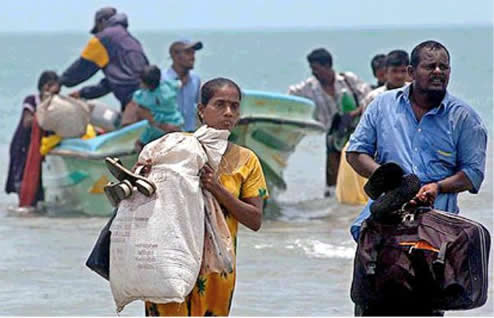
Exodus From Jaffna, 31st October 1995
UTHR(J) Special Report No.6
Extract;
The Exodus: Varying Claims and Perceptions

On the evening of 30th October 1995, LTTE loudspeakers announced in
Jaffna town, “No one must take this announcement lightly. We are
battling intensely and courageously against a demonic force. It will
attack us from multiple directions. We too will respond likewise. Since
we are going to resist every inch of the way against a state drunk with
racism, you people must evacuate for Thenmaratchi and Vadamarachi this
same night.” LTTE men then went from house to house and ordered people
to evacuate. They were told, “Jaffna town would soon become a battle
zone. We are blowing up Chemmani bridge at 4.00 a.m. If you are not out
by then, you will have to remain and face the consequences.” By 6.30
p.m. Kandy Road was blocked by panic stricken people trying to leave on
foot. A man who decided not to leave and went 300 yards to discuss plans
with another family said that owing to the press of the multitude, the
journey took him two hours.
There had evidently been privileged sections of the civilian population who had received prior notice of the exodus and had made an early exit with their moveable property. On the 30th evening people in different places were told different things. Some were told that the Chemmani Bridge (Navatkuli Bridge) would be blown up at twelve mid-night. In Uduvil people were told that the army would soon subject the area to a rain of shells. Four shells were fired into the area, which were later identified by the people as LTTE shells. People in Jaffna town were told that an army attack from Mandathivu is imminent.
There had evidently been privileged sections of the civilian population who had received prior notice of the exodus and had made an early exit with their moveable property. On the 30th evening people in different places were told different things. Some were told that the Chemmani Bridge (Navatkuli Bridge) would be blown up at twelve mid-night. In Uduvil people were told that the army would soon subject the area to a rain of shells. Four shells were fired into the area, which were later identified by the people as LTTE shells. People in Jaffna town were told that an army attack from Mandathivu is imminent.
 Chemmani
Bridge was never blown up as threatened. On the morning of that same
day, the LTTE had made a proclamation of ‘War-time Exigency’ through
loudspeakers. It was that night, after the exodus order, that the people
found out what it meant.
Chemmani
Bridge was never blown up as threatened. On the morning of that same
day, the LTTE had made a proclamation of ‘War-time Exigency’ through
loudspeakers. It was that night, after the exodus order, that the people
found out what it meant.
Those in Jaffna who switched on to the LTTE’s radio bulletin
that night were astonished to discover that no reference was made to the
exodus that had been ordered. In the days that followed, while doing
everything to force civilians to leave Jaffna, the LTTE went on denying
that it had ordered people to do so.
There had been a steady exodus of people from Jaffna fleeing the
fighting and the bombing and shelling, owing to the fact that the
Government had failed in its duty to give confidence to the civilians
that tangible measures for their safety had been taken. What is worse,
it was denying or greatly underplaying civilian casualties and suffering
behind a mask of censorship. By its reprimand (and subsequent
suspension) of the Government Agent of Jaffna, the Government was
behaving as though it was treachery to talk about such matters – an
ironical position for a Government that had staked much on openness,
democracy, political accommodation and human rights.
On 3rd November the Spokesman for the UN
Secretary General Boutros Boutros-Ghali issued the following statement:
“Reports of the massive displacement of the civilian population in
northern Sri Lanka are a source of deep concern to the Secretary
General. It is evident that humanitarian assistance on a significant
scale will be essential to minimise suffering…”
Read More
