Peace for the World World ! Your War Our Lives

The Dalai Lama
A Brief Colonial History Of Ceylon(SriLanka)
Sri Lanka: One Island Two Nations
A Brief Colonial History Of Ceylon(SriLanka)
Sri Lanka: One Island Two Nations
(Full Story)
Back to 500BC.

Sunday, November 1, 2015
Sri Lanka: A Ray of Hope for those Looking for War Missing
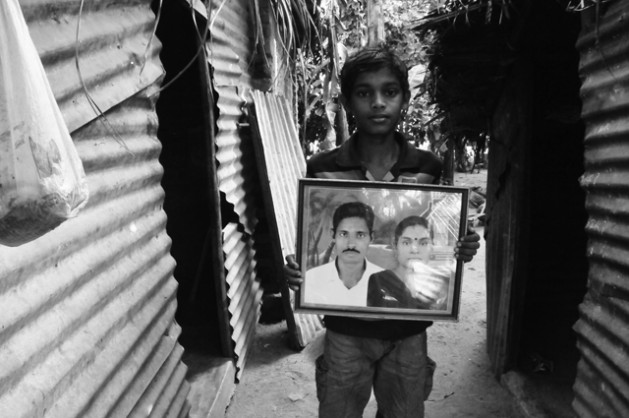
Thavarasa Utharai son Jadusan, 14 years, holds a picture of his missing
father and mother. He last saw his father in March 2009. Credit: Amantha
Perera/IPS
 Saturday, October 31, 2015
- Thavarasa Utharai’s most treasured belongings are stuck inside several plastic bags and tucked within old traveling bags.
Inside, wrapped in more plastic sheets, are old fading photographs,
scrap books, legal documents and even some old bills. These are the only
processions the 36 year old mother of two has to show of her husband.
He went missing on March 20, 2009 while returning home after tending to
his cattle. No one really knows what happened to him.
“They took him, I know they did, I know the person who did it also,”
Utharai says of suspected abductors who she says were linked to
government military. The abduction took place as a three decade old
bloody civil conflict was drawing to an end and government forces were
poised to achieve a decisive military victory over the Liberation Tigers
of Tamil Eelam (LTTE). The separatist LTTE had fought successive Sri
Lankan governments to achieve a separate state for the country’s
minority Tamils like Utharai.
Utharai hails from the remote village of Pavakodichennai, in the eastern
Batticaloa District about 350 km from the capital Colombo. But distance
and lack of public utilities like transport and a functioning public
service have not prevented her from seeking justice. She has sought the
intervention of police, a Presidential Commission and the International
Committee of the Red Cross (ICRC) to gain any morsel of information on
her husband. So far she has hit a blank wall, except when an officer
with Criminal Investigation Department suggested that if she register
her husband as deceased her family would be eligible for Rs 100,000 (700
dollars) in compensation.
“Why should I? I will seek the truth, I owe it to him,” the slightly built woman says with a feisty tone.
Her circumstances however are not rare in the former conflict-zone. Tens
of thousands are still looking for their missing loved ones six years
after the guns fell silent. The number of the missing has remained
contentious since the war ended. A Presidential Commission on Missing
Persons that has been conducting interviews since 2013 has so far
received over 20,000 complaints, including over 5,000 of missing members
of government forces. The ICRC, which has been registering missing
persons since 1990, has recorded 16,064 cases. An Advisory Panel to the
UN Secretary General put the death toll during the final phase of the
war at 40,000. Research by the advocacy group University Teachers for
Human Rights from northern Jaffna increased that figure to 90,000.
“It really does not matter how high or how low these figures are, for
each family it is vital that they get to know what happened to their
loved ones,” Vallipuram Amalanayagni said. She has been searching for
her husband since he went missing in February 2009. He went missing
while at his paddy field.
Amalanayagni also acts as a community leader for families of the
missing. She says the last six years have been some of the hardest in
her life. “We were hounded like criminals because we looked for our
family members.”
As the then Mahinda Rajapaksa government fought off wave after wave of
international scrutiny on the conduct of the final phase of the war, it
did not encourage any action that could fuel international pressure –
looking for the missing or tabulating them was one of them. During the
last months of his administration, Rajapaksa loosened the grip a bit but
not by a lot.
All that changed in January this year, when a new president, Maithripala
Sirisena, took office. The new government has renewed engagement with
the UN and has pledged to strengthen efforts to trace the missing and
provide compensation.
It will set up a missing persons office and also issue Certificates of Absence. Last week it also released a report by a Presidential Commission looking
into allegations of abductions and disappearances. The commission has
acknowledged that disappearances did take place while persons were in
military custody and that military linked groups were involved in
abductions.
“This is not a political gimmick, we are serious about what we have set
out to do,” Minister Rajitha Senarathana, the cabinet spokesperson told
IPS.
The minister said that investigating the thousands of missing cases was a
pledge that President Sirisena, Prime Minister Ranil Wickremasinghe and
their loyalists made while they campaigned to oust the Rajapaksa
administration
“For a nation to heal we must know the truth, however difficult and uncomfortable it may be,” Senarathana said.
Given the media hype, expectations have also risen that there could be
fast tracked action. But Sri Lanka watchers caution not to raise hopes
too high and to give the current government enough time to feel
politically secure.
“It would be slow progress, the government has shown its inclination
that it wants to act on these, it has international support right now,
but it would need time to convince everyone,” Jehan Perera, Executive
Director National Peace Council, a national advocacy body.
Diplomatic sources in Colombo also say that the Sirisena government is
still wary of the Rajapaksa factor and the former president’s core
support base of ultra-nationalists from the Sinhala majority.
For the families of the missing, there is at least a new ray of hope.
“Some of us have been looking for loved ones for decades, imagine living
without any kind of knowledge of your husband for over a decade, that
is a terrible tragedy, at least now there should be closure,”
Amalanayagni said.
(End)
