Peace for the World World ! Your War Our Lives

The Dalai Lama
A Brief Colonial History Of Ceylon(SriLanka)
Sri Lanka: One Island Two Nations
A Brief Colonial History Of Ceylon(SriLanka)
Sri Lanka: One Island Two Nations
(Full Story)
Back to 500BC.

Tuesday, December 1, 2015

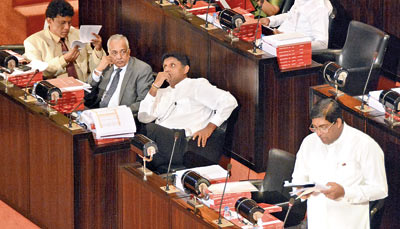
Finance Minister presents the budget.
The 2016 Budget has been welcomed by the business and economic
establishment. The big question is whether economic policies good for
business are necessarily good for the economy and the people? To what
extent are the economic policies in the 2016 Budget and the Prime
Minister’s Economic Policy Statement different from the crisis-prone
economic policies of the past?Economic policies in recent decades have
been dominated by a neoliberal vision of transforming the economy to
ensure the greater accumulation of profits by finance capital.
Neoliberal capitalism does not only depend on profits through the
increasing exploitation of labour in production as with intensive
farming and industrial factories, but also through creating business
friendly conditions for financialised speculation of people’s savings
and the grabbing of their assets such as land. This budget and the
economic policies it reflects are certainly business friendly and
neoliberal in character. However, as with so many neoliberal economic
policy packages around the world, they can also become the ground for
repeated economic crises as with the Western Economic Crisis of 2008 and
the Asian Economic Crisis a decade before that.
Neoliberal waves
Neoliberal economic policies are not new to Sri Lanka, one of the first countries in South Asia to liberalise its economy. The open economy policies of 1977 constituted the first wave of liberalisation in Sri Lanka. In subsequent decades, economic scholars argued that the period from 1989 to 1993 under the Premadasa Government represented the second wave of liberalisation, which was characterised by financial, trade, tax and exchange rate liberalisation. The period from 1996 to 2000 under the Kumaratunga Government carried forward the liberalisation agenda further with an emphasis on privatisation.That a major shift of economic policy occurred in 1977 is accepted across the spectrum. However, I would argue that this first wave of neoliberalism continued into subsequent decades. The conditions to embark on a second wave of neoliberalism were encountered in 2002 with the internationalised peace process and the Wickremesinghe Government in power. However, acceleration of neoliberal policies does not only depend on the regime in power, but equally, if not more, on economic conditions both nationally and globally. Between 2002 and 2004, the Wickremesinghe Government failed at a second wave of neoliberal economic transformation for the very reason that the previous regimes could not attempt it. Neither the national stability nor the conditions for the global inflow of capital existed as the country was embroiled in a protracted war.
Neoliberal economic policies are not new to Sri Lanka, one of the first countries in South Asia to liberalise its economy. The open economy policies of 1977 constituted the first wave of liberalisation in Sri Lanka. In subsequent decades, economic scholars argued that the period from 1989 to 1993 under the Premadasa Government represented the second wave of liberalisation, which was characterised by financial, trade, tax and exchange rate liberalisation. The period from 1996 to 2000 under the Kumaratunga Government carried forward the liberalisation agenda further with an emphasis on privatisation.That a major shift of economic policy occurred in 1977 is accepted across the spectrum. However, I would argue that this first wave of neoliberalism continued into subsequent decades. The conditions to embark on a second wave of neoliberalism were encountered in 2002 with the internationalised peace process and the Wickremesinghe Government in power. However, acceleration of neoliberal policies does not only depend on the regime in power, but equally, if not more, on economic conditions both nationally and globally. Between 2002 and 2004, the Wickremesinghe Government failed at a second wave of neoliberal economic transformation for the very reason that the previous regimes could not attempt it. Neither the national stability nor the conditions for the global inflow of capital existed as the country was embroiled in a protracted war.
Thus it was left to the Rajapaksa regime, in its second term after the
end of the war in 2009, to launch the second wave of neoliberalism
amidst authoritarian national stability and favourable global financial
flows. Indeed, there are many parallels between the high growth years of
the late 1970s and the period of accelerated growth starting in 2010,
particularly in relation to the inflow of capital and the boom in
construction. The Rajapaksa regime carried forward the ‘Regaining Sri
Lanka’ policy package of the previous Wickremesinghe Government, albeit
piece-meal and to suit its own political and economic priorities.
Indeed, it is with this second wave of neoliberalism that we have seen
tremendous financialisation as well as massive infrastructure and urban
build-out. The increasing indebtedness of Sri Lanka over the last many
years that has become a major topic of discussion in recent months, is
not an aberration, but the very manifestation of neoliberal integration
with global capital and markets.
Corruption to the fore
The question is whether there is a difference between the neoliberal push of the Rajapaksa regime and the new Government. To the extent that they both consider financialisation and urbanisation as central to economic growth, there is no difference. By the beginning of its second term in 2010, the Rajapaksa regime had consolidated an oligarchic vision with a group of actors eager to share the spoils by committing to the regime’s political and economic project. The somewhat disjointed moves lacking a forceful ideological stance on neoliberalism had to do with the Rajapaksa regime’s social base; a populist appeal to placate the rural constituencies even as the regime attempted to take financialised urbanisation full steam.
The question is whether there is a difference between the neoliberal push of the Rajapaksa regime and the new Government. To the extent that they both consider financialisation and urbanisation as central to economic growth, there is no difference. By the beginning of its second term in 2010, the Rajapaksa regime had consolidated an oligarchic vision with a group of actors eager to share the spoils by committing to the regime’s political and economic project. The somewhat disjointed moves lacking a forceful ideological stance on neoliberalism had to do with the Rajapaksa regime’s social base; a populist appeal to placate the rural constituencies even as the regime attempted to take financialised urbanisation full steam.
The new Wickremesinghe regime, on the other hand, is still in the
process of consolidation. Whether and how, President Maithripala
Sirisena and his SLFP base, will or will not be integrated with the
interests of the new regime will greatly affect its consolidation. Here I
use ‘regime’ with reference to those at the helm of state power with
particular ideological and economic interests. In any case, through its
budget, the Wickremesinghe Government has sent a clear message to the
business class, specifically finance capital. Although there is a
difference in the specific actors who may benefit from the substance of
the neoliberal policies favoured by the Wickremesinghe and Rajapaksa
Governments, the larger class interests are essentially the same.
Furthermore, the new Government is just not shy about its open embrace
of business and the market.
The central theme in the contemporary phase of the second wave of
neoliberalism is financialisation and urbanisation. The Rajapaksa regime
ensured an IMF Standby Facility at the outset in late 2009, floated
sovereign bonds, propped up the stock market, attempted a process of
financial consolidation including the merging of banks and moved on the
beautification of Colombo. The new Government is going to do more of the
same with financialisation, including the merging of banks and the
promotion of capital markets, and the massive urban transformation of
the Western Province into the Megapolis. In fact, these initiatives will
be augmented with labour reforms, market oriented land policies and
changes to state institutions, with the assurance that these measures
will be undertaken wearing cleaner shirts.
The other side to this story is the continuing abandonment of the rural
sectors such as agriculture and fisheries; despite the lip service of
the new Government as with the Rajapaksa regime, there is a steady
decline in budgetary allocations. The Rajapaksa regime promoted pawning
and leasing by banks, and thus facilitated the siphoning off of the
meagre liquid assets of the rural people by finance capital. The new
Government recognising the problems for banking, with increasing
non-performing assets, is pushing the banks to reject pawning and
leasing. However, they are creating a grander game on the speculation of
land, the largest fixed assets of ordinary people, where converting
their lands into marketable private lands and simultaneously promoting
Real Estate Investment Trusts (REITs) that opens the door for
speculation by finance capital and the eventual dispossession of
people’s homes and land.
Over the last year, the public wanted to see the previous regime
prosecuted for its obscene and large scale corruption, but the new
Government has been slow in moving on such prosecutions. In many ways,
it is the continuing attention on the excesses of the Rajapaksa
Government that serve as an effective cover for the economic policies
launched over the last month by the Wickremesinghe Government. The
Rajapaksa regime should have been prosecuted for corruption months ago,
but the long-drawn process has been not only a relief to the previous
regime but also a cover for the regime in the making. Indeed, the public
was fed doses of the Avant Garde scandal even as far reaching economic
policies were unveiled. It is this grand deflection through the
discourse on corruption that may facilitate the dangerous neoliberal
transformation with labour reforms resulting in easy hire and fire of
workers, land policies that make it a resource for capital and state
institutions that work for business through public private partnerships.
Precarious future
The economic situation is not all that rosy for the Government. Five years into the second wave of neoliberalism, the conditions for crisis have matured in the country. The increasing national indebtedness, the falling foreign exchange reserves and the looming balance of payment problems are both conditions for financial crisis and also for global finance capital to abandon Sri Lanka; this is what happened with repeated financial crisis around the world including more recently in Southern Europe. In 2010, the Rajapaksa regime was fortunate to be placed in an opportune moment following the 2008 Western Economic Crisis, with a flush of capital to the “emerging markets”. Now, with the US Federal Reserve increasing interest rates, there has already been a reversal of the flow of global capital. Given the Wickremesinghe regime’s neoliberal push for national economic growth through the inflow of global finance capital absorbed in urban construction, the new Government will have to do more to make the local market inviting. This will involve dispossessing people of their assets, including land, savings and pensions, which can be channelled into the market for speculation by global finance capital.
The economic situation is not all that rosy for the Government. Five years into the second wave of neoliberalism, the conditions for crisis have matured in the country. The increasing national indebtedness, the falling foreign exchange reserves and the looming balance of payment problems are both conditions for financial crisis and also for global finance capital to abandon Sri Lanka; this is what happened with repeated financial crisis around the world including more recently in Southern Europe. In 2010, the Rajapaksa regime was fortunate to be placed in an opportune moment following the 2008 Western Economic Crisis, with a flush of capital to the “emerging markets”. Now, with the US Federal Reserve increasing interest rates, there has already been a reversal of the flow of global capital. Given the Wickremesinghe regime’s neoliberal push for national economic growth through the inflow of global finance capital absorbed in urban construction, the new Government will have to do more to make the local market inviting. This will involve dispossessing people of their assets, including land, savings and pensions, which can be channelled into the market for speculation by global finance capital.
Indeed, repeated financial crisis around the world have also opened
opportunities for neoliberal transformations. These changes have been
accompanied by repression and dispossession. While these dangers await
the people of Sri Lanka, they are overlooked in most public commentaries
on the budget and the Prime Minister’s Economic Policy Statement. Would
even the provisions for greater educational investment, the only
potential gain for the people in this budget, withstand the cycle of
neoliberal capitalist crisis and dispossession once it is unleashed? In
the weeks and months ahead, not only debates on concrete issues like
land, work, and social protection, but peoples’ struggles will be
important to protect what they have in the face of neoliberal
dispossession.
