Peace for the World World ! Your War Our Lives

The Dalai Lama
A Brief Colonial History Of Ceylon(SriLanka)
Sri Lanka: One Island Two Nations
A Brief Colonial History Of Ceylon(SriLanka)
Sri Lanka: One Island Two Nations
(Full Story)
Back to 500BC.

Wednesday, December 16, 2015
Increasing The Education Budget & The Merging Of Education & Business

Public education has been at the centre of many struggles in Sri Lanka.
While images of the brutal attacks on the HNDA student protests are
still fresh in our minds, another budget has been presented to us by the
Government. Increases in the allocations for education was announced as
a highlight of the 2016 Budget. As a sector that has a widespread
interest among the people, this Government’s policy direction for
education proposed in the budget has generated much debate.
 The
expenditure increases for education have to be situated within the
broader economic policy direction set by this Budget, which is an
intensification of neoliberalism in Sri Lanka characterised by the power
of business interests. Indeed, there are concerns as to whether the
Government is investing in the education sector to develop it as a
revenue making business in the future, instead of investing in education
with the purpose of raising the social wellbeing of the people.
The
expenditure increases for education have to be situated within the
broader economic policy direction set by this Budget, which is an
intensification of neoliberalism in Sri Lanka characterised by the power
of business interests. Indeed, there are concerns as to whether the
Government is investing in the education sector to develop it as a
revenue making business in the future, instead of investing in education
with the purpose of raising the social wellbeing of the people.
Education Budget for 2016
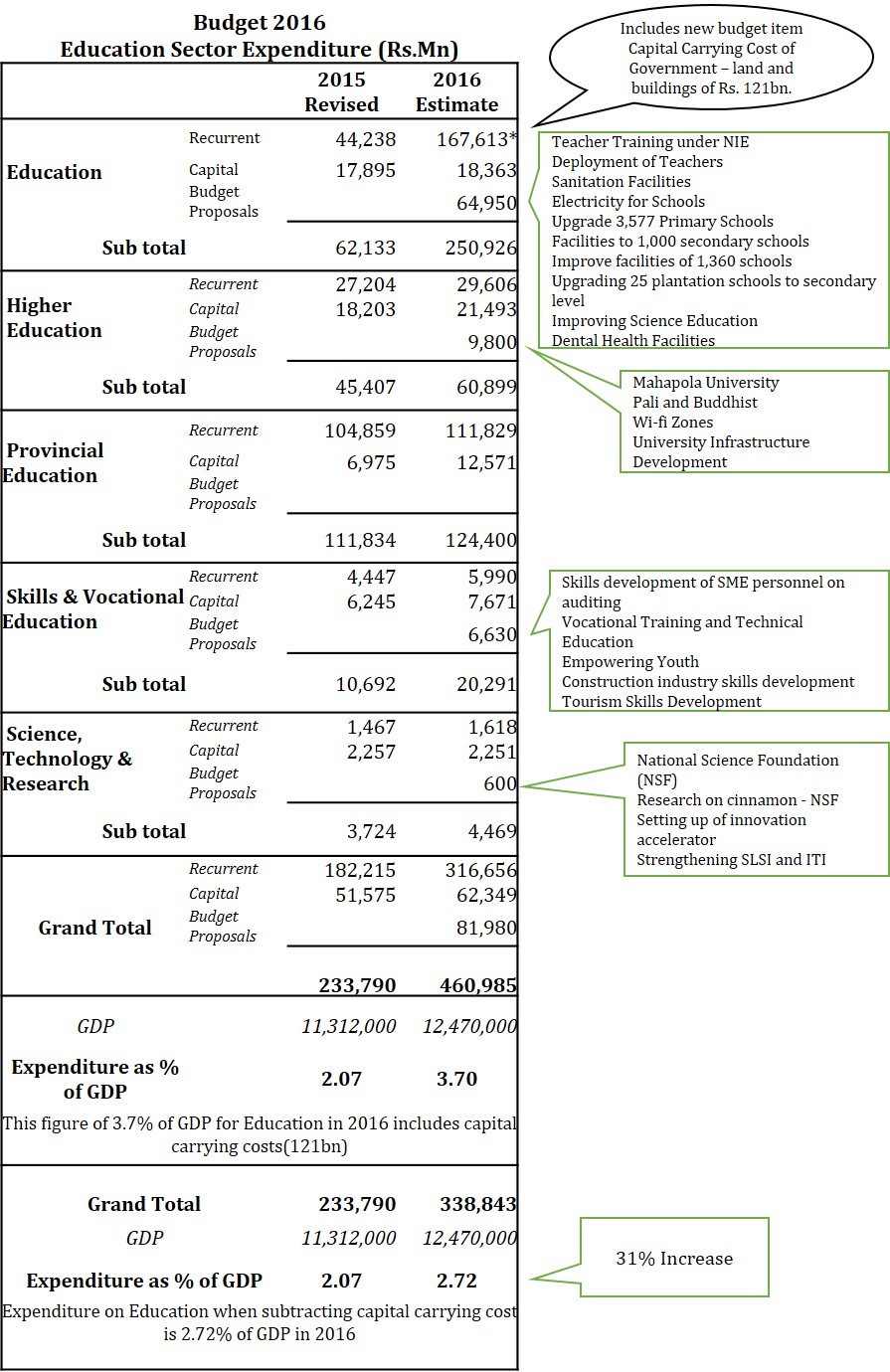
There is considerable confusion regarding the education budget figures.
Although it was widely reported in the media that the allocation for
education is 5.4% of GDP, the total government spending on education as
stated in the budget is Rs. 461 bn, which is 3.7% of GDP.
However, a significant portion of this education budget amounting to
Rs.121 bn is for “capital carrying costs” of the government, a new
budget item included for the first time in this year’s budget. No
explanations have been provided as to how such a major allocated line
item will be utilised. It is perhaps merely a fictional figure based on
creative financial engineering that has been added to education and
health totalling Rs.139 bn, which is counter-balanced in the revenue
side by a new budget item called the “notional rent income from land and
building.”
The proposed education budget for 2016
makes up 2.72% of GPD when the controversial capital carrying costs are
removed from the calculations. Regardless of such confusion, there is a
significant increase of 31% in allocations for education compared to the
2.07% of GDP in 2015. Read More
