Peace for the World World ! Your War Our Lives

The Dalai Lama
A Brief Colonial History Of Ceylon(SriLanka)
Sri Lanka: One Island Two Nations
A Brief Colonial History Of Ceylon(SriLanka)
Sri Lanka: One Island Two Nations
(Full Story)
Back to 500BC.

Tuesday, December 1, 2015
Need for placing 88-89 events in perspective
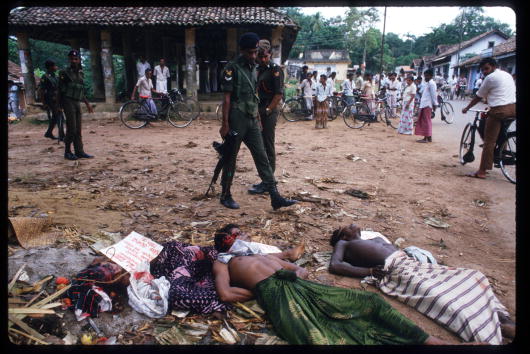
Bodies of JVP followers killed by the PRRA lie on the ground with posters tied around their necks in Tihagoda. The sign says, ”This is the punishment for followers of the JVP signed by the PRRA.”
December 1989 (Photo by Robert Nickelsberg/Liaison)

December 1989 (Photo by Robert Nickelsberg/Liaison)
NOV
27
2015
Science, Technology and Research Minister Susil Premajayantha has called
for a full investigation into the events of 1988-89 which saw a blood
bath in the country. Speaking during the budget debate in Parliament
Premajayantha has urged for the appointment of a Commission to
investigate the mass killings that took place during the period in
question when the JVP staged its second uprising.
It is not clear if what the Minister meant was a probe on the JVP
killing spree or the lives lost in the counter strike by vigilante
groups or an amalgam. But a probe should necessarily encompass all the
killings that took place, during one of the blackest chapters in the
country's post independence history where rivers of blood flowed and the
law and order machinery ground to a halt.
Those who lived through those traumatic days would recall the anarchic
state to which the country plunged into where life lost its value, with
corpses strewn at every street corner and floating in rivers, canals and
waterways which also saw the birth of the 'tyre pyre' that subsequently
became a popular mode for expression of dissent by street protesters.
Shops were forced to put up shutters on receipt of a 'chit' delivered by
the sparrow units of the JVP. Those who defied the edict had it coming
to them, their bodies mutilated and publicly displayed in the most gory
fashion with the inevitable sign attached to the body spelling out the
fate that awaited the traitors.
Unlike in 1971, the initial foray of the JVP to grab state power, the
second uprising took a most virulent form exacting a heavy toll of lives
and state property. This is largely due to the most sophisticated
weapons that were in use in 1988-89, what with the Eelam war at its
height, compared to the primitive weaponry that the JVP fighters had to
make do with in 1971.
The Opposition at the time went to town blaming the UNP Government and
particularly President Premadasa for the carnage, blinding itself to the
fact that it was the UNP supporters, local activists and party office
bearers who were the prime targets of the Deshapremi Janatha Viyaparaya,
the military wing of the JVP, which was later extended to the left
parties which supported the Indo-Lanka Accord, with Vijaya Kumaratunga
being the most high profile victim.
Be that as it may, the UNP had the 1988-89 period thrown at its face at
every election that followed, with CBK chanting the famous Dooshanaya,
Beeshanaya manthra successfully to win elections. The UNP known as a
staid, moderate and conservative party was demonized with its profile
taking a huge beating which contributed in no small measure to its
serial defeats at the hustings.
But the truth needs to be put in their proper perspective in order to
come to terms with that unfortunate period where tens of thousands lost
their lives in the mindless blood letting. True, the Government of the
day took counter terrorism measures to halt the anarchy and some may
question the means adopted in this regard. However looking at things
from another perspective, a legitimate Government is duty bound to
defend the country from threats both within and without. It also has to
take measures to prevent the country slipping into anarchy. Besides what
was under assault was the democratic system itself and had the
Premadasa Government allowed things to drift without taking effective
measures to halt the anarchy, democracy itself would have been in peril.
Just as Mrs. Bandaranaike did in 1971 Premadasa was compelled to take
drastic measures. As already mentioned more lives may have been lost,
but this should be viewed in context, considering that a full blown
terrorist war was on with availability of sophisticated weapons such as
the T56 and AK 47 in the hands of the JVP.
There was an element that was not witnessed in 1971, namely the tit for
tat attacks carried out by the JVP in 88- 89 targeting family members of
army and police personnel, the last straw that broke the camels back
leading to a no holds barred assault on the JVP ending in its
liquidation.
Minister Premajayantha, whatever his motive, should be commended for
suggesting the appointment of a Commission to probe this ugly chapter in
post independence Sri Lanka, if for no other reason than to vindicate
the Premadasa's Government's action in protecting democracy. Desperate
situations calls for desperate solutions. It certainly was not a clean
counter terrorism operation. Many innocents perished, as could be
expected in a blood bath of such a magnitude. But those who suffered the
most were the members and activists of the UNP which in some instances
had their entire families wiped out. The Commission, it is hoped will do
justice to the survivors of these hapless victims from far flung
villages, who braved the odds to preserve the democratic way of life.
The UNP as a party too should be cleansed of the stigma attached to it
for defeating an anarchic force, instead of continuing to be pilloried
for the actions it took towards this end, even if these were not always
according to Queensbury Rules.
