Peace for the World World ! Your War Our Lives

The Dalai Lama
A Brief Colonial History Of Ceylon(SriLanka)
Sri Lanka: One Island Two Nations
A Brief Colonial History Of Ceylon(SriLanka)
Sri Lanka: One Island Two Nations
(Full Story)
Back to 500BC.

Wednesday, December 16, 2015
Record high Arctic temperatures in 2015 having 'profound effects' on region
Latest
Noaa report reveals 2015 temperatures were in some cases 3C above
long-term average and 70% of ice pack in March was made of first-year
ice
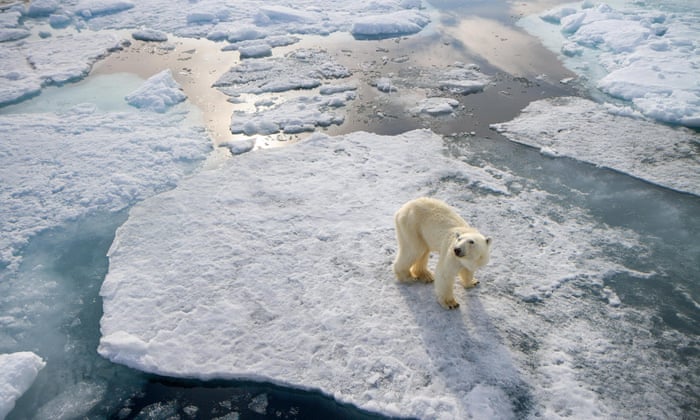
A
skinny polar bear is isolated on fragments of sea ice at the start of
the Arctic summer. Photograph: Jonnie Hughes/BBC/Silverback Films/Jonnie
Hughes

The Arctic experienced
record air temperatures and a new low in peak ice extent during 2015,
with scientists warning that climate change is having “profound effects”
on the entire marine ecosystem and the indigenous communities that rely
upon it.
The latest National Oceanic and Atmospheric Administration (Noaa) report card on the state of the Arctic revealed
the annual average air temperature was 1.3C (2.3F) above the long-term
average – the highest since modern records began in 1900. In some parts
of the icy region, the temperature exceeded 3C (5.4F) above the average,
taken from 1981 to 2010.
This record heat has been accompanied by diminishing ice.
The Arctic Ocean reached its peak ice cover on 25 February – a full 15
days earlier than the long-term average and the lowest extent recorded
since records began in 1979. The minimum ice cover, which occurred on 11
September, was the fourth smallest in area on record.
More than 50% of Greenland’s huge ice sheet experienced melting in 2015,
with 22 of the 45 widest and fastest-flowing glaciers shrinking in
comparison to their 2014 extent.
Not only is the ice winnowing away, it is becoming younger – Noaa’s
analysis of satellite data shows that 70% of the ice pack in March was
composed of first-year ice, with just 3% of the ice older than four
years. This means the amount of new, thinner ice has doubled since the
1980s and is more vulnerable to melting.
The report card – compiled by 72 scientists from 11 countries – noted
sharp variations in conditions in the northern part of the Arctic
compared to its southern portion. The melting season was 30-40 days
longer than the long-term average in the north but slightly below
average in the south, suggesting that changes to the jet stream, causing
colder air to whip across the southern part of the Arctic, are having
an impact.
Noaa said warming in the Arctic is occurring at twice the rate of
anywhere else in the world – a 2.9C (5.2F) average increase over the
past century – and that it is certain climate change, driven by the
release of greenhouse gases, is the cause.
“There is a close association between air temperature and the amount of
sea ice we see, so if we reduce the temperature globally it looks like
it will stabilize the Arctic,” said Dr James Overland, oceanographer at
Noaa.
“The next generation may see an ice-free summer but hopefully their
decedents will see more ice layering later on in the century.”
Overland said if the world hits the 2C (3.6F) warming limit agreed by nations in
the recent Paris climate talks, the Arctic will experience a 4C (7.2F)
to 5C (9F) increase in temperature by 2050. The Chukchi Sea, by Alaska,
is warming the fastest of any of the Arctic waters while the overall
minimum ice extent has slumped by 13.4% a decade, on average.
The changes in the Arctic are also causing “major challenges” for the
indigenous communities in the region, according to Rick Spinrad, Noaa’s
chief scientist. Warmer-water fish such as cod are moving north,
displacing Arctic species, while an increase in sunlight reaching the
upper layers of the ocean triggered widespread blooms of algae in the
Bering Sea, between Alaska and Russia, in 2015.
This altered environment is causing severe problems for walruses, with
unprecedented “haul outs” of the animals occurring in 2015. The large
marine mammals traditionally use sea ice for mating and nurturing young
but in recent years have been forced to congregate on land in north-west
Alaska. This behaviour has led to stampedes that have killed calves and
hampered walruses’ ability to find food.
“Females now have to make 110-mile (177km) treks for food. We just
haven’t seen haul outs in these numbers before,” said Kit Kovacs,
biodiversity research program leader at the Norwegian Polar Institute.
“I don’t think there is much uncertainty here. We have a dramatic
situation in the north Pacific with walruses.”
