Peace for the World World ! Your War Our Lives

The Dalai Lama
A Brief Colonial History Of Ceylon(SriLanka)
Sri Lanka: One Island Two Nations
A Brief Colonial History Of Ceylon(SriLanka)
Sri Lanka: One Island Two Nations
(Full Story)
Back to 500BC.

Friday, December 11, 2015
The Future of US-Sri Lanka Relations
As
Washington continues to embrace Sri Lanka’s new government, it’s
important to remember that America’s next president is unlikely to shake
up ties.
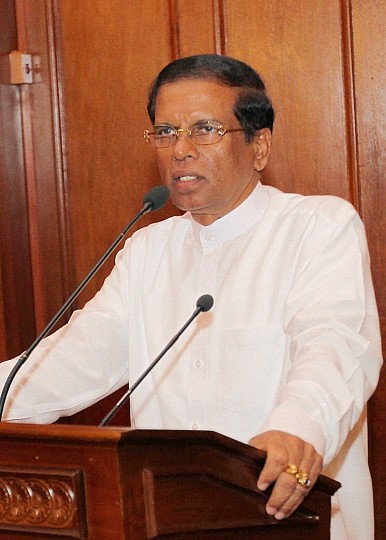

Sri Lanka’s President, Maithripala Sirisena, will soon complete his
first year in office and many promises remain unfulfilled. More
recently, we’re now hearing talk about the creation of a special court to handle alleged wartime abuses and the drafting of a new constitution.
Would expecting genuine progress on either of the aforementioned fronts
be realistic? After all, there remain other, less complicated aspects of
reform that the Sirisena administration has yet to address, such as the
matter of Tamil political prisoners.
Given Colombo’s unwillingness to address some of the more
straightforward matters, is it reasonable to believe that more complex
changes are viable at this time?
Regrettably, the United States continues to make platitudinous remarks
about further reform, accountability and reconciliation in Sri Lanka.
It’s time to think about Washington’s remarks in a different way. Is the
Obama administration willing to do anything substantial if Sirisena’s
reform agenda continues to flounder? Has the United States already
decided that the progress thus far is sufficient? If that decision
hasn’t already been made, what actions could Obama’s team conceivably
take over the next 12 months to further pressure Colombo?
Let’s get real. Under Obama’s watch, the United States played a major
role in pressuring Sri Lanka to respect human dignity and deal with the
past. And, while Mahinda Rajapaksa (the previous president) responded to
international pressure, his regime was always focused on doing the bare
minimum to placate the international community.
Now we’ve got Sirisena and, somewhat incredibly, a coalition government
where the country’s two principal political parties – the Sri Lanka
Freedom Party (SLFP) and the United National Party (UNP) – have entered
into a power-sharing arrangement.
A few lines of thinking are permeating Washington’s corridors of power
at the moment. Obama’s team has been promoting Sri Lanka’s new
government while concurrently assessing its own role in a
self-congratulatory fashion. Indeed, it appears that the administration
is reliving Myanmar’s “democratic opening” from a few years ago and
concomitantly ignoring the lessons that we can and should learn from
Myanmar – starting with the fact that deeper, lasting reform is always
more complicated and difficult than it at first appears.
The Obama administration will be out of power in about a year’s time.
Even if the Sirisena administration makes more significant strides in
the right direction over the next 12 months, Sri Lanka’s complicated
reform agenda, including transitional justice, will be far from finished
in January 2017. And, frankly, there’s no guarantee that an incoming
U.S. administration, Republican or Democrat, would want to elevate human
rights or accountability in Sri Lanka the way that the Obama
administration did from 2012-2014.
Aside from Obama’s obvious legacy concerns, Colombo’s political
leadership likely understands that an upcoming transfer of power in
Washington would probably not change the current trajectory of bilateral
ties. Given the way that U.S.-Sri Lanka relations have been shifting,
would a Hillary Clinton administration really want to intensify pressure
on Colombo? And most of the leading Republican contenders have little
knowledge of foreign affairs anyway. Would any of them want to
prioritize justice and accountability vis-a-vis a small island nation in
the Indian Ocean?
Irrespective of who wins the White House in 2016, Sri Lanka’s human
rights and accountability issues are unlikely to receive the amount of
attention that the Obama administration has devoted to them – which
makes Obama’s swift resetting of U.S.-Sri Lanka ties that much more
unfortunate.
