Peace for the World World ! Your War Our Lives

The Dalai Lama
A Brief Colonial History Of Ceylon(SriLanka)
Sri Lanka: One Island Two Nations
A Brief Colonial History Of Ceylon(SriLanka)
Sri Lanka: One Island Two Nations
(Full Story)
Back to 500BC.

Monday, January 25, 2016
A Special Day To Remember Sugitharajah And Why He Was Murdered
By Johan Mikaelsson –January 24, 2016

Johan Mikaelsson

Sri Lanka’s calendar is full of reminiscences from the bloody years.
January is a month to remember the targeted killings of journalists
under the previous government’s supervision. Impunity for these crimes
against democracy prevails.
In February attention is on independence, which opened up the doors for ethnical strife, in May it’s the end of the war, in ‘Black July’ the race riots against Tamils, and in November Tamil families remember their dead guerrillas.
January is the month that most clearly is associated with violence against journalists. January 8, 2009 Lasantha Wickrematunge, the Sunday Leader’s
brave editor was killed. He lives on as an icon of the struggle for
press freedom. He is and remains “unafraid and unbowed”, the newspaper’s
motto.
Today, January 24, 2006, ten years ago Subramaniyam Sugitharajah was
shot dead in Trincomalee. He was an ambitious and talented journalist
for the Tamil daily Sudar Oli, and he also worked as a labourer
at the port to support his family. Sugitharajah had gained popularity
among the readership for his articles. Above all he was a 35 year-old
married man and a father of two.

Sugitharajah
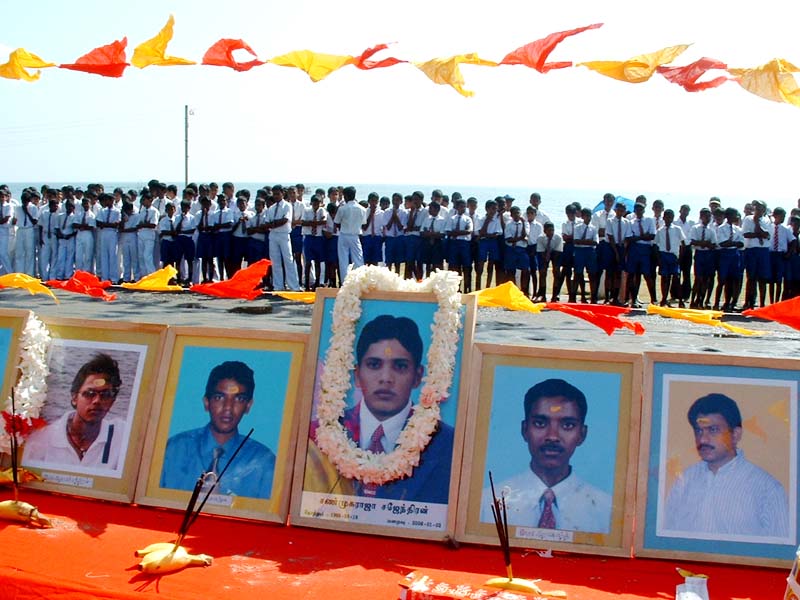
In 2005, the situation in Trincomalee constantly deteriorated. This culminated January 2, 2006, when five 20-year old Tamil students were
shot dead by soldiers in the middle of the city. The military and state
media tried, as usually at this time, to spread disinformation. The
young men were falsely accused of having died of an explosion while they
were preparing an attack against government soldiers.
Sugitharajah along with a young colleague was able to get into the
morgue to photograph the dead boys, all with bullet wounds in the head.
The portrait images published on the newspaper’s front page was not
lying. It was a drastic editorial decision — according to the Sudar Oli Editor Nadesapillai Vithyatharan it was the only way to get the truth out.
 The following Sunday Iqbal Athas had an in-depth description of the events in his Situation Report in The Sunday Times. The Sunday Leader also
carried a story. Soon, even more detailed reports came out and the
Toronto based Tamil journalist D.B.S Jeyaraj wrote lengthy articles with
a thorough documentation of the chain of events. The military and the
government media’s attempts to cover-up failed.
The following Sunday Iqbal Athas had an in-depth description of the events in his Situation Report in The Sunday Times. The Sunday Leader also
carried a story. Soon, even more detailed reports came out and the
Toronto based Tamil journalist D.B.S Jeyaraj wrote lengthy articles with
a thorough documentation of the chain of events. The military and the
government media’s attempts to cover-up failed.
There had been too many witnesses. The entire area where it all took
place was being sealed-off by the military. All lights were suddenly
out, and the entire neighbourhood was pitch-black. The father of one of
the boys had pleaded with the soldiers in vain to be let through.
Hundreds of people could hear the young people’s cries for mercy, and
then the fatal shots. Two young men miraculously survived. They, as well
as family members can and still want to testify. The families opposed
strongly when the army and the state media pointed to their sons as
‘LTTE terrorists’. The following days Trincomalee residents rallied
behind them in mass protests.
A cable sent from the U.S. Embassy in Colombo later came out through Wikileaks. It revealed that the Presidents’ brother and Economical advisor Basil Rajapaksa had said that
he and the government knew that the soldiers from the Special Task
Force (STF), a special force within police, had committed the deed. But
the soldiers had used other automatic weapons than their ordinary ones
and could therefore not be legally bound. It was of course a lame excuse
for not going to the bottom. Read More
