Peace for the World World ! Your War Our Lives

The Dalai Lama
A Brief Colonial History Of Ceylon(SriLanka)
Sri Lanka: One Island Two Nations
A Brief Colonial History Of Ceylon(SriLanka)
Sri Lanka: One Island Two Nations
(Full Story)
Back to 500BC.

Monday, February 15, 2016
Kidneys Going Cheap in Poor Estate Community
 Saturday, February 13, 2016
-
One and half years ago, Johnson, a 20- something youth, hailing from
Sri Lanka’s tea plantations, received an unusual request. The caller,
someone Johnson knew casually, made an offer for his kidney. “It was for
a half a million rupees (around US $3,500),” he said.
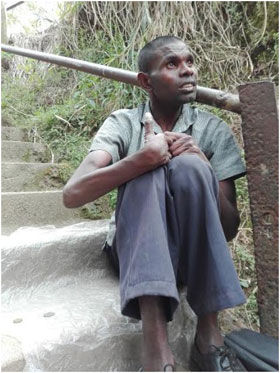
Rajendaran, a 24 year-old beggar at the Talawakele railway station who
gets regular requests for his kidney but has so far refused. Credit:
Amantha Perera/IPS
Johnson thought for a while and agreed. Mired in poverty and without a
permanent job, half million was something he could only dream about till
then. Soon he admitted himself into a private hospital in the capital
city, Colombo, about 170 km from his native Talawakele. Neither did
Johnson know anyone there nor was he familiar with the sprawling urban
maze.
After several tests, his kidney was deemed compatible with a 41 year-old
man from the north of Sri Lanka, the only detail Johnson knew of the
man who now has his kidney. From the time he got admitted, Johnson was
well taken care of by his initial caller, a middle man. To those who
were curious, he was advised to tell them that he was a relative of the
kidney patient. No one asked, Johnson said later.
 Johnson stayed in the hospital for several days after the operation.
When he returned home, he was provided a vehicle. But the benevolence
ended there. For days Johnson went to the bank and checked his account.
No monies had been credited. Nervous, he called the middle man; the
number returned a message that said it had been disconnected.
He visited the man’s residence, only to be told that he had moved out
and was now overseas. “I did not receive a cent for my kidney,” a
desperate Johnson told IPS. He suspects that the middle man did in fact
get the cash, but decamped with it.
Johnson’s story may be unusual in other segments of Sri Lanka society
that are richer and savvier. But among the estate community in the
central hills, selling a kidney has now become a frequent tale of woe.
Mahendran, a 53 year-old father of four, is also a victim of the same
racket. He received a request for his organ while working as a helper at
a rich household. It was the same modus operandi: a middle man, known a
little but not that much, approached Mahendran, made the play for the
kidney and got his consent.
Both thereafter travelled to Colombo, where Mahendran like Johnson was a
fish out of water. At the hospital he was asked to pretend to be a
relative of the patient. Mahendran also got played out after he had
parted with his kidney. “I was promised Rs 150,000 ($1,050) and paid Rs
10,000 ($70).”
Mahendran told IPS that he initially balked at selling his organs, but
finally gave way because of abject poverty. “I have four children to
look after, that was why I did it,” he said.
Now with one kidney, he can’t work hard and earn as much as he used to.
Two of his eldest kids, two boys have now dropped out of school.
Both men said that poverty was the main factor behind their decision.
Sri Lanka’s plantations, where the island’s popular tea is grown, has
been mired in poverty. According to the Government’s Census and
Statistics Department, over 15 per cent of the population lives below
the poverty line, in some areas the rate is close to 30 per cent.
However, there are no statistics on the large-scale trafficking racket.
Officers at the Talawakele Police station say that they have heard about
the sale of the kidneys but no complaints have been lodged.
There could be several reasons for the lack of police complaints. Both
Mahendran and Johnson told IPS that they have now become the butt-end of
village jokes. Another is that according to Sri Lanka’s Penal Code
anyone who sells an organ faces a jail term of seven years.
Clearly, this issue warrants closer investigation. Prabash Karunanayake,
a doctor at the Lindula hospital in Talawakele has had to regularly
admonish villagers who have sought advice on parting with a kidney. “In
recent days I have had to warn at least three persons on the dangers
they court by doing this,” he added.
Another one who has had to deal with such offers is Rajendaran, a 24
year-old beggar, who lives and begs at the Talawakele railway station.
He said that several people have made offers for his kidney which he
says have now become routine. “I have refused all of them so far. I
don’t want to make a complaint because these are dangerous people.”
Kanapathi Kanagaraja, a member of the Central Provincial Council, feels
that before the sale of kidneys acquires larger proportions, the
government should take decisive action to stem it. “We will take this up
at provincial level, but it warrants national level attention.”
Prathiba Mahanama, the former head of the national Human Rights
Commission said that till national level programmes are launched, the
most effective deterrent is public awareness. That is a view that
Karunanayake, the area doctor, also agrees on. “Right now because people
don’t know the medical dangers, the sale of kidneys is purely a
financial transaction. People are unscrupulously making such offers
because they know that at the right price, a kidney can be bought.”
(End)
