Peace for the World World ! Your War Our Lives

The Dalai Lama
A Brief Colonial History Of Ceylon(SriLanka)
Sri Lanka: One Island Two Nations
A Brief Colonial History Of Ceylon(SriLanka)
Sri Lanka: One Island Two Nations
(Full Story)
Back to 500BC.

Saturday, February 20, 2016
More than an ornament: Iran's 'female statesmen' and elections
Rules
impeding the progress of female politicians in the Islamic republic
remain firmly in place and the battle to change them advances slowly
Revolutionary slogans and a
portrait of Ayatollah Khomeini are reflected in the glasses of a
demonstrator outside of the US Embassy in Tehran, November 1979.
Photograph: AFP/Getty Images

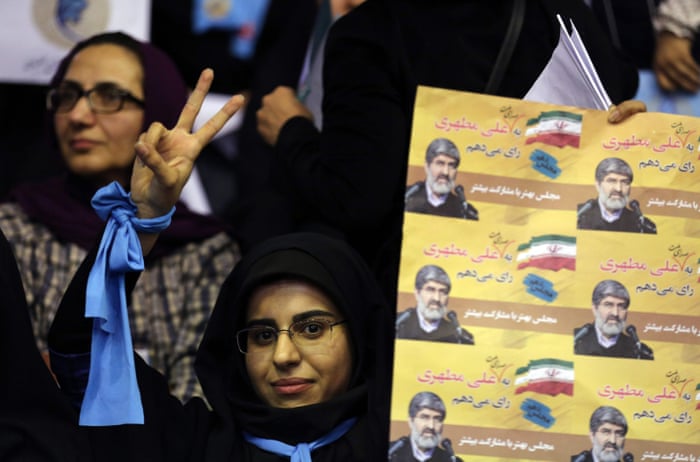

 Iranian
women, among them activists in the foreground, attend a reformists
campaign rally for the parliamentary elections in Tehran. Photograph:
Vahid Salemi/AP
Iranian
women, among them activists in the foreground, attend a reformists
campaign rally for the parliamentary elections in Tehran. Photograph:
Vahid Salemi/AP
Farnoosh Amirshahi for Tehran Bureau-Friday 19 February 2016
 Traditionalist clerics often invoke a masculine term to discourage women from running for political office in Iran.
While the question of gender isn’t addressed in Iran’s electoral laws,
candidates wishing to participate in the Iranian political scene must be
considered “Rajol-e-siasi,” or statesmen. If the political arena is
legally defined as the purview of statesmen, women have no business
entering it, conservatives argue.
Traditionalist clerics often invoke a masculine term to discourage women from running for political office in Iran.
While the question of gender isn’t addressed in Iran’s electoral laws,
candidates wishing to participate in the Iranian political scene must be
considered “Rajol-e-siasi,” or statesmen. If the political arena is
legally defined as the purview of statesmen, women have no business
entering it, conservatives argue.
This paradox helps explain the status of female politicians in a system
where only 49 women have served in parliament since 1979, accounting for
only 3% of all parliamentary seats. To maintain any presence at all,
female lawmakers must reconcile conservative Islamic values with the
social advancement of their gender.
Even if they possess an immaculate political and theological pedigree,
female politicians struggle to advance their agendas without altering
traditional women’s roles as defined by male Islamic jurists. When
addressing basic issues such as workforce participation, successful
female lawmakers like conservative MP Soheila Jelodarzadeh take care to
only support part-time employment, prioritizing women’s roles as mothers
and homemaker.
Outspoken female parliamentarians from across Iran’s political spectrum
have been ostracized, even jailed, for their overly progressive views.
Others have maintained a merely ornamental presence in politics, voting
along factional lines and against their own interests as women.
Read More
