Peace for the World World ! Your War Our Lives

The Dalai Lama
A Brief Colonial History Of Ceylon(SriLanka)
Sri Lanka: One Island Two Nations
A Brief Colonial History Of Ceylon(SriLanka)
Sri Lanka: One Island Two Nations
(Full Story)
Back to 500BC.

Tuesday, February 16, 2016
Sri Lanka faces crucial tests ahead with
growing opposition to ETCA

Monday, 15 February 2016
The proposed Economic and Technological Cooperation Agreement or ETCA has been one of the crucial economic reforms which the Government is planning to introduce, according to the Government, to deliver the promised prosperity to Sri Lankans.
 It
had not been specifically mentioned as a policy by name in the
manifesto which the ruling United National Party had presented to the
electorate in August 2015 coaxing voters to vote it to power. However,
the ETCA can be considered as one of the programs under the main
economic strategy outlined in the manifesto to deliver prosperity to
people. That main economic strategy consists of linking Sri Lanka to the
global economy and to do so, making Sri Lanka globally competitive.
It
had not been specifically mentioned as a policy by name in the
manifesto which the ruling United National Party had presented to the
electorate in August 2015 coaxing voters to vote it to power. However,
the ETCA can be considered as one of the programs under the main
economic strategy outlined in the manifesto to deliver prosperity to
people. That main economic strategy consists of linking Sri Lanka to the
global economy and to do so, making Sri Lanka globally competitive.
Produce for a market that is bigger than that of Sri Lanka
What was meant by linking Sri Lanka to the global economy was further elaborated by the Prime Minister in his economic policy statement delivered in Parliament in November 2015. He said that Sri Lanka should produce for a “market bigger than the domestic market” indicating that Sri Lanka’s markets should be ‘enlarged’.
To attain that target, he proposed to enter into trade agreements with “India and China”. The reason for singling out these two countries for having bilateral trade relationships has been due to their fast economic growth accompanied by an equally fattening middle class with an appetite for Sri Lanka’s products.
Further, by regaining GSP+ concessions, he expressed the hope of entering the European markets as well. He had also opined that Sri Lanka should look into the possibility of partnering with Trans-Pacific Partnership Agreement, commonly known as TPPA, signed by the Pacific-rim countries recently. That agreement has enabled countries like Vietnam to get extra benefits for its garment exports, a competitor for Sri Lanka’s threatened garment industry. Partnering with TPPA is to open up all the Pacific-rim countries for Sri Lanka’s international trade.
Hence, ETCA is only one item on the long list of bilateral trade agreements which Sri Lanka is planning to sign in the period to come.
Fear of Indian professionals flooding Sri Lanka’s job markets
- See more
growing opposition to ETCA
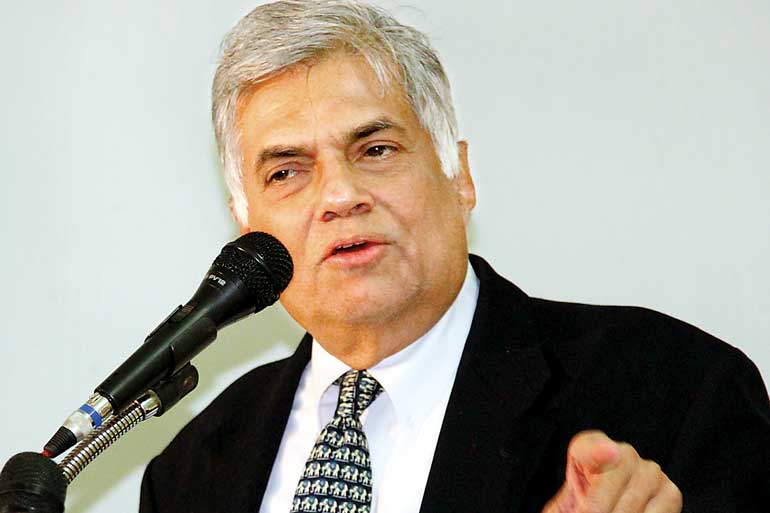
Prime Minister Ranil Wickremesinghe
Linking Sri Lanka to the global market
Monday, 15 February 2016
The proposed Economic and Technological Cooperation Agreement or ETCA has been one of the crucial economic reforms which the Government is planning to introduce, according to the Government, to deliver the promised prosperity to Sri Lankans.
It
had not been specifically mentioned as a policy by name in the
manifesto which the ruling United National Party had presented to the
electorate in August 2015 coaxing voters to vote it to power. However,
the ETCA can be considered as one of the programs under the main
economic strategy outlined in the manifesto to deliver prosperity to
people. That main economic strategy consists of linking Sri Lanka to the
global economy and to do so, making Sri Lanka globally competitive. Produce for a market that is bigger than that of Sri Lanka
What was meant by linking Sri Lanka to the global economy was further elaborated by the Prime Minister in his economic policy statement delivered in Parliament in November 2015. He said that Sri Lanka should produce for a “market bigger than the domestic market” indicating that Sri Lanka’s markets should be ‘enlarged’.
To attain that target, he proposed to enter into trade agreements with “India and China”. The reason for singling out these two countries for having bilateral trade relationships has been due to their fast economic growth accompanied by an equally fattening middle class with an appetite for Sri Lanka’s products.
Further, by regaining GSP+ concessions, he expressed the hope of entering the European markets as well. He had also opined that Sri Lanka should look into the possibility of partnering with Trans-Pacific Partnership Agreement, commonly known as TPPA, signed by the Pacific-rim countries recently. That agreement has enabled countries like Vietnam to get extra benefits for its garment exports, a competitor for Sri Lanka’s threatened garment industry. Partnering with TPPA is to open up all the Pacific-rim countries for Sri Lanka’s international trade.
Hence, ETCA is only one item on the long list of bilateral trade agreements which Sri Lanka is planning to sign in the period to come.
Fear of Indian professionals flooding Sri Lanka’s job markets
