




04/04/2016
The Centre for Policy Alternatives (CPA), and the Vibhavi Academy of Fine Arts (VAFA)
exhibition of 14 artists from different parts of Sri Lanka imagining
transitional justice which recently exhibited at the JDA Perera hall was
exciting from an aesthetic point but depressing from a political one.
While all art is, in one way or another political, atrocity art offers a
trenchant opportunity to capture the scope and scale of a horrific act,
and allows for the examining of some elusive imaginative truths of that
moment. It is something graphic photojournalism often aspires to but
most often fails into gratuitousness. Goya’s series on the Spanish civil
war, George Bellows’ series on the German invasion of Belgium and the
wood cuts of Yoshitashi are part of that pre-photographic proto-human
rights tradition that predates the expressionism of the current
exhibition.
One of the challenges for post-Rajapakse-lapsarian civil society has
perhaps been to construct a vibrant public discourse about transitional
justice. The task has not been easy. There is a natural lassitude
towards truth telling, and the monolithic narcissism of the Sri Lankan
state struggles to concede justice to its constituents. Within this
context the exhibition is a valuable provocateur of debate.
From an aesthetic viewpoint the exhibition was an enormously satisfying
engagement of the mind and the eye and offered a striking lack of
‘miserablism’ that was invigorating. Take for instance Nirmalavasan’s
polyptych ‘Unthrowable Questions on Carpet Roads’.
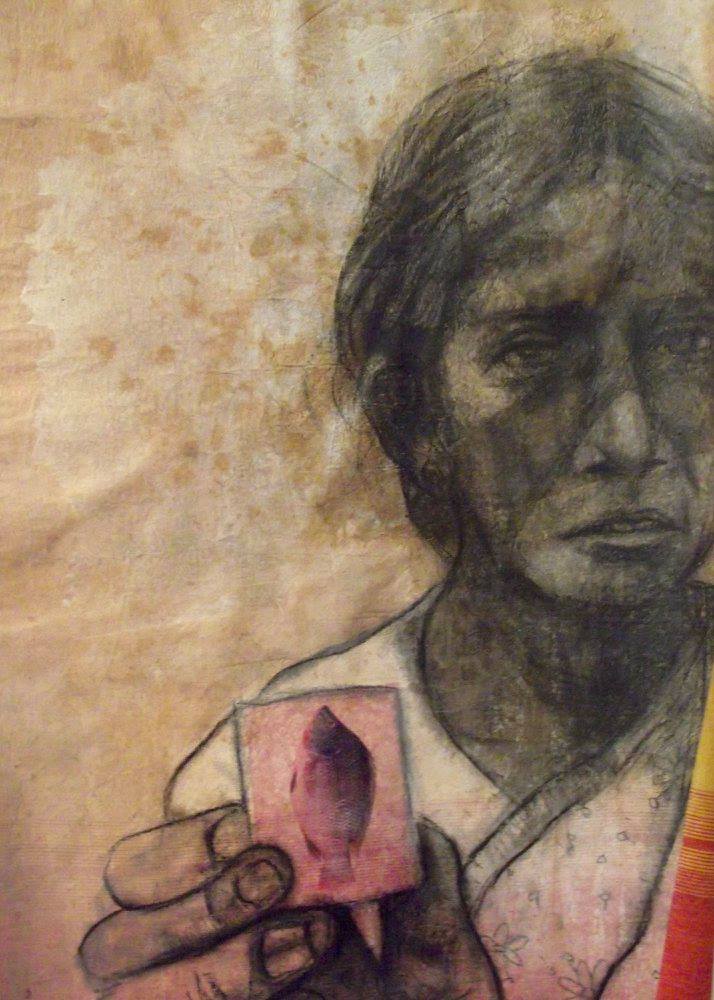
The series in a palette of bleached browns of dried blood hung on a
clothes line, portrays women with photographs of their missing. But the
pictures of the missing intermingle with pictures of fish – a motif that
multiplies across each painting – line upon line of fish hung out to
dry – suggesting perhaps the multitude of the missing and the nature of
our indifference. The fish are drawn with the same neutral accuracy of
the photographs of the missing. The meditative veneer of the composition
is belied by the insidiously jarring imagery and the skill with which
the slow desperation of grief in the faces of the women has been
captured. Traffic lines of the carpet road lace the series together.
Perhaps the high point of the exhibition must be Pushpakanthan’s triptych ‘What is your father? Where is your father’
a deeply disturbing nightmarescape response to the killing of his
father in his own bed by ‘unknown’ gunmen. This is a hoarse,
inarticulate scream of a painting dominated by the bizarre recurring
imagery of metamorphic toads – a grief prohibited from expression
sublimating into the grotesque. It is a dark imaginative detail that
could well slip unnoticed into a Hieronymus Bosch painting.

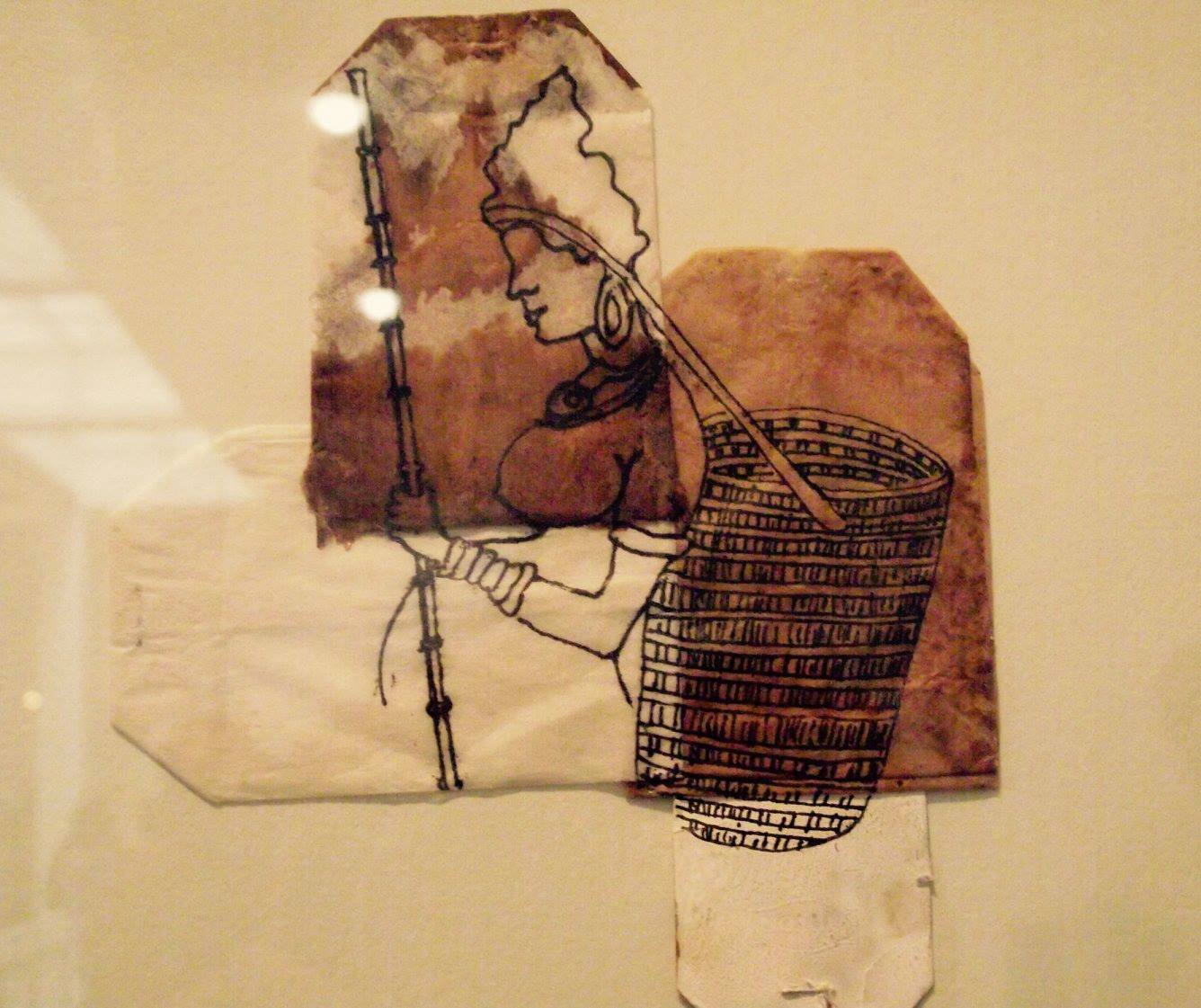
Hanusha Somasundaram’s ‘Backbones’ with
used teabags as a medium, somewhat archly transposes images of pregnant
estate labourers with those of the damsels of the Sigiriya frescoes –
the adroit reworking of two of Sri Lanka’s best touristic clichés .
What was perhaps disappointing, particularly after the common time spent
together grappling with transitional justice issue, was the stark
difference in the nature and scope of the imagination of the Sinhala and
the Tamil artists. In fact I asked my fellow visitors to try and
indentify the artists’ ethnicity…a superfluous exercise of cynicism…but
nevertheless an instructive one.
For the Tamil artists the conflict is an all encompassing immersive
tsunami of experience, the boundaries of which overwhelm the knowable
universe. For Vijitharan’s Bunker for instance it is imagined as a topographical invasion of militarism that engulfs the landscape. Tharmakrishna’s Untitled is
a myriad of floating cubes, each cube repetitively etched with symbols
of handcuffs, prison bars, guns, money wheels chairs and barbed wire.
Cumulatively the works reveal pent-up emotional forces at play in the
Tamil artist’s mind that seek release. And the best of them recall the
words of Yeats contemplating the aftermath of the Irish Easter uprising a
century ago “a terrible beauty is born”.
For the Sinhala artists, the conflict is imagined as incidental –
particularly in the form of explosive incidents. They conceive the
suffering as a joint condition, and more significantly, an equal one.
This comfortable binary of mutual suffering is the base upon which a
common humanism can be rediscovered. Asoka Manjula’s binary grenadehead ‘Searching for Humanity’or Malika Sanjeewani’s ‘Confession of Two Criminals’
are examples. On the other hand, the Tamil artists have no place to
accommodate the ‘Sinhala’ in the existential horror of their past. Nor
perhaps have they reached a dispassionate equilibrium that admits
introspection of the violence of the past.
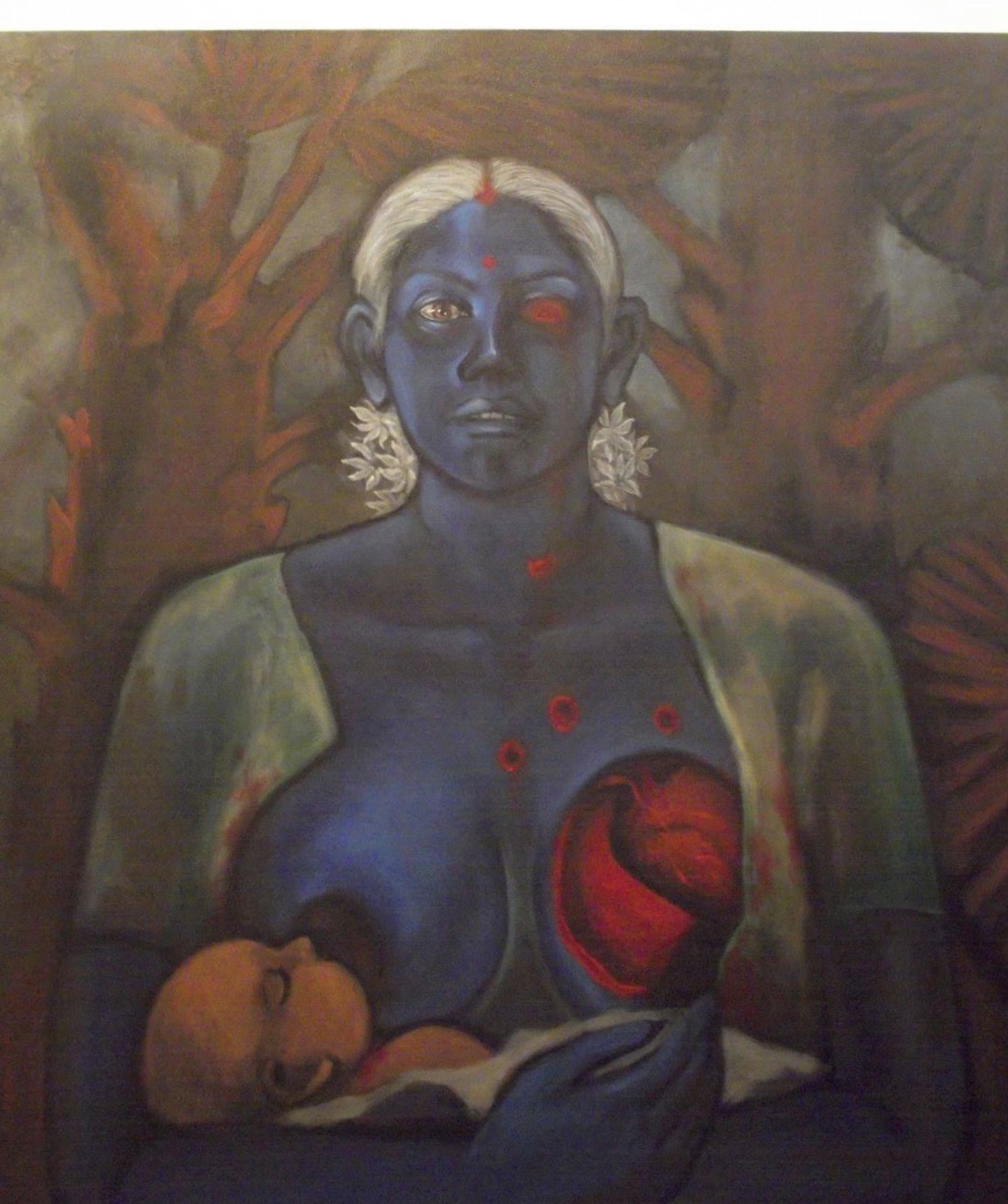
“Confession of Two Criminals” Malika Sanjeewani
Shorn of the aesthetics, what emerges is two fairly distinct and
separate narratives based on the geography of personal experience which
also seems to echo the subtexts of the dialogues of the communities: the
pressure cooker of anguish in the north, the claim of equality of
suffering by the South and the resentment towards the structures of
exploitation and neglect that echo from the Hills. The truth telling
experience is a mask of fragmented, self-serving truths, a sort of
visual echo chamber.
But truth telling cannot be a buffet of cherry picked platitudes.
Individual experiential truths may be many, disparate, enriching,
complex and cathartic but they cannot be a substitute for facts.
In fact the essential aim of truth telling in transitional justice is
the deliberative flocculation of cold hard factual truths from the
multiples of experiential truths so that society has a single, commonly
agreed, coherent, narrative of the past.
Which is perhaps why the Truth to Truth exhibition, despite the rich and
bracing art it offered, really points to the need for a deus ex machina of a state sponsored truth-telling mechanism that is able to order the truths into facts.
