Peace for the World World ! Your War Our Lives

The Dalai Lama
A Brief Colonial History Of Ceylon(SriLanka)
Sri Lanka: One Island Two Nations
A Brief Colonial History Of Ceylon(SriLanka)
Sri Lanka: One Island Two Nations
(Full Story)
Back to 500BC.

Tuesday, April 5, 2016
Israeli doctors assist in torture of Palestinian prisoners
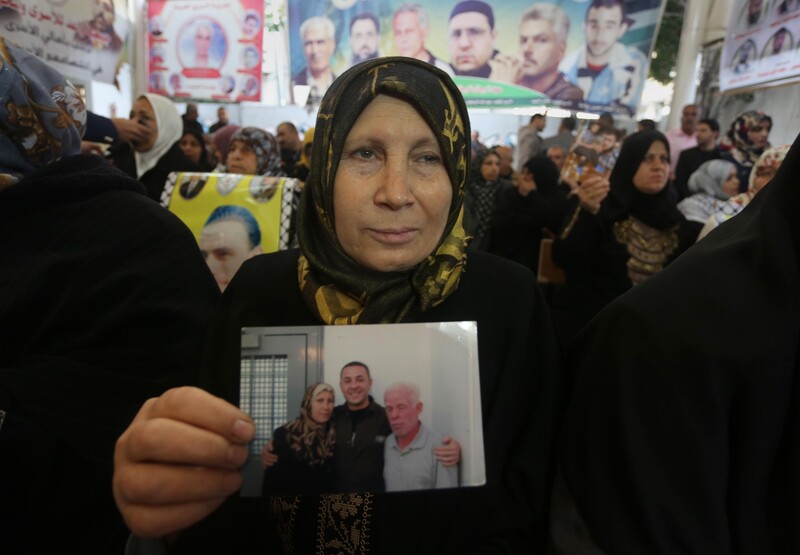
Palestinians take part in a protest demanding the release of prisoners
in Israeli jails, in front of Red Cross office in Gaza City, on 28
March.
APA images
Charlotte Silver-2 April 2016
 A growing portion of the Palestinian prisoners held in solitary confinement by Israel have gone on hunger strike to protest their mistreatment.
And a new report reveals the ways Israeli doctors are helping carry out abuses amounting to torture.
As of last Wednesday, three Palestinians serving lengthy prison terms were refusing meals.
Nahar Saadi and Isam Ahmad Zein al-Din are protesting being held in solitary confinement for three and two years respectively.
Abdullah al-Mughrabi, who announced his hunger strike this week, has been held in isolation since February.
Al-Mughrabi was transferred to a solitary confinement cell after he was scheduled to be released.
In addition, Sami Janazrah, Imad al-Batran, Abd al-Rahim Sawayfeh and
Abdul Ghani Safadi are on hunger strike to protest being held without
charge or trial in accordance with Israel’s widespread use of administrative detention, a holdover from British colonial rule.
Forty-three-year old Janazrah, arrested on 15 November 2015, stopped eating on 3 March.
That month Israeli authorities extended his administrative detention order for an additional four months. These orders can be renewed indefinitely in periods of up to six months.
Sawayfeh announced his hunger strike on 24 March. He had previously
spent 11 years in prison and was released in 2011 as part of that year’s
prisoner exchange between Israel and Hamas.
He was arrested six months ago and, like 670 other administrative detainees, has not been charged with any crime.
According to Al-Quds newspaper, last week Sawayfeh refused an offer by Israel to deport him to Jordan.
His family reports that he suffers from more than one chronic illness that they fear will be compounded by his hunger strike.
Solitary confinement
Over the last two years, Israel has doubled its use of solitary
confinement for all of its prisoners, both criminal and political,
according to a new report from Physicians for Human Rights–Israel (PHRI).
While the total number of Palestinians currently in isolation is
reportedly 14, that figure does not represent the uncounted number of
Palestinian detainees who are placed in solitary confinement during
their interrogation or for “punitive” reasons.
“Solitary confinement is chosen for the duration of interrogations
precisely because of its devastating psychological effects on
individuals,” the report states.
In 2009, the United Nations Committee against Torture found that Israel
used isolation against Palestinians to “encourage confessions from
minors,” as well as to punish violations of prison rules.
PHRI writes that Israel’s secret police agency, the Shin Bet, places
Palestinians in solitary confinement on the grounds of “protecting state
security,” often based on secret information that a prisoner cannot
appeal.
In 2012, following a mass hunger strike, the Israel Prison Service
agreed to release Palestinians placed in isolation by the Shin Bet. PHRI
believes this supports the view that that these placements are
arbitrary.
“The real reason behind it was punishment and vengeance,” the report states.
Collusion of Israeli medical professionals
PHRI finds that Israeli healthcare professionals give solitary confinement “a medical stamp of approval” despite the World Medical Association Declaration of Tokyo prohibiting physicians from taking part in any way in torture or cruel punishment.
In 2011, the UN Special Rapporteur on Torture, Juan Méndez, argued that
solitary confinement for more than 15 days constitutes torture and can
result in permanent psychological damage.
PHRI reviewed prisoner medical files and found that prison health
providers will explicitly state whether a prisoner is “fit for solitary
confinement” or “there is nothing to prevent solitary confinement in
this case.”
Medical professionals also visit prisoners held in solitary confinement.
But in spite of the involvement of medical professionals in the process
of confining prisoners to isolation cells, Israel’s health ministry and
the Israel Prison Service do not consider the practice a “medical
matter,” thereby relieving the medical establishment of any
responsibility to intervene.
Last year, PHRI wrote a letter to the health ministry outlining its
concerns over prisoners held in solitary confinement. In response, the
ministry wrote, “From the medical perspective, we see no justification
for your complaint.”
An update to the World Medical Association’s Declaration of Tokyo in 2007, which the Israeli Medical Association approved, obliges physicians to report any instance of torture they witness.
The Israeli Medical Association claims that the physicians working for the prisons are not its members.
In a position paper, the IMA established that physicians should not
sanction solitary confinement because “prolonged solitary confinement
might have have negative effects on the physical and mental health of
the prisoner.”
However, the IMA says that physicians are only obliged to intervene to
end the torture if they are able to “identify some concrete risk to the
prisoner’s health.”
“This approach fundamentally contradicts the ethical obligations falling
to physicians,” PHRI writes, stating their duty compels them “to
prevent damages to their patients and not just stop it after it
occurred.”
