
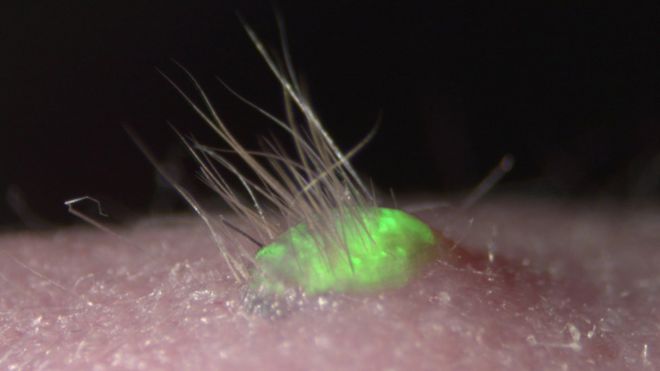
 The transplanted skin cells, labelled here with a green protein, successfully sprouted hairs
Peace for the World World ! Your War Our Lives

The Dalai Lama
A Brief Colonial History Of Ceylon(SriLanka)
Sri Lanka: One Island Two Nations
A Brief Colonial History Of Ceylon(SriLanka)
Sri Lanka: One Island Two Nations
(Full Story)
Back to 500BC.
Sunday, April 3, 2016
Promising lab-grown skin sprouts hair and grows glands
The transplanted skin cells, labelled here with a green protein, successfully sprouted hairs By Jonathan Webb-1 April 2016
Scientists in Japan have successfully transplanted mice with lab-grown
skin that has more of the organ's working parts in place than ever
before.
Starting with stem cells made from a mouse's gums, they managed to craft
skin with multiple layers - as well as hair follicles and sweat glands.
When implanted into a "nude mouse" with a suppressed immune system, it integrated well and sprouted hairs.
Researchers say this success will take 5-10 years to translate into humans.
But eventually, the team hopes their system will lead to perfectly
functioning skin that can be grown from the cells of burns victims and
transplanted back on to them.
Personalised organs
This would be vastly superior to the culturing and grafting techniques
that are currently available, which produce skin without many of the the
biological components and functionality that we are used to.
The technique could also be adapted to manufacture realistic skin
samples that drug or cosmetics companies could use to test their
products - instead of using animals.
The findings, reported in the journal Science Advances, have been greeted with enthusiasm by other scientists working in this field.
Takashi Tsuji is the paper's senior author. He said the dream of re-growing personalised organs was beginning to materialise:
"Up until now, artificial skin development has been hampered by the fact
that the skin lacked the important organs, such as hair follicles and
exocrine glands, which allow the skin to play its important role in
regulation.
"With this new technique, we have successfully grown skin that replicates the function of normal tissue.
"We are coming ever closer to the dream of being able to recreate actual organs in the lab for transplantation."
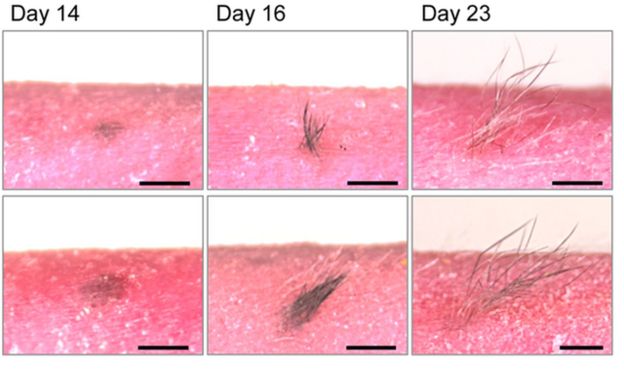
The researchers saw the transplanted skin going through normal hair growth cycles
Dr Tsuji, from the Riken Centre for Developmental Biology in Kobe,
conducted the research with colleagues in Tokyo, Sagamihara and Sendai.
They began their experiments by taking cells from the gums of a mouse
and converting them into "induced pluripotent stem cells" or iPSCs.
This is a popular and promising technique in stem cell research,
discovered in 2006, which bathes the cells in chemicals to "wind back
the clock". The resulting cells, like those of an embryo, can divide
again and again, and be guided down many developmental pathways to
become nearly any type of cell in the body.
The team's real achievement was in coaxing these cells to form the
different layers and structures of deeply layered skin - the
"integumentary organ" that protects our bodies, senses touch, regulates
heat and does myriad other jobs as well.
'Whole box of stuff'
John McGrath, a professor of molecular dermatology at King's College
London, said this study was one that researchers in his field had been
looking out for - and it was a substantial step forward.
He told BBC News that the new system took us "over the halfway mark"
towards growing functional skin for human patients - where previous
efforts had stumbled at much earlier stages.
"It's recapitulating normal skin architecture," Prof McGrath said. "So
rather than having isolated bits of skin... here we've actually got a
whole box of stuff.
"To give you a football analogy: anybody can have Wayne Rooney, but now
we've got Manchester United. There's a whole team on the pitch, of
interacting players."
And that means there is hope, he added, for lifelike, lab-grown skin.
"[Today's skin grafts] function, but they don't really look like or
behave like skin. If you don't have the hair follicles and you don't
have the sweat glands and things, it's not going to function as skin."
Prof McGrath also said that many other laboratories would now be trying
to reproduce these findings - and to adapt them for different purposes,
such as recreating skin diseases in a dish and trying out treatments.
"There will be lots of benefits for immediate use, as well as for translational science," he said.
Follow Jonathan on Twitter
