Peace for the World World ! Your War Our Lives

The Dalai Lama
A Brief Colonial History Of Ceylon(SriLanka)
Sri Lanka: One Island Two Nations
A Brief Colonial History Of Ceylon(SriLanka)
Sri Lanka: One Island Two Nations
(Full Story)
Back to 500BC.

Saturday, April 2, 2016
RTI Licence to fight

 2016-04-01
The Act alone won’t bridge the info gap Exactly 14 months after January 20, last year, the date on which the Right to Information Bill was to be presented in Parliament under the 100 Day Programme put forward by President Maithripala Sirisena during the last Presidential election campaign, the Government managed to present it in the House on March 23 this year.
 Before
that Right to Information (RTI) was incorporated in the 19th Amendment
to the Constitution that was adopted on April 28 last year.
Before
that Right to Information (RTI) was incorporated in the 19th Amendment
to the Constitution that was adopted on April 28 last year.
It is interesting to note that the Bill has been presented in Parliament at a time, when Karu Jayasuriya, who unsuccessfully attempted twice to introduce the Bill during the last regime, was presiding over the House.
The Rajapaksa Government hoodwinked him to withdraw his first private member’s Bill in September, 2010 through the then Chief Government Whip Dinesh Gunawardane, who stated that the Government was planning to present a Bill in six months. But the same Government, which did not live up to its promise, unashamedly defeated Jayasuriya’s second private member’s Bill in 2011.
Although the present Bill, if adopted, is said to provide every citizen of this country the right to access to information, which is in the possession, custody or control of a public authority, it also contains a plethora of restrictions to access information.
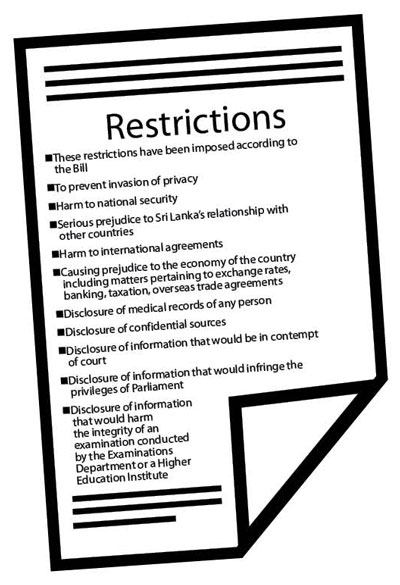
These restrictions have been imposed, according to the Bill, in order to prevent invasion of privacy, harm to national security, serious prejudice to Sri Lanka’s relationship with other countries, harm to international agreements, causing prejudice to the economy of the country including matters pertaining to exchange rates, banking, taxation, overseas trade agreements, disclosure of medical records of any person, disclosure of confidential sources, disclosure of information that would be in contempt of court, disclosure of information that would infringe the privileges of Parliament and disclosure of information that would harm the integrity of an examination conducted by the Examinations Department or a Higher Education Institute.
See more >>>
2016-04-01The Act alone won’t bridge the info gap Exactly 14 months after January 20, last year, the date on which the Right to Information Bill was to be presented in Parliament under the 100 Day Programme put forward by President Maithripala Sirisena during the last Presidential election campaign, the Government managed to present it in the House on March 23 this year.
Before
that Right to Information (RTI) was incorporated in the 19th Amendment
to the Constitution that was adopted on April 28 last year. It is interesting to note that the Bill has been presented in Parliament at a time, when Karu Jayasuriya, who unsuccessfully attempted twice to introduce the Bill during the last regime, was presiding over the House.
The Rajapaksa Government hoodwinked him to withdraw his first private member’s Bill in September, 2010 through the then Chief Government Whip Dinesh Gunawardane, who stated that the Government was planning to present a Bill in six months. But the same Government, which did not live up to its promise, unashamedly defeated Jayasuriya’s second private member’s Bill in 2011.
Although the present Bill, if adopted, is said to provide every citizen of this country the right to access to information, which is in the possession, custody or control of a public authority, it also contains a plethora of restrictions to access information.
These restrictions have been imposed, according to the Bill, in order to prevent invasion of privacy, harm to national security, serious prejudice to Sri Lanka’s relationship with other countries, harm to international agreements, causing prejudice to the economy of the country including matters pertaining to exchange rates, banking, taxation, overseas trade agreements, disclosure of medical records of any person, disclosure of confidential sources, disclosure of information that would be in contempt of court, disclosure of information that would infringe the privileges of Parliament and disclosure of information that would harm the integrity of an examination conducted by the Examinations Department or a Higher Education Institute.
See more >>>
